
New Holland SP310 Cranked for 10 Seconds: The Hydraulic Pump Was Still Loaded

10-Second Crank? Find The Extra Load
The New Holland SP310 had only about 80 hours on it, yet starting took more than ten seconds. A high-pressure fuel pump and filter housing had already been replaced. Neither fixed it. That history made the next decision important: repeat the fuel diagnosis, or ask whether the starter was fighting a load that should not exist during cranking?
A battery-and-cranking-system tester is a sensible first screen because low voltage and a weak lead-acid battery can also create a long crank. The AUTOOL BT880 is one option for that opening check on a compatible 12/24-volt system. BT880 can screen compatible 12/24-volt lead-acid battery, cranking and charging systems. It cannot capture a 750-amp waveform, identify hydraulic loading, test lithium batteries or localize the unloader-circuit fault.
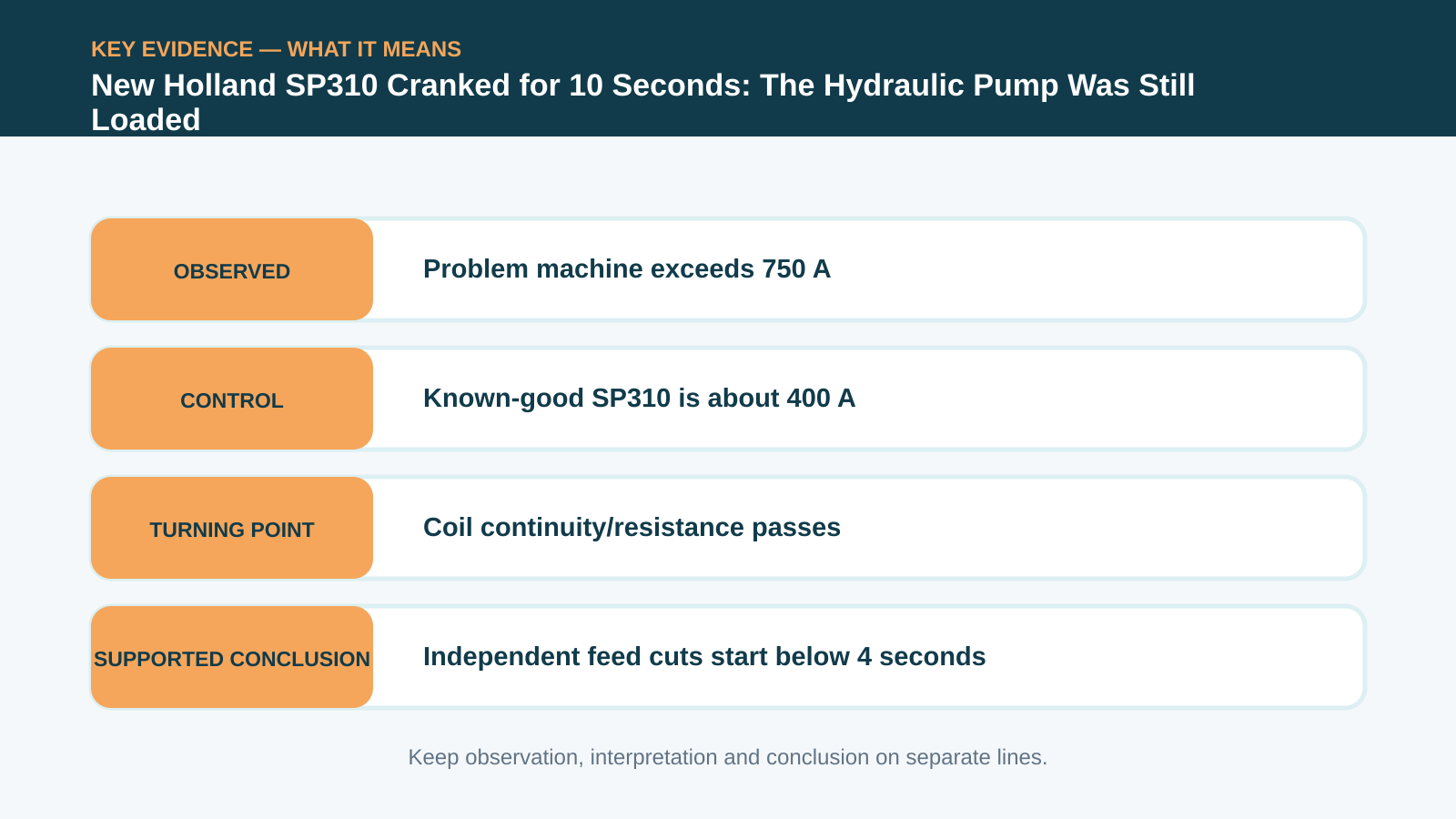
Fuel command, rail pressure and cam/crank evidence were credible. Starter current was not: the problem machine exceeded 750 amps, while a known-good SP310 was near 400 amps. Giving the hydraulic-pump unloader coil a controlled independent feed shortened the start to under four seconds. That localized the excessive load to the unloader control path, but the published case stopped before a permanent harness repair was documented.
Quick answer: The starter drew more than 750 A versus about 400 A on a healthy SP310. Energizing the hydraulic-pump unloader cut starting from over ten seconds to under four.
In this guide
- The long crank survived expensive fuel work
- Compare the whole crank event, not resting voltage
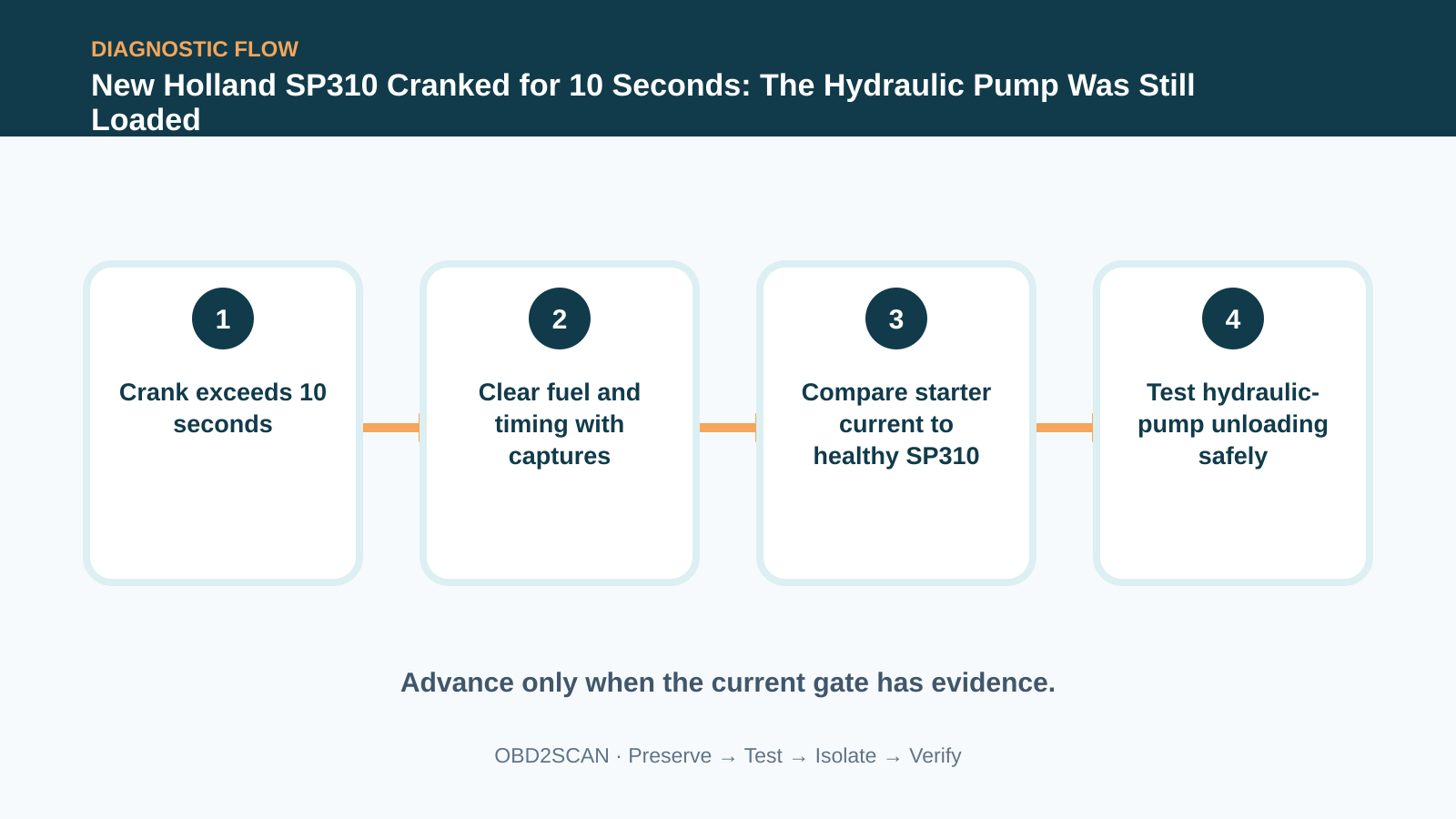
- Clear fuel and mechanical timing with evidence
- Ask what else the starter is turning
- Use the healthy SP310 as the control
- Command the unloader only under a safe plan
- Localize the open without inventing the final repair
- Define the verification still required
The long crank survived expensive fuel work
List the previous work before making another measurement. The pump assembly included the lift function, and the filter housing contained the drain-back check valve, so the earlier choices were understandable. Their failure to change the symptom is still evidence. Record overnight temperature, battery state, exact crank duration and whether the engine starts differently after running. A video with sound and a voltage reading can preserve an intermittent change better than a description such as “slow.” Keep people clear of sprayer hydraulics and disable motion according to the service procedure.
Compare the whole crank event, not resting voltage
Resting voltage cannot describe the work being done during those ten seconds. Observe battery voltage and starter speed throughout the crank, and inspect terminals, disconnects and grounds under load. A battery tester can flag a weak supply, but a high-current clamp and scope are needed to see current magnitude and cylinder-to-cylinder pattern. Save the cold condition, because viscosity and temperature alter current. If voltage collapses or cranking speed is low, repair that foundation first; if the supply holds while current is abnormally high, ask what mechanical load the starter is carrying.
Clear fuel and mechanical timing with evidence
The diagnostic team checked the fuel-metering PWM, rail-pressure response and cam/crank relationship through repeated start/stop attempts. Those signals were acceptable. Relative compression did not expose a weak cylinder. That combination does not prove every injector or mechanical component perfect, but it removes the reason to install another fuel part without a new test. The crucial habit is to let a passed system leave the foreground. A long crank can mean fuel arrives late; it can also mean the engine is being turned too slowly because another system did not unload.
Ask what else the starter is turning
A self-propelled sprayer couples the engine to more than an alternator and fan. Its main hydraulic pump is supposed to destroke during starting, reducing torque demand until the key returns to run. If its unloader never energizes, the starter must turn the engine and a loaded pump together. Consult the New Holland and Parker iQAN wiring information before touching the circuit. Identify the controller output, coil, supply and return. Do not energize an unknown hydraulic valve or bypass interlocks merely because a connector fits.
Use the healthy SP310 as the control
The useful comparison came from another SP310, not a generic starter-current chart. Its cranking demand was roughly 400 amps under the conditions available, almost half the problem machine’s draw. Match temperature, battery condition, engine and attachments as closely as possible; the reference was a 2019 machine, so the comparison is directional rather than a factory limit. A known-good machine answers “can this design crank differently?” It does not convert one measurement into a universal pass/fail specification for every sprayer.
| Evidence | Problem SP310 | Known-good or controlled result | Meaning |
|---|---|---|---|
| Crank duration | More than 10 seconds | Under 4 seconds with unloader energized | Hydraulic unloading changes the complaint |
| Starter current | More than 750 A | About 400 A on a healthy SP310 | Problem machine carries excess load |
| Fuel and timing signals | Credible | Repeated checks agree | Fuel delivery and correlation move down the list |
| Unloader coil resistance | Acceptable | Coil responds to independent feed | Focus shifts to its control path |
Command the unloader only under a safe plan
After coil continuity and resistance looked sound, the technician applied an independent 12-volt feed under a controlled plan. The pump unloaded and starting time fell below four seconds. That A/B test proved the valve could change the load and that its normal command path was not doing so. It did not grant permission to leave a jumper installed. Unexpected hydraulic behavior can injure people. An independent feed belongs only in a qualified stationary test with the circuit identified, current protected and machine functions secured.
Localize the open without inventing the final repair
The source’s most probable conclusion was a broken conductor between the Parker iQAN node and the unloader coil. To finish the job, divide the harness at accessible connectors, load-test both supply and return, inspect pin fit, rub points and water entry, and confirm the controller is actually commanding the output. Repair the conductor with an environment-appropriate method or correct the terminal/module fault found. The publication did not show this permanent step, so it would be inaccurate to say a specific wire was located and repaired.
Define the verification still required
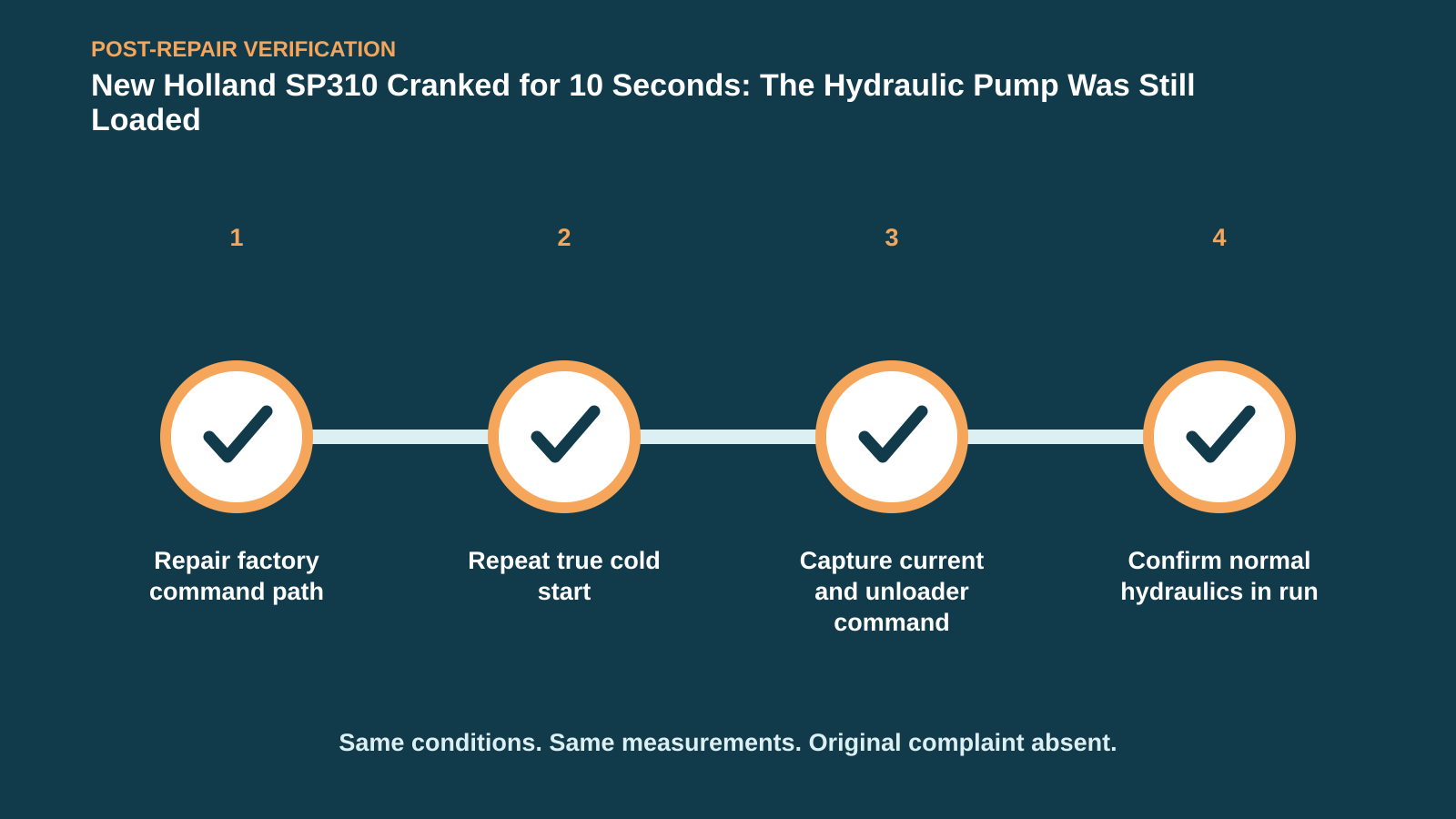
A closed case would repeat the original cold start without the temporary feed. Record crank time, voltage, current and unloader command; confirm the sprayer hydraulics behave correctly after the engine enters run. Repeat several starts after an overnight soak and rescan the iQAN system. A permanent repair must deliver the under-four-second improvement through the factory circuit, not through a diagnostic bypass. Until that evidence exists, this is a strong functional localization with a clearly defined final test—not a fully documented harness repair.
The starter-current comparison changed the story from “fuel is late” to “the starter is carrying too much.” Just as important, the case teaches where to stop: the independent feed proved the unloader path mattered, while the exact permanent wiring repair remained work to document.








Comments 0
Questions, fixes, and real-world diagnostic notes from readers.
Be the first to share a diagnostic result or ask a follow-up question.