
Iveco Eurocargo Dropped Into Neutral: One Corroded CAN Branch Pulled the Truck Down

Neutral, High Idle, No Throttle? Map The Can Branch
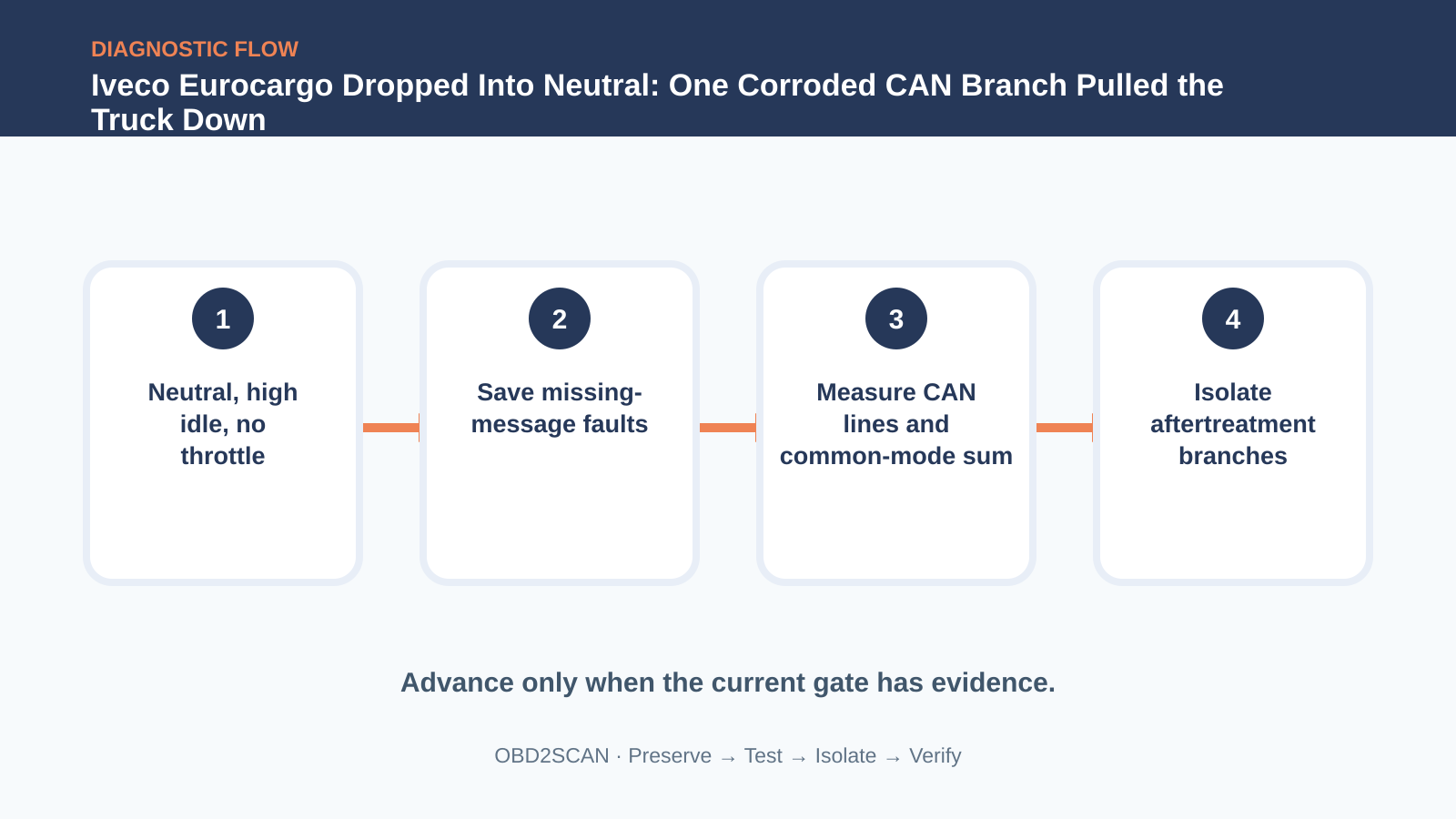
When the Iveco fault appeared, the gearbox selected neutral, idle speed rose and the accelerator stopped responding. Then the truck would behave normally again. A large code list blamed missing messages, but the network was still talking when it reached the workshop. The task was to find which branch could disturb the shared conversation badly enough to create the driver’s exact event.
A 16-pin breakout box can make initial DLC power, ground and CAN measurements less intrusive. The AUTOOL OBD2 Breakout Box Premium is one example where this Iveco uses the identified 16-pin connector. The breakout box exposes the identified 16-pin DLC circuits for measurement and adds visual voltage/protocol screening. It does not decode J1939, identify the offending branch, authorize a manual short or repair altered emissions software.
Both CAN lines sat too low at idle, although the differential data remained readable. Branch isolation restored normal voltage when the NOx sensor was disconnected, and its connector showed corrosion from water ingress. A controlled network-short experiment reproduced the neutral, high-idle and no-throttle behavior. The missing sensor produced no corresponding DTC and still appeared as changing live data, pointing to nonstandard ECU software. The road-legal completion was stock programming plus a new sensor.
Quick answer: A corroded NOx-sensor branch biased both CAN lines and could recreate neutral, high idle and no throttle. The lawful completion was a new sensor and stock ECU software.

In this guide
- Freeze the truck when neutral and high idle appear
- Save every missing-message code before clearing
- Read both CAN lines and their sum
- Redraw the aftertreatment branch
- Use isolation to find the branch, not the part
- Treat the missing NOx code as new evidence
- Separate a site test from a lawful repair
- Verify stock software, sensor and road operation
Freeze the truck when neutral and high idle appear
Treat the fault as a loss-of-control event, not just an amber lamp. Save where the truck can be stopped safely, what the transmission does first and how it recovers. Do not continue road testing if throttle or gear selection can disappear. Photograph the warnings and collect a full scan while the condition is active. The order matters: a transmission controller reporting missing engine messages and an engine controller reporting missing transmission messages describes a shared communication problem more convincingly than either code considered alone.
Save every missing-message code before clearing
Save freeze-frame and status information before the first clear. In the documented case, active gearbox faults included missing messages and CAN errors; after deletion, none immediately returned. That is normal for an intermittent problem and does not make the repair complete. Build a small table of which module complained about which absent sender. Also record previous ECU programming, emissions work and connector repairs. Those details became critical later, when the software’s response to a disconnected NOx sensor did not match the physical truck.
Read both CAN lines and their sum
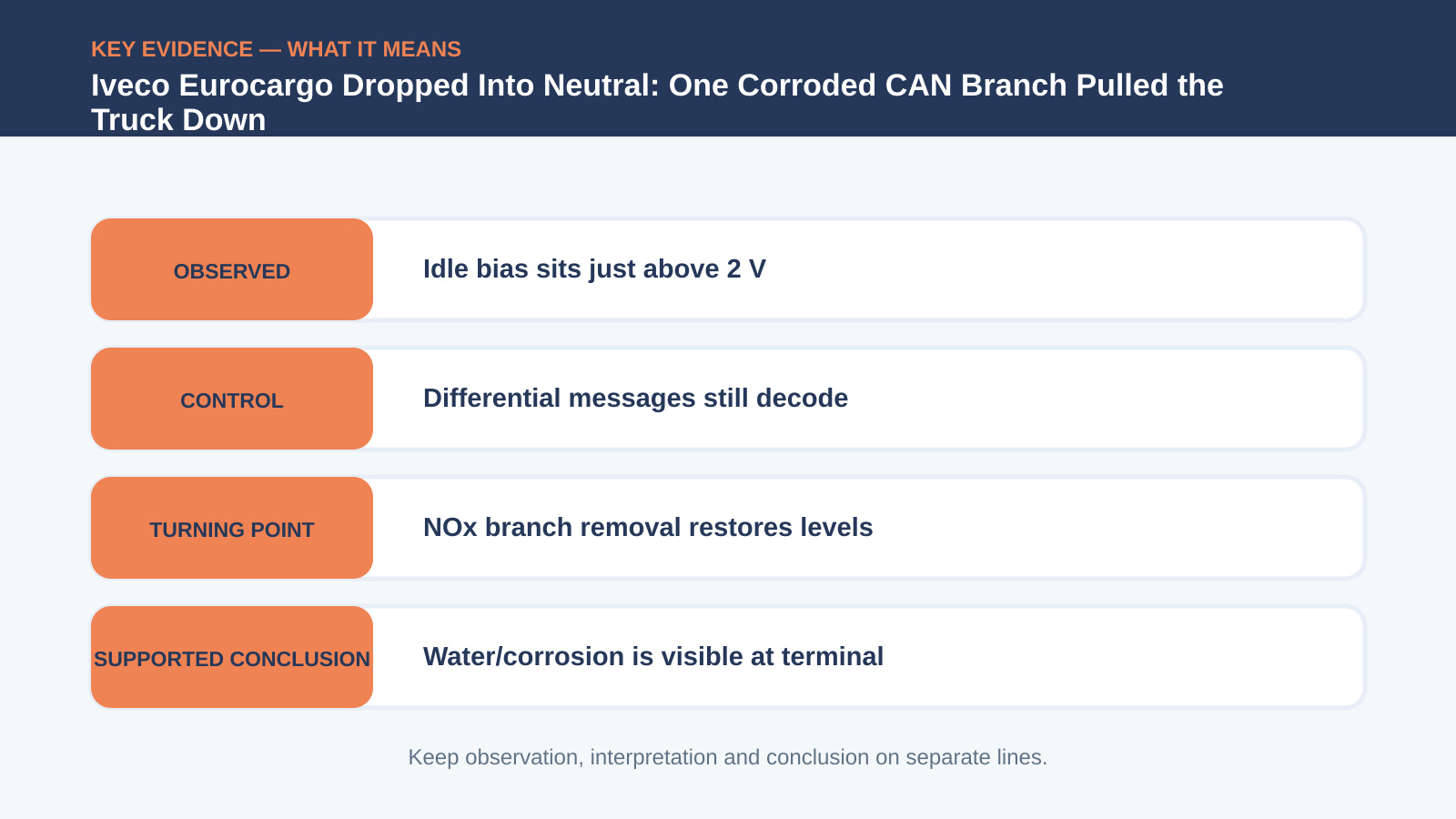
At the 16-pin DLC, CAN high and CAN low idled just above two volts instead of centering near the expected 2.5 volts used in this case. Adding the channels produced a common-mode sum that was low rather than near five volts. Yet subtracting them left a usable differential signal. That explains why messages could still decode while the physical layer looked unhealthy. Capture both conductors to chassis ground; viewing only the difference can hide a bias affecting both lines.
Redraw the aftertreatment branch
Redraw only the network involved in the missing messages. Mark the engine, transmission, aftertreatment controller and NOx-sensor branch, plus each splice and terminator. Disconnecting by location rather than by theory can create more warnings, so predict what each test should remove. When the aftertreatment area was divided, the suspect side retained the biased voltage while the other side returned to normal. Removing the NOx sensor from that smaller group restored the expected levels and exposed corrosion at its terminal.
Use isolation to find the branch, not the part
A branch test localizes an area before it names a component. Inspect the NOx connector, harness and splices for conductive moisture, terminal spread and insulation damage. The deliberate short used in the mature case recreated the exact symptoms, but it was performed as a controlled diagnostic experiment. It is not a general workshop shortcut: shorting CAN can stall the truck, create numerous faults and damage equipment. Most readers need the logic—compare the genuine event with a safely isolated branch—not instructions to force a failure.
| Observation | What it supports | What it does not authorize |
|---|---|---|
| CAN lines share a low bias | Physical-layer loading exists | Replacing every module with a CAN code |
| NOx branch removal restores levels | Fault lies on or beyond that branch | Permanent sensor disconnection |
| Corrosion and water are visible | Connector/sensor damage is plausible | Skipping terminal and harness checks |
| Controlled short recreates complaint | Bus collapse explains driver symptoms | Shorting a live network casually |
Treat the missing NOx code as new evidence
The next clue was software behavior. With the NOx sensor physically absent, no missing-sensor fault appeared and live data still showed a changing NOx value. The source reasonably suspected an earlier emissions-software modification, but that finding should be phrased as an inconsistency requiring confirmation. Do not treat simulated emissions data as a repair or teach the vehicle to ignore a required sensor. Preserve the calibration identification and engage a qualified Iveco programming route.
Separate a site test from a lawful repair
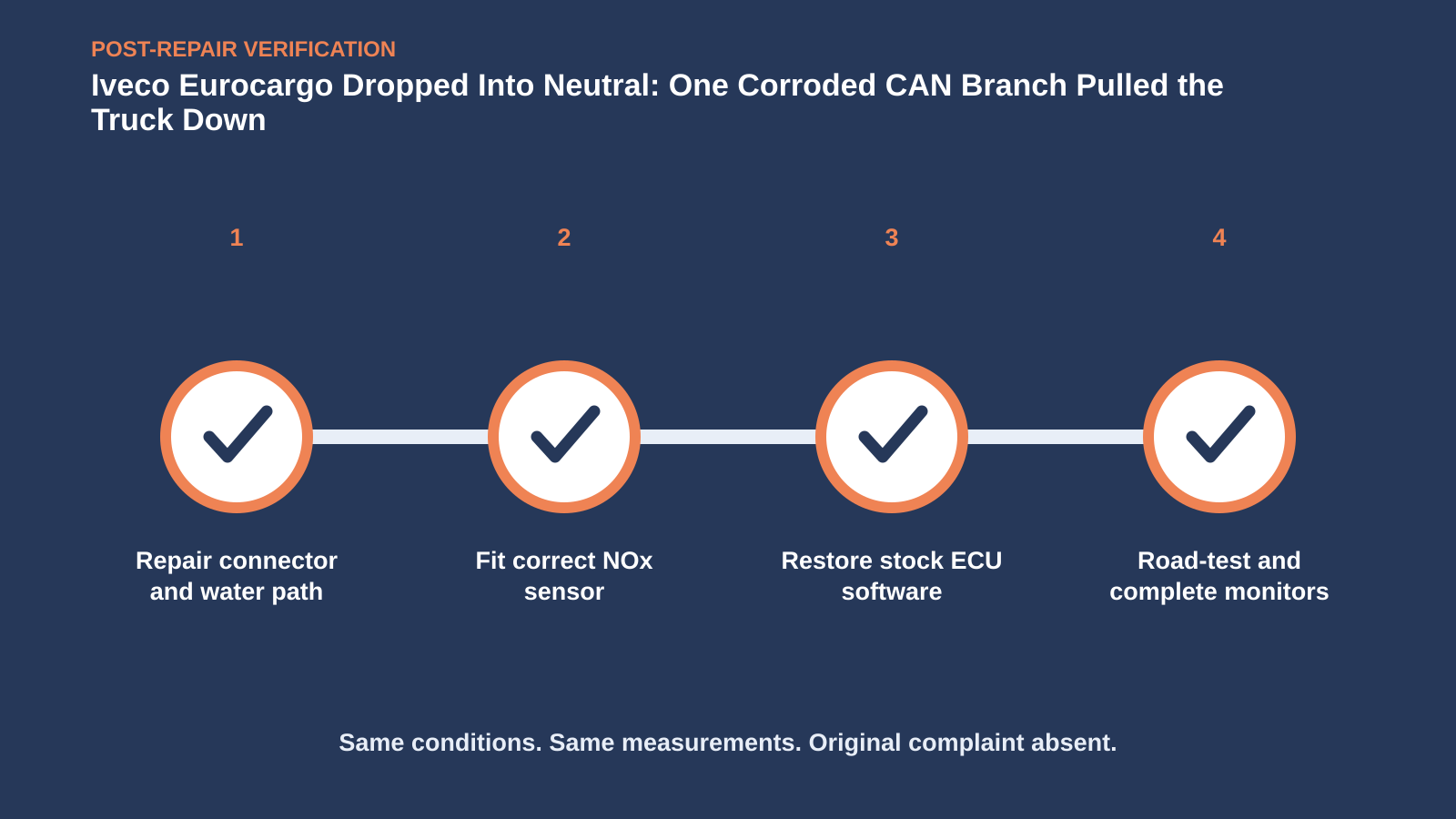
The truck was observed for several weeks on a confined site with the branch isolated, a diagnostic step used to assess recurrence. That is not a lawful public-road completion. The recommended permanent route was to replace the damaged NOx sensor and restore the ECU to stock software. Repair water entry and terminal damage at the same time. After programming, perform required aftertreatment checks and ensure every mandated component is present and reporting plausible data.
Verify stock software, sensor and road operation
Repeat the original warm drive under controlled conditions, watching gear state, throttle response and network common-mode voltage. Rescan engine, transmission and aftertreatment modules; confirm an unplugged-sensor test now produces the appropriate response only if the official procedure calls for it. Inspect the connector after a wetting cycle and verify emissions monitors complete. The case closes when the stock system stays online and compliant—not simply when the driver can move the truck again.
The corrosion explained the electrical disturbance; the impossible live data explained why scan-tool logic had not exposed it. Repairing both the physical branch and the nonstandard software is what turns a clever isolation test into a legitimate road repair.





Comments 0
Questions, fixes, and real-world diagnostic notes from readers.
Be the first to share a diagnostic result or ask a follow-up question.