
Komatsu PC210 Kept Ruining DEF Injectors: The Cooling Passage Was Blocked

Repeated Def Injector Failure? Check Its Cooling
A Komatsu PC210 LC reached a level-four emissions warning after two DEF injectors had already been replaced. The third injector could still be blocked, but another part alone would only restart the same clock. Repeat failure changes the question from “is this part bad?” to “what has been making this location hostile to every replacement?”
An electrical meter or scope can first confirm an identified doser supply, ground and current event while an approved active test runs. The AUTOOL DM303 is one supporting option for those bounded circuit checks once Komatsu data defines the connection. DM303 can support identified doser supply, ground, current and accessible waveform checks. It cannot run Komatsu active tests, verify DEF spray quality, measure system pressure directly or replace the machine monitor and cooling-system procedure.
The injector clicked when commanded but passed no fluid. The machine’s abnormality history recorded injector overheat, and the small coolant passages around the doser were completely blocked. Cleaning and flushing that circuit before fitting a new injector restored a measurable pressure drop during dosing and normal purge behavior. The repair succeeded because it treated the failed part and the condition that killed it.
Quick answer: The doser clicked but passed no fluid. An overheat record led to completely blocked coolant passages; cleaning the path before replacing the injector restored dosing and purge.
In this guide
- A third injector is not a diagnosis
- Confirm fluid quality and the exact warning level
- Command the doser and separate click from flow
- Read pressure change during dosing and purge
- Search the abnormality history for a cause
- Open the cooling path around the injector
- Clean, flush and install the repair as one job
- Verify dosing, purge, leaks and warning release
A third injector is not a diagnosis
Put the replacement history at the top of the work order: dates, hours, part numbers and how long each injector lasted. Save the current warning level and all aftertreatment faults before resetting anything. Check DEF age, concentration with an approved method and contamination in the tank or service equipment. Crystallization at a nozzle can be an effect of heat, leakage, poor purge or fluid quality. Wear eye protection and follow depressurization rules; DEF is not high-pressure diesel fuel, but an active dosing system still should not be opened casually.
Confirm fluid quality and the exact warning level
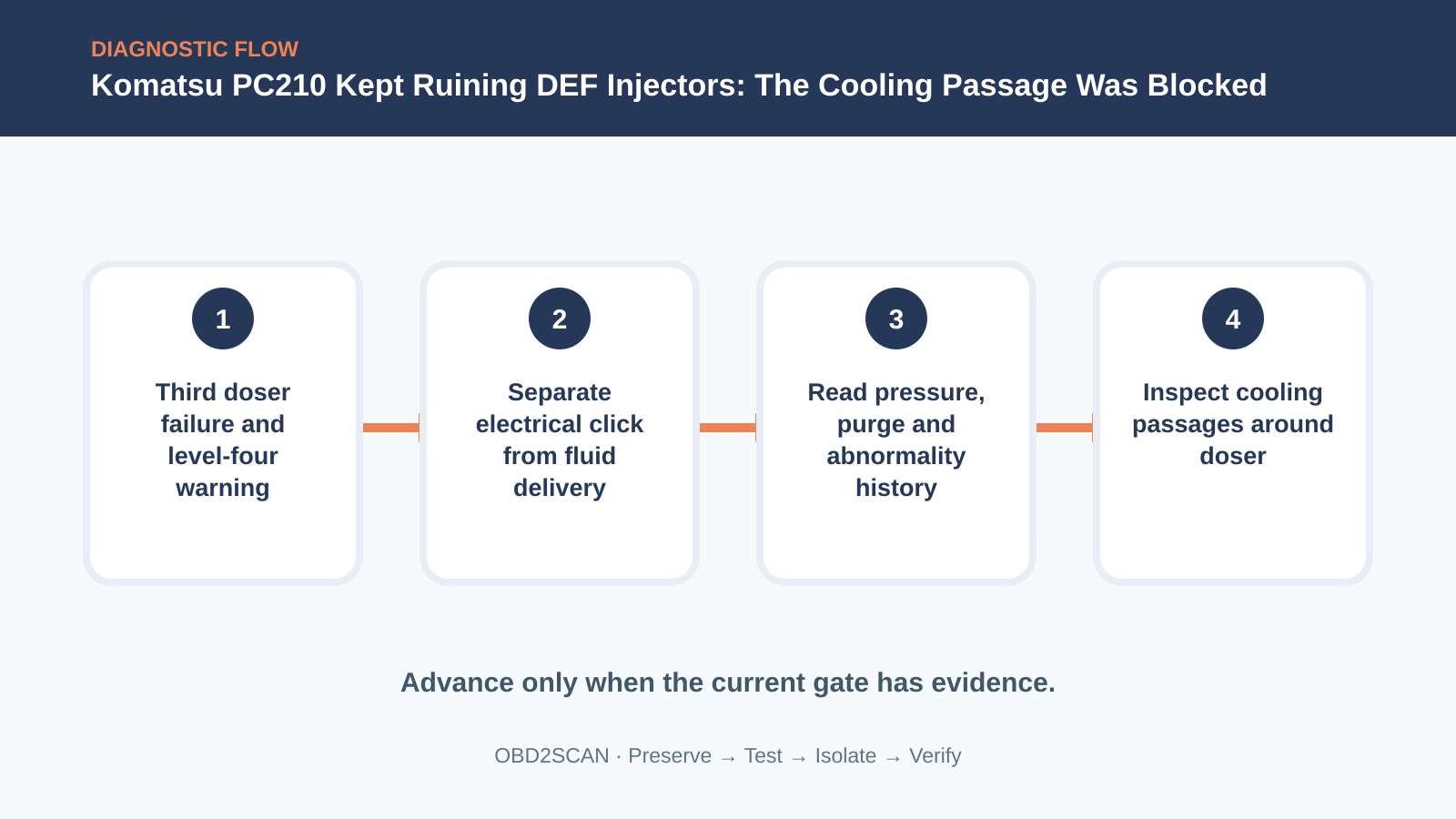
Use the machine’s approved test to command the doser while monitoring system pressure and electrical response. A click proves an armature moved or a coil reacted; it does not prove liquid crossed the valve or formed a usable spray. In this case, the injector clicked yet delivered nothing. Compare pressure before, during and after the command, collect output only where the procedure permits, and inspect for crystallization. If the electrical event is missing, stay with the circuit. If it is present without flow, move into the fluid path.
Command the doser and separate click from flow
Pressure behavior helps separate creation, delivery and purge. Record how quickly the pump builds pressure, how the value changes when dosing is commanded and whether the system returns through its normal purge sequence. No pressure creation keeps the pump and supply path high on the list. Stable pressure with no commanded drop suggests the doser is not passing fluid. An abnormal decay could indicate leakage elsewhere. Use Komatsu limits rather than a universal number, and never use pressure alone to judge spray quality.
Read pressure change during dosing and purge
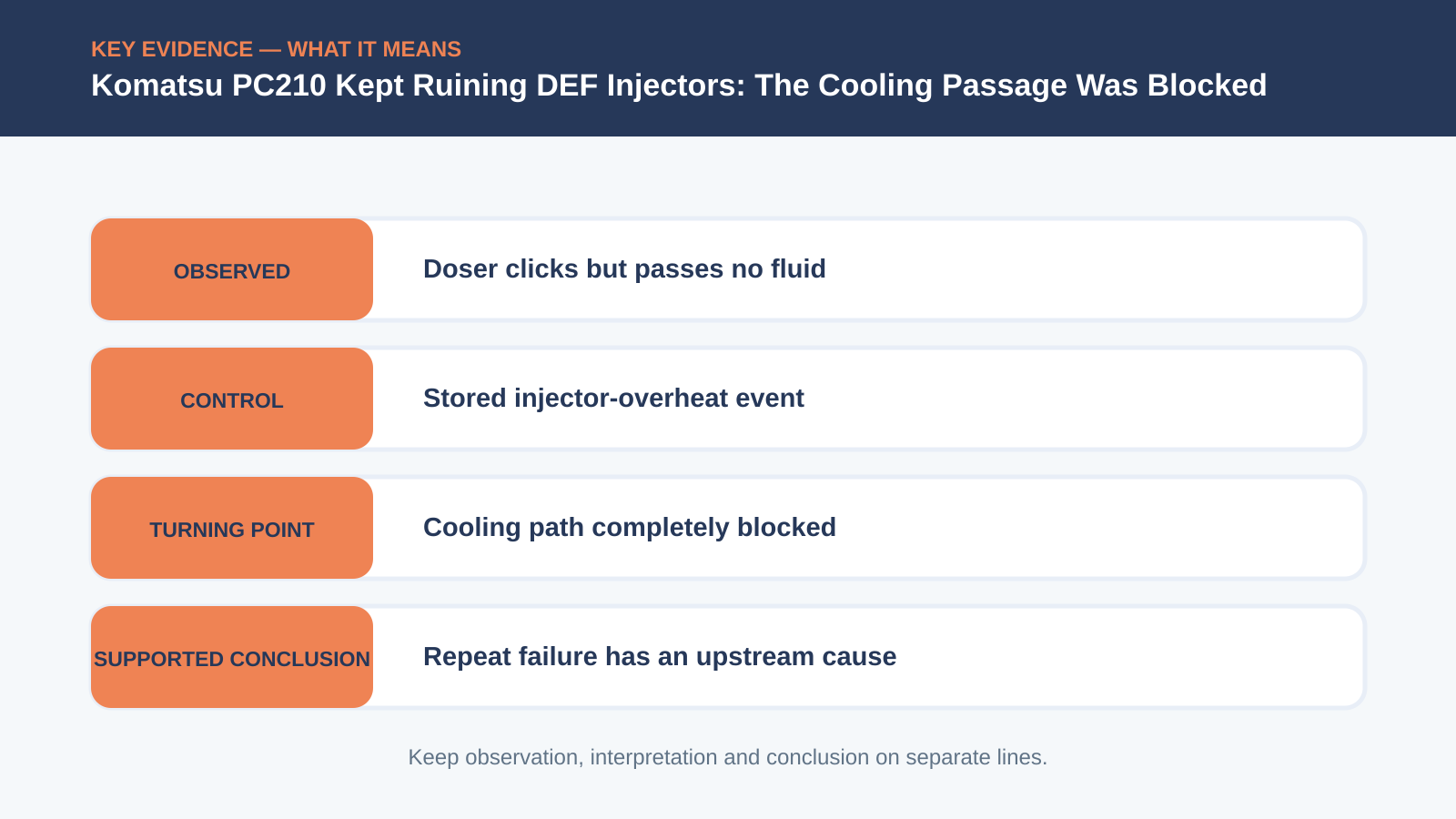
The historical log contained the clue that made this more than a blocked-nozzle job: injector overtemperature. Fault histories are not decorative. Compare the time and hours of the event with each previous replacement, coolant service and machine workload. Ask what cools the injector after shutdown and during operation. An overheat entry does not itself prove a blocked passage, but it gives a reason to inspect the injector’s operating environment before authorizing another identical repair.
Search the abnormality history for a cause
The coolant channels around the injector were completely restricted. Open the route only after the machine is cool, pressure is released and the correct coolant is identified. Inspect both ends of the path; clearing the visible port while debris remains upstream is not a repair. Determine whether deposits, mixed coolant, scale or a collapsed hose contributed. Flush and verify flow according to Komatsu guidance, then restore concentration and bleed the system. Keep coolant away from the DEF circuit and replace disturbed seals.
| Finding | Immediate meaning | Next question |
|---|---|---|
| Injector clicks on active test | Coil/armature responds | Does fluid actually pass? |
| No delivery or pressure response | Doser is blocked or path is restricted | Why did it block again? |
| Overheat stored in history | Injector experienced abnormal temperature | Is its coolant path flowing? |
| Coolant passages fully blocked | Cooling cannot protect the doser | Can the circuit be cleaned and proven? |
Open the cooling path around the injector
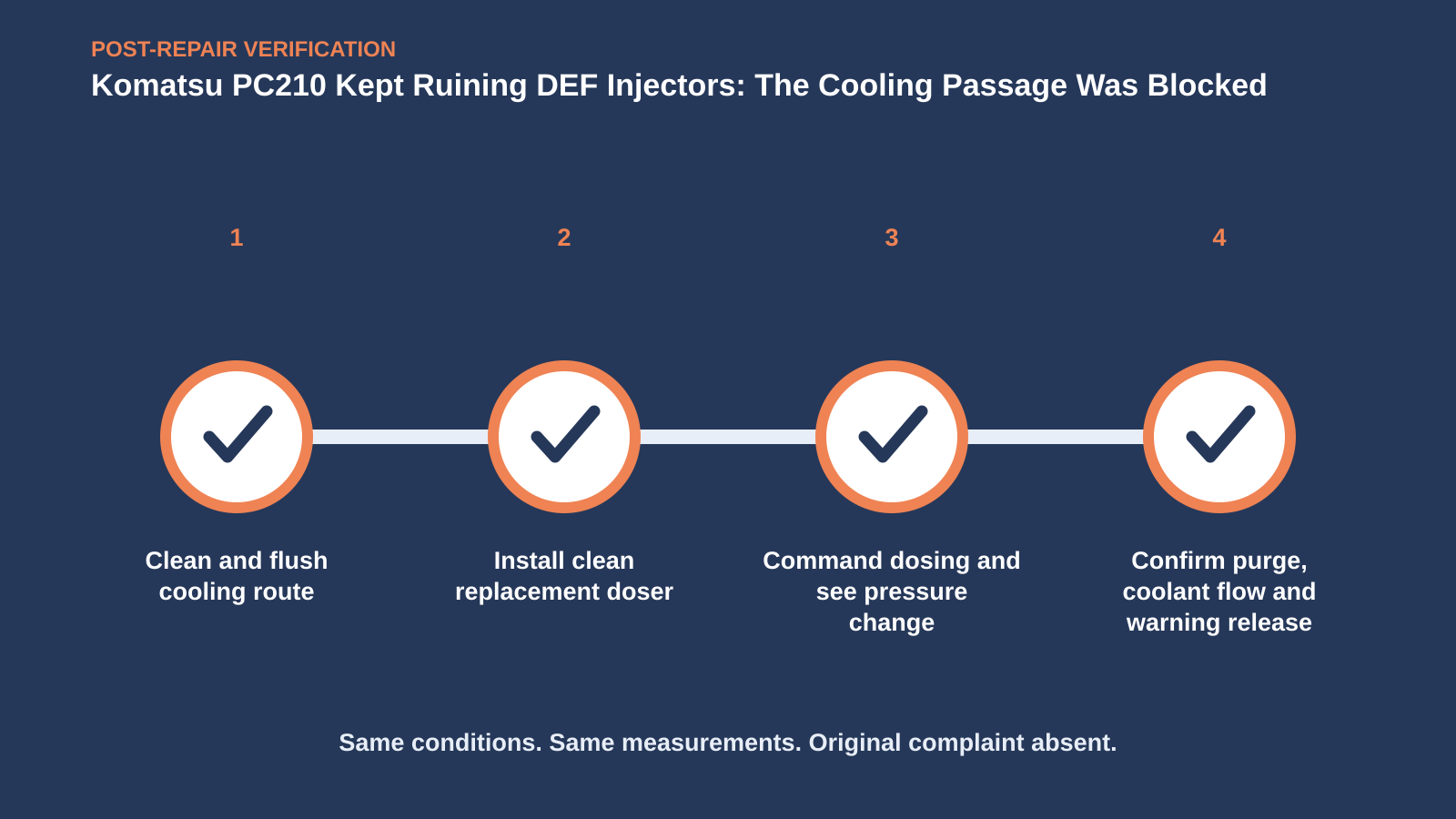
Install the new injector only after the cooling route can support it. Clean the mounting area, prevent crystals from entering the exhaust or fluid line, use specified fasteners and inspect the electrical connector for heat damage. If a line or pump carries contamination, address it in the same job. The documented case combined cleaning and flushing with injector replacement. That distinction matters: it was not evidence that another injector alone had finally been lucky.
Clean, flush and install the repair as one job
Repeat the active dosing test with the same warm-up and pressure view. The repaired system should show the expected pressure reaction when the injector opens, then complete its purge normally. Check coolant circulation and leaks as well as DEF leaks. Clear warnings only after the as-found records are saved, follow any inducement-reset or confirmation routine, and run the machine under an approved load. An electrical click plus a disappearing warning is weaker proof than flow, pressure response and purge together.
Verify dosing, purge, leaks and warning release
Add a recurrence plan to the service record. Recheck coolant condition, the small doser cooling circuit and external crystallization at a sensible interval. If the machine repeats an overheat event, stop before sacrificing another injector. This was one documented PC210 LC, so the blocked passages are not a universal explanation for every dosing code. The transferable rule is broader: when an expensive component fails repeatedly, test the environment it depends on before installing the next one.
The third failed injector was real, but it was also evidence. Following that evidence upstream to the blocked cooling passage converted a repeating parts bill into a repair with a reason to last.







Comments 0
Questions, fixes, and real-world diagnostic notes from readers.
Be the first to share a diagnostic result or ask a follow-up question.