
Volvo FMX Euro 6 Lost Rail Pressure: Testing One Injector at a Time Hid Six Leaks

One-By-One Test Inconclusive? All Six May Leak
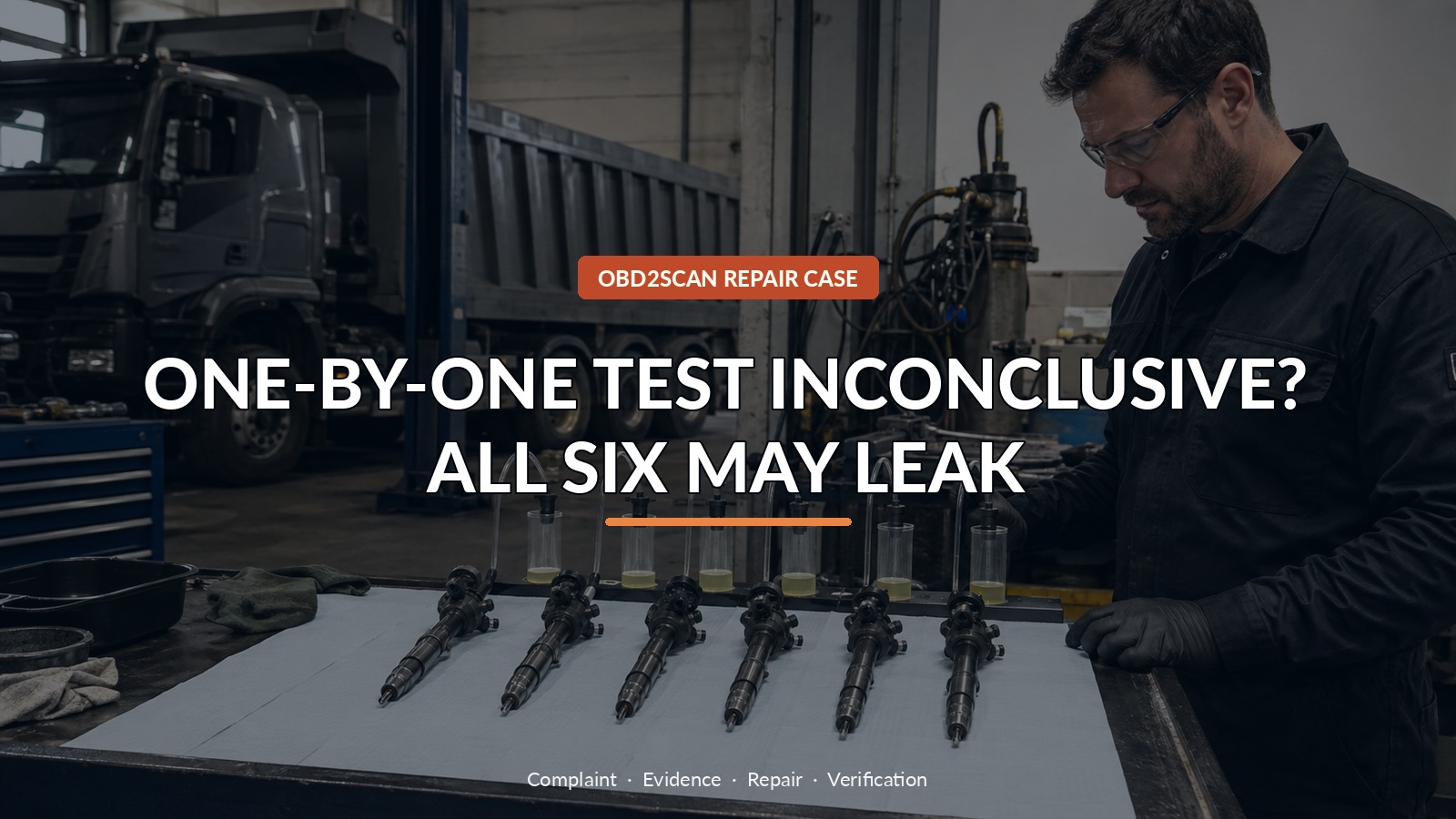
A Volvo FMX Euro 6 entered limp mode with fuel-pressure trouble and rail pressure that fell too quickly after operation. Standard one-injector-at-a-time isolation did not deliver the neat outlier the workshop expected. The hidden assumption was that the other five injectors formed a healthy reference group. In this engine, all six were leaking.
A diagnostic meter can support the low-voltage side of an identified rail-pressure sensor circuit before specialist fuel testing. The AUTOOL DM303 is one example for that limited role. DM303 can support identified low-voltage rail-sensor supply, ground and signal checks using Volvo data; it cannot connect to common-rail pressure, safely block injector returns, rate injector leakage or replace Volvo-approved high-pressure procedures and specialist equipment.
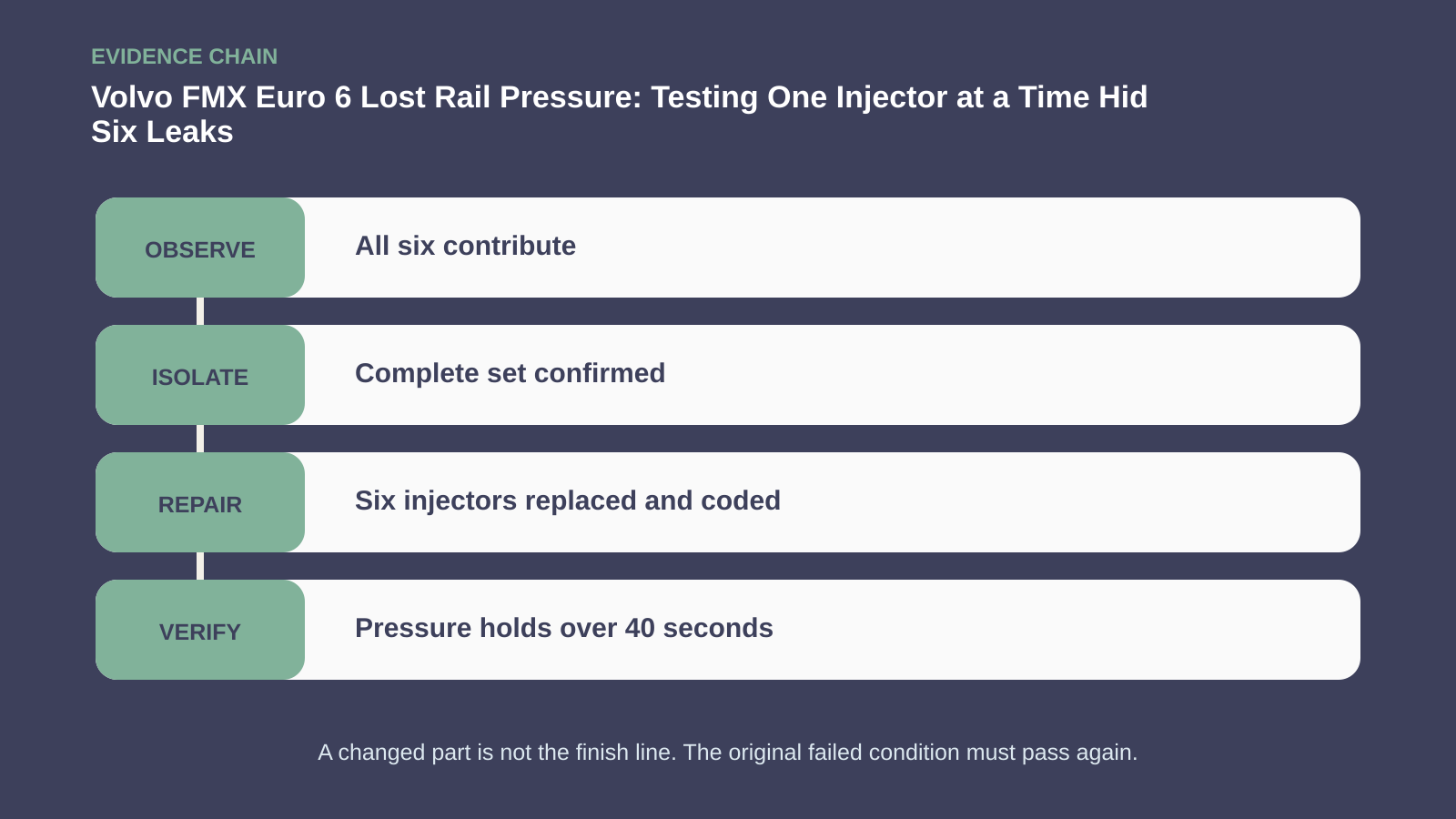
System-level decay and collective return evidence were stronger than a misleading relative comparison. Replacing and coding all six confirmed injectors transformed pressure hold from rapid loss to more than 40 seconds and, in recorded tests, several minutes. The article’s useful idea is statistical as much as mechanical: a comparison fails when its baseline is also bad.
Quick answer: One-at-a-time isolation looked weak because all six injectors leaked. A complete confirmed set restored rail-pressure hold from rapid decay to over 40 seconds.
In this guide
- Treat rapid pressure decay as a system symptom
- Keep low-voltage sensor checks outside the fuel hazard
- Measure the whole rail hold event
- Understand what one-at-a-time isolation assumes
- Question the baseline when every result looks alike
- Confirm collective injector leakage safely
- Replace and code the confirmed injector set
- Verify pressure hold, road load and leak-free operation
Treat rapid pressure decay as a system symptom
Save fuel-pressure codes, freeze-frame data, derate state and recent fuel-system history. Record whether limp mode begins under load, after a hot soak or at restart. Check low-pressure supply, fuel quality and external leakage before opening anything. Common-rail systems operate at pressures that can inject fuel through skin; never loosen a line on a running or recently pressurized engine. Only trained technicians with Volvo procedures and rated equipment should perform isolation or return tests. Stop immediately for leaks, damaged lines or uncontrolled engine behavior.
Keep low-voltage sensor checks outside the fuel hazard
Before touching high-pressure hardware, verify the sensor’s low-voltage foundation. Check its reference, ground and signal against scan data using the wiring diagram. A meter or scope can reveal an open circuit or implausible response; it cannot certify actual rail pressure by itself. Compare commanded and reported pressure during crank, idle, load and shutdown. If the signal remains coherent while pressure decays in a physically plausible way, the diagnosis can proceed into hydraulic leakage rather than replacing the sensor from a code label.
Measure the whole rail hold event
Measure the full pressure-hold event with approved data. Define starting pressure, shutdown point, time base and threshold from Volvo information. A rapid decay tells the technician that stored pressure escapes somewhere—injectors, relief path, pump or external leak—but it does not name the route. Repeat to establish consistency and temperature dependence. Preserve the graph because post-repair hold time will be one of the strongest comparisons. Do not improvise plugs or clamps on high-pressure lines.
Understand what one-at-a-time isolation assumes
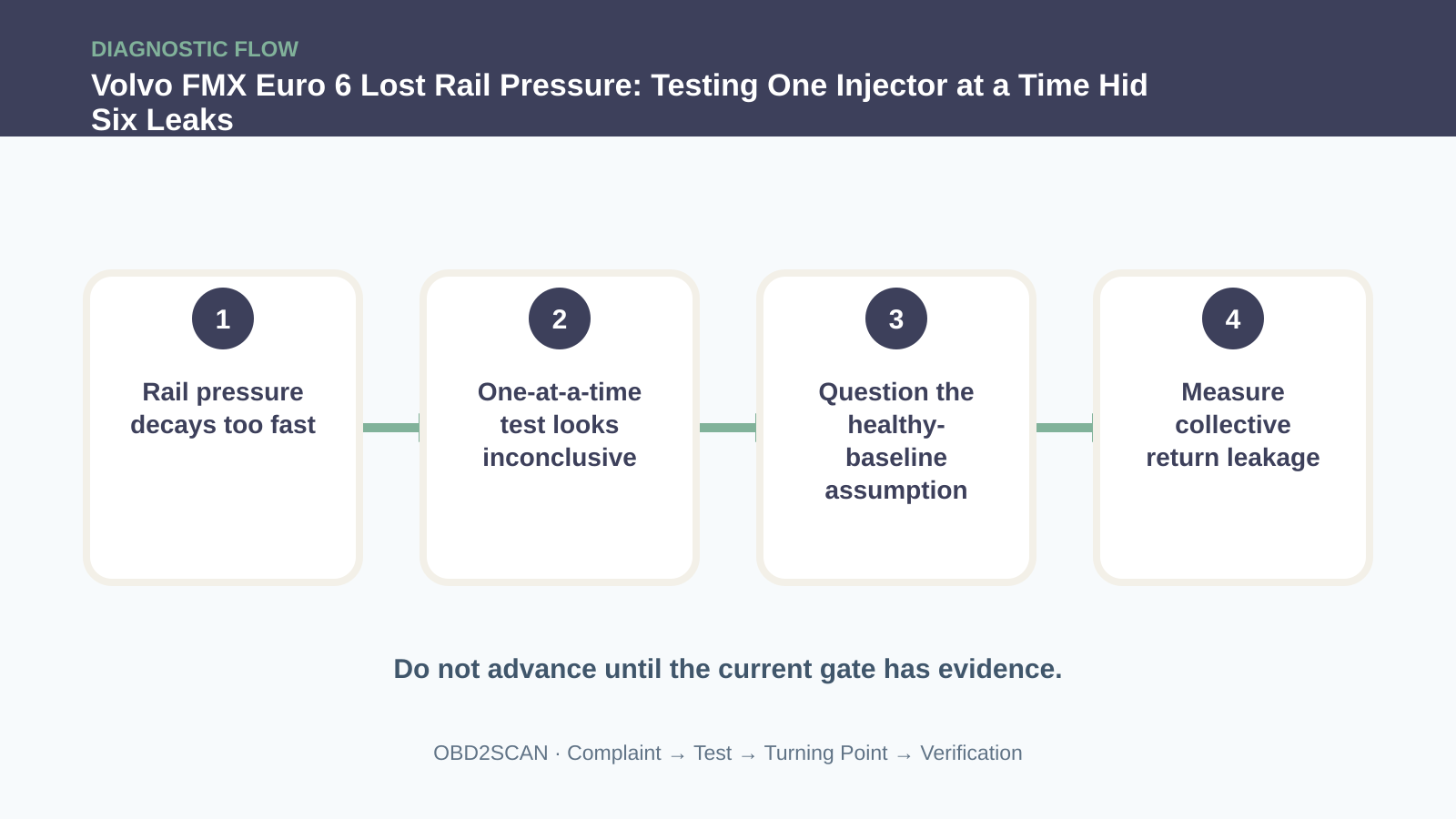
One-at-a-time isolation assumes that changing the failed member will stand out against several healthy members. If every injector leaks, removing one contribution may produce only a modest improvement, and the shared return gallery can blur the difference. The test has not become useless; its interpretation has changed. Ask whether the total leakage is excessive and whether the comparison group is trustworthy. A test method should expose its assumptions on the work order, especially before six expensive parts are authorized.
| Test idea | Hidden assumption | What happened here |
|---|---|---|
| Isolate one injector | Other five are mostly healthy | All five remaining still leaked |
| Compare return volume | One unit will be a clear outlier | Collective leakage dominated |
| Watch rail decay | Stored pressure should hold | Pressure fell too rapidly |
| Repeat after six injectors | Repair should change whole system | Hold time improved dramatically |
Question the baseline when every result looks alike
Confirm collective leakage with Volvo-approved return measurement and isolation equipment, observing all pressure-relief precautions. Compare totals, cylinder behavior and any available correction data, but do not let correction numbers replace physical flow evidence. Check the pressure-control valve and pump paths so six similar results are not blamed on injectors by default. In the documented case, the combined evidence supported all six. That conclusion was expensive, so the before/after pressure contract mattered.
Confirm collective injector leakage safely
Replace injectors as a matched, clean high-pressure procedure. Protect every open port, renew specified pipes, seals and hold-down hardware, and follow torque and calibration-code requirements. Contamination that damaged the original set can damage the replacement set, so inspect filters and fuel quality. Do not reuse questionable lines to save time. After priming, check carefully for leakage without using hands. The product mention stayed on the sensor circuit because ordinary meters and low-pressure gauges do not belong on the rail.
Replace and code the confirmed injector set
Repeat the exact shutdown pressure capture. In the reported repair, pressure remained above the relevant level for more than 40 seconds and some captures held for over three minutes, a dramatic change from the rapid decay. Verify hot restart, commanded versus actual pressure under road load and absence of limp mode. Rescan after the drive and inspect every opened connection. A new injector code or leak is a failed release even if the original pressure fault has disappeared.
Verify pressure hold, road load and leak-free operation
Explain the paradox to the owner: the first comparison expected good neighbors, but every injector contributed to the leak. Provide the total return and pressure-hold evidence, the reason a complete set was chosen and the matched post-repair graph. Avoid turning one truck into a model-wide rule. Another FMX may have a relief valve, supply or sensor problem. The transferable answer is to question the reference group when every relative result looks equally unhelpful.
No single injector looked uniquely guilty because none of the six supplied a healthy baseline. System evidence exposed the collective failure, and the much longer post-repair pressure hold supplied the proof that the costly decision was right.





Comments 0
Questions, fixes, and real-world diagnostic notes from readers.
Be the first to share a diagnostic result or ask a follow-up question.