
New Flyer Bus Smoked and Misfired With No Codes: A Missing Injector Suppressor Was Ringing the Circuit

No Codes, Black Smoke? Check The Suppressor
A 60-foot New Flyer articulated bus produced black smoke and a random misfire under acceleration, yet stored no helpful fault code. In fleet work, that combination can trigger expensive fuel-system suspicion. The more revealing fact was mundane: a transient suppressor at the injector-control valve had been left disconnected after earlier service.
A truck/bus-capable automotive meter and compact scope can support an early check of identified supply, ground and slow circuit waveforms. The AUTOOL DM303 is one example for that limited layer before specialist multi-channel testing. DM303’s official page lists trucks and buses and it can support identified voltage, ground and accessible waveform checks within its ratings; it cannot replace the multi-channel current-and-pressure capture used here, identify every transient cause or justify energizing an unknown heavy-vehicle circuit.
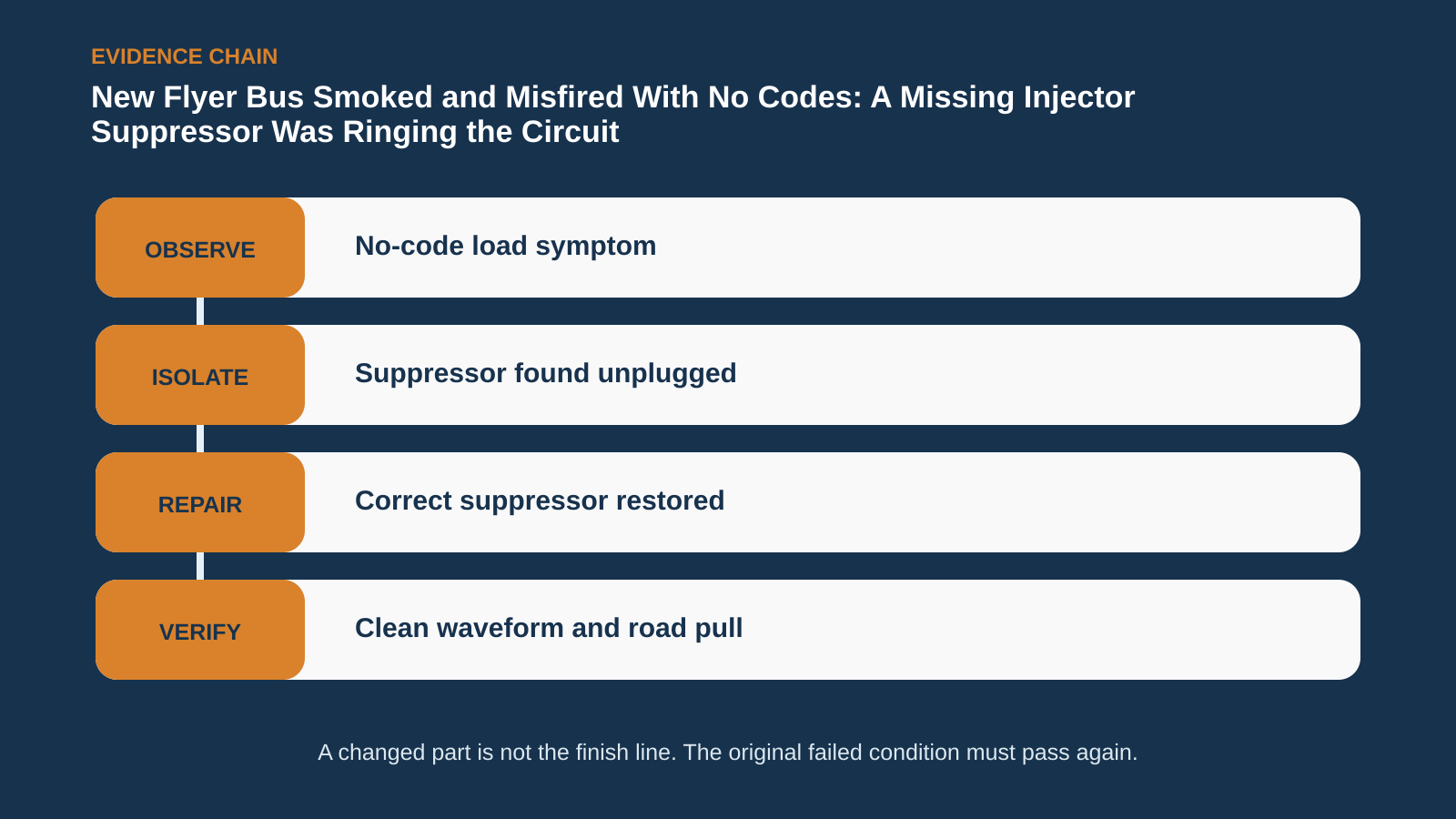
Synchronized current, fuel-pressure and ground captures showed severe electrical ringing at injector-control events. Reconnecting the correct suppressor removed the ringing, smoke and misfire on the road test. This is a fleet handoff case—what was omitted during the last job mattered more than the absence of a code.
Quick answer: An unplugged injector-control-valve suppressor allowed electrical ringing that coincided with black smoke and misfire. Restoring it cleared the loaded complaint.
In this guide
- Reproduce smoke and misfire under the same load
- Do not treat no codes as no evidence
- Audit every connector touched during prior service
- Capture command, current and ground together
- Read ringing as a missing energy-control clue
- Restore the correct transient suppressor
- Inspect nearby circuits for collateral damage
- Verify acceleration, smoke and repeatability
Reproduce smoke and misfire under the same load
Define the event without smoking out the shop. Record engine temperature, rpm, gear, accelerator request, boost, road grade and whether the smoke appears only during a transient. Inspect oil, coolant and intake condition first. Use an approved loaded test with a second person recording, and stop for runaway behavior, excessive smoke, fuel leakage or unsafe loss of power. A stationary snap-throttle test may not reproduce a bus under mass, but repeated road pulls are not justified until the basic engine and wiring inspection passes.
Do not treat no codes as no evidence
No code means the controller did not recognize and store a monitored failure; it does not mean fuel delivery was clean. Save live data and look for rail or actuation behavior that shifts during the misfire. Compare cylinders or control events rather than staring at one average value. Black smoke indicates more fuel-derived carbon than available air can burn, but causes include air restriction, boost loss, timing, injection control and mechanical faults. Smoke color is a branch selector, not a component verdict.
Audit every connector touched during prior service
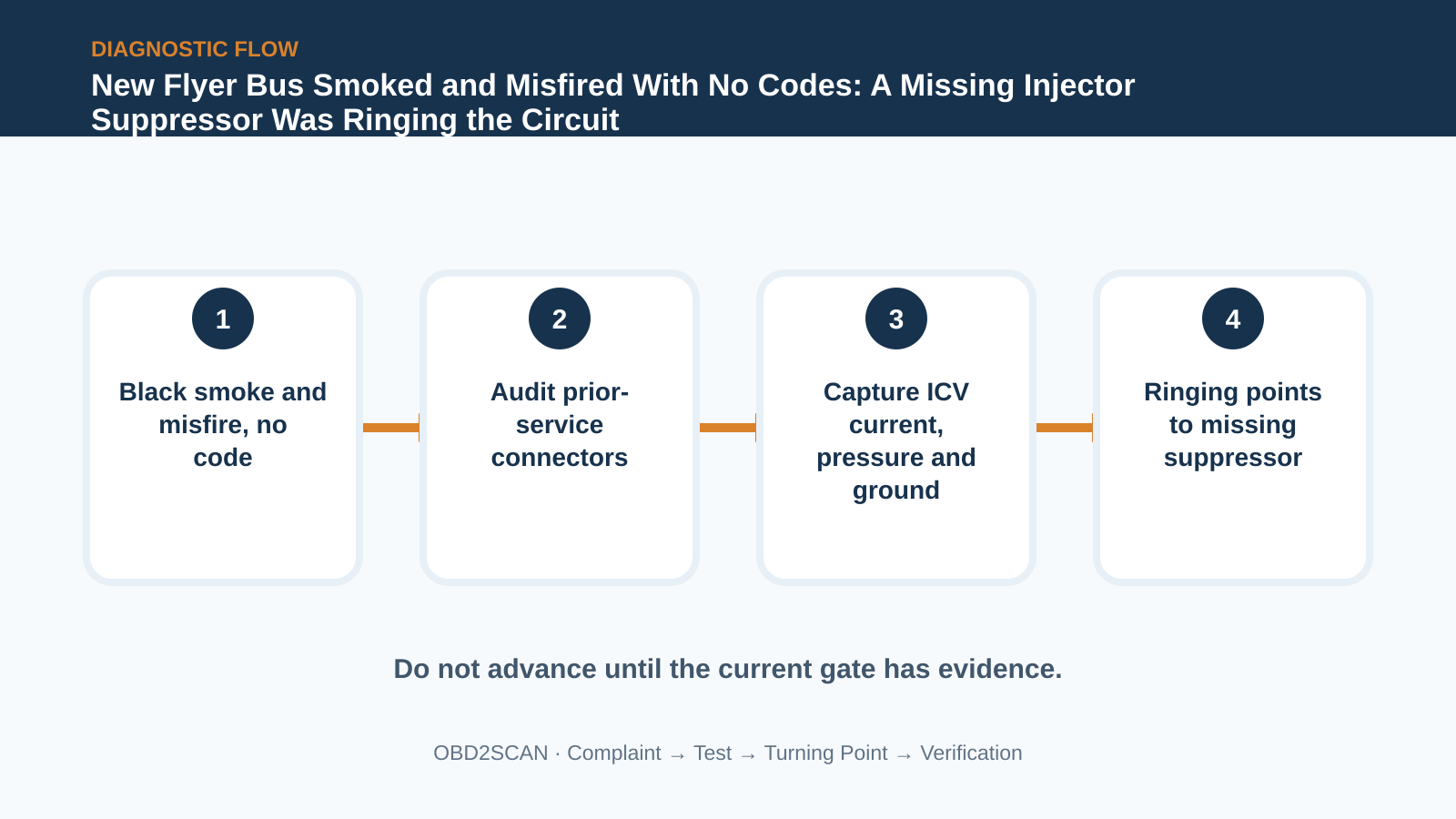
Before connecting advanced equipment, audit every part touched during recent service. Compare the harness with diagrams and a sister vehicle if available. Check that suppressors, grounds, shields, clips and terminating devices are present—not merely that the main connector is latched. Photograph unused plugs before moving them. A small module may exist only to control the energy released when a coil switches off; the engine can run without it while the electrical environment becomes noisy enough to disturb control.
Capture command, current and ground together
The mature test viewed injector-control-valve current, pressure response and ground behavior together. That matters because a voltage spike on one channel could be probe placement or normal switching, while a repeating ring aligned with current interruption and pressure disturbance tells a stronger story. Use correct attenuation, current clamps and common-ground strategy for heavy-vehicle work. A handheld one-channel view may reveal that ringing exists, but it cannot safely recreate the full cause-and-effect comparison by itself.
| Evidence | Interpretation | Avoid saying |
|---|---|---|
| Black smoke only under acceleration | Load-dependent air/fuel control problem | Injectors are automatically worn |
| No DTCs | No monitor stored a recognized fault | Electrical control is healthy |
| Ringing follows ICV switching | Transient energy is poorly controlled | ECU is definitely damaged |
| Suppressor restored, symptoms gone | Missing suppressor caused this event | Every smoky bus needs a suppressor |
Read ringing as a missing energy-control clue
A transient suppressor gives inductive energy a controlled path when current is interrupted. Without it, voltage can overshoot and oscillate. The pattern in this case fit the physical discovery of the unplugged device. Check the suppressor itself, its connector and its ground or mounting requirements; do not fit a random diode or resistor because it looks similar. Polarity, clamping voltage and energy capacity matter, and the engine manufacturer’s part and wiring information should govern the repair.
Restore the correct transient suppressor
Reconnect or replace the specified suppressor, repair damaged terminals and secure the loom against vibration. Then inspect nearby control modules and connectors for heat or arcing evidence created during operation without suppression. Clear nothing until the original data is saved. If ringing persists with the correct device installed, check ground paths, supply impedance and other inductive loads rather than declaring the new part bad. One omitted component can be the cause, but a damaged circuit may remain after prolonged exposure.
Inspect nearby circuits for collateral damage
Verification repeats the same acceleration window with the bus safely loaded. Compare current, pressure and ground using the same scaling so the suppressed waveform can be distinguished from the original ringing. Observe exhaust smoke, engine response and misfire behavior, then rescan even though the case began without codes. Check the suppressor connector again after heat and vibration. A clean pull in the bay is encouraging; an equivalent road event without smoke or stumble is the closing test.
Verify acceleration, smoke and repeatability
Fleet prevention belongs in the final note. Add the suppressor connection to the post-service checklist, mark its harness branch clearly and share the as-found photo with the shift that performed the earlier work without turning the article into blame. The human lesson is that small omitted hardware can create large symptoms while staying below code thresholds. A careful handoff and connector count may prevent the next bus from spending days in fuel-system diagnosis.
The no-code bus still left evidence—in smoke, current, pressure and one empty connector. Restoring the suppressor closed the electrical event and the drivability complaint at the same time.


Comments 0
Questions, fixes, and real-world diagnostic notes from readers.
Be the first to share a diagnostic result or ask a follow-up question.