
Mercury Mariner Outboard Cranked but Had No Spark: The Main Relay Was Losing Its Key Feed

Cranks, No Spark? Watch The Main Relay Feed
A V6 two-stroke Mercury Mariner outboard first failed intermittently, then reached a permanent state: the starter turned, but there was no spark. Six missing spark outputs can make six ignition paths look suspicious. The more economical question was whether the engine-management system stayed powered while the starter loaded the battery.
A 9–30V circuit analyzer can help follow an identified feed or ground only when the marine service procedure and environment permit the connection. The MRCARTOOL B550 is a road-vehicle example of that tool class, not proof of marine sealing or ignition protection. B550 is specified for 9–30V electrical systems and can support an identified low-voltage feed, ground or voltage-drop check only if Mercury service information and the marine environment permit it; its road-vehicle product page does not establish marine sealing, connector or ignition-protection suitability, and it cannot replace an ignition-output capture or authorize a bypass.
The main relay was losing its ignition-live feed during cranking. A protected test supply made the engine start repeatedly, localizing the fault to the control-supply path. The owner accepted a fused bypass rather than an ECU. That ending should be described accurately: diagnosis was confirmed, an alternative repair was chosen, and the factory-correct route remained different.
Quick answer: The outboard had no spark because the main relay lost its ignition-live feed during crank. A protected test feed restored repeated starts and localized the cause.
In this guide
- Preserve the intermittent-to-permanent timeline
- Check system power before chasing six spark outputs
- Watch the main relay during cranking
- Separate relay load power from relay command
- Use a fused test feed only as a diagnostic step
- Explain the ECU-versus-bypass decision honestly
- Build the accepted repair for the marine environment
- Verify cold, warm and repeated starts
Preserve the intermittent-to-permanent timeline
Begin with the story of the last successful starts. Did the engine cut out at speed, refuse only when warm, or wake when the key was moved? Note whether gauges, fuel pump, warning horn and trim functions behave during the no-start. Confirm fuel ventilation and safe water or test-tank arrangements before cranking. Gasoline vapor, battery sparks and a running propeller are an unforgiving combination. Keep the propeller area clear, ventilate the work space and use marine-approved procedures. Stop immediately for fuel odor, hot cables or uncontrolled cranking.
Check system power before chasing six spark outputs
No spark across every cylinder often points upstream of individual coils. Check battery voltage at rest and during crank, engine and battery grounds under load, required stop-lanyard state, main fuses and the relay’s supply and command. Do not bypass the kill circuit casually; it is a safety system. The question is whether the ECU and ignition system receive stable power at the exact moment the starter operates. A static 12-volt reading before crank can disappear once cable drop, relay contacts or a control output meet real load.
Watch the main relay during cranking
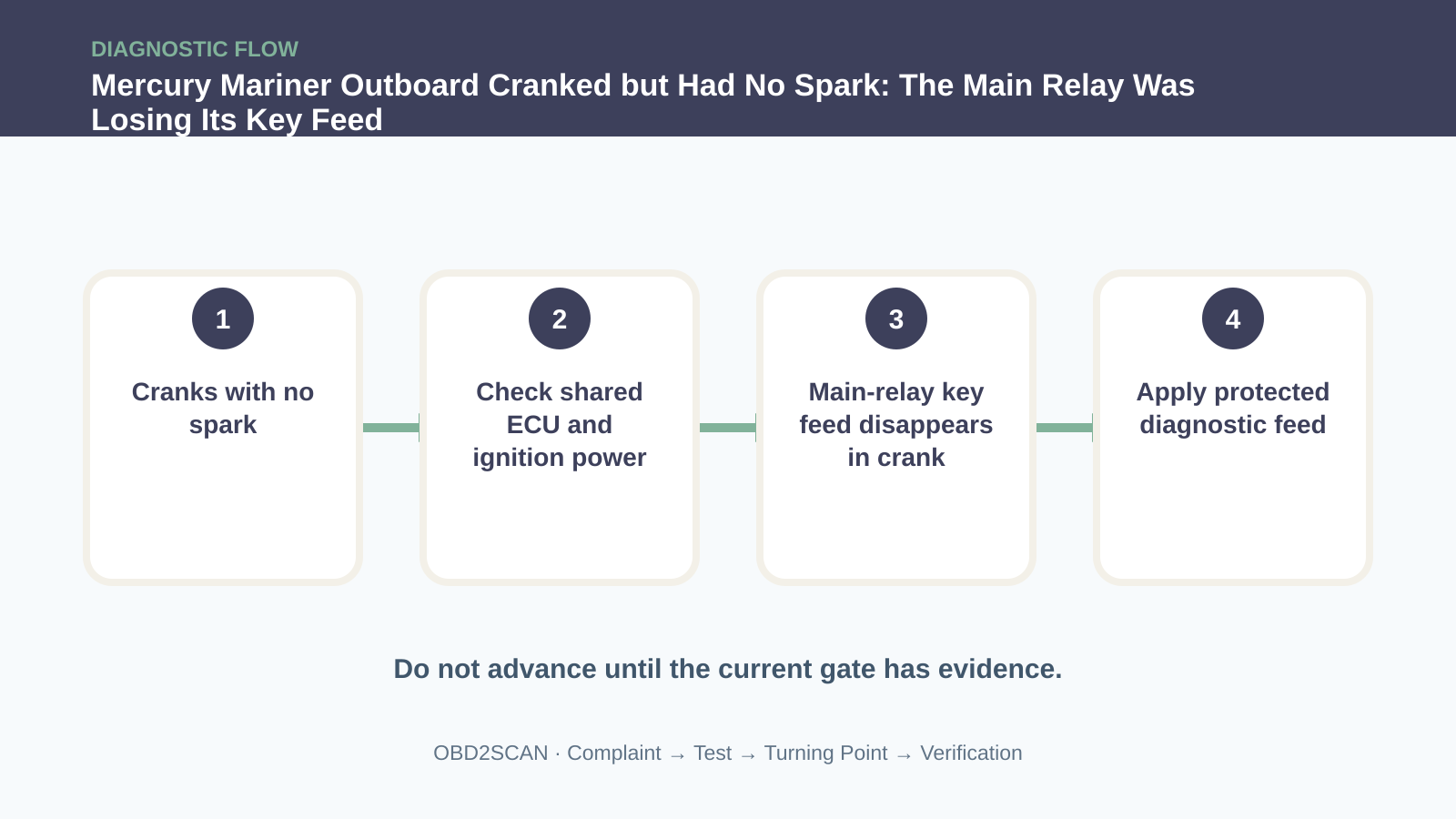
A relay has two jobs: its coil must be commanded, and its contacts must deliver power. Identify both sides from the diagram. Listen for a click only as a clue; a relay can click with burned contacts, and silent operation can come from a missing coil feed. Back-probe safely, record voltage on both sides during the complete crank and compare it with battery voltage. In the documented case the ignition-live feed to the main relay was the disappearing link, so downstream spark testing could not solve the primary loss.
Separate relay load power from relay command
The turning point was a fused test feed applied to the correct identified point. It restored starts repeatedly. This is not permission to bridge unknown terminals or remove current protection. Choose a fuse and conductor according to circuit requirements, keep the connection away from fuel and moving parts, and have a way to disconnect it immediately. The result answers a narrow question: when the relay receives a stable ignition-live supply, does the engine-management system operate? Here it did.
| Observation | What it narrows | What remains open |
|---|---|---|
| Starter cranks normally | Cranking path can turn engine | ECU and ignition power during crank |
| No spark on all cylinders | Shared enable/supply deserves priority | Exact upstream component |
| Relay ignition feed disappears | Control-supply path fails | Wire, key circuit or ECU output location |
| Fused test feed restores every start | Missing feed is causal | Factory repair versus accepted alternative |
Use a fused test feed only as a diagnostic step
Trace the missing feed back through connectors, ignition switch logic and ECU output as the diagram allows. Inspect terminals for corrosion and perform voltage-drop tests with the circuit loaded. If external wiring and key inputs pass but the ECU fails to provide the required output, module repair or replacement may be the factory route. Do not infer ECU failure simply because the test feed works; a hidden open wire or poor connector can produce the same response. The evidence must eliminate those paths first.
Explain the ECU-versus-bypass decision honestly
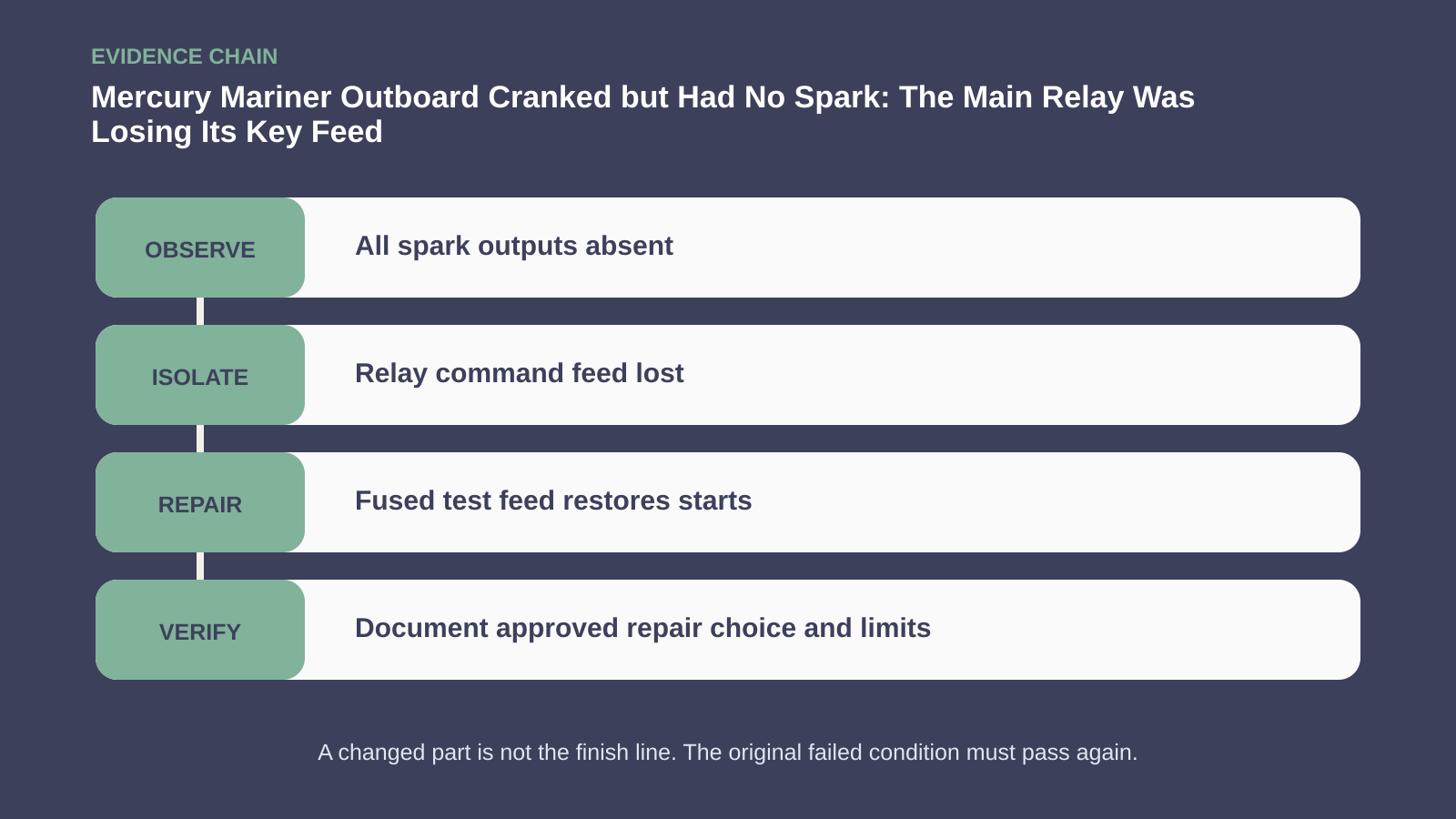
Cost and parts availability shaped the final choice. The customer accepted a fused bypass instead of an ECU. Record that decision and design the accepted circuit as defensibly as possible: marine-rated wire and protection, sealed connections, strain relief, abrasion control, correct key switching and no defeat of stop-lanyard function. Label the modification for future service. A diagnostic jumper is not automatically suitable as a permanent harness, and a road-vehicle probe’s ratings do not certify it for a fuel-vapor marine space.
Build the accepted repair for the marine environment
Verification should challenge the original intermittent pattern. Perform several cold starts, allow heat soak, then repeat warm restarts while monitoring the relay feed. Confirm spark, stable running, charging voltage, stop-lanyard shutdown and normal key-off behavior. A successful start at the dock does not verify operation under vibration and load, so complete an approved water test if safe. The documented follow-up reported no further no-start, an important time-based result for an intermittent repair.
Verify cold, warm and repeated starts
Give the owner a clear record of the evidence and chosen scope. State that the missing relay feed caused the no-spark condition, which repair path was declined, how the alternative was protected and what symptoms require immediate shutdown. This preserves informed consent and helps the next marine technician. It also keeps the lesson honest: the case demonstrates a power-supply diagnosis, not a universal recipe for every Mariner that cranks without firing.
When every spark disappears, move upstream before multiplying parts. The decisive test on this outboard restored one missing relay feed—and the repair story stays trustworthy by naming the difference between proof, workaround and factory repair.










Comments 0
Questions, fixes, and real-world diagnostic notes from readers.
Be the first to share a diagnostic result or ask a follow-up question.