
GM 8-Speed Rumble-Strip Shudder at Light Throttle? Separate TCC From Vibration

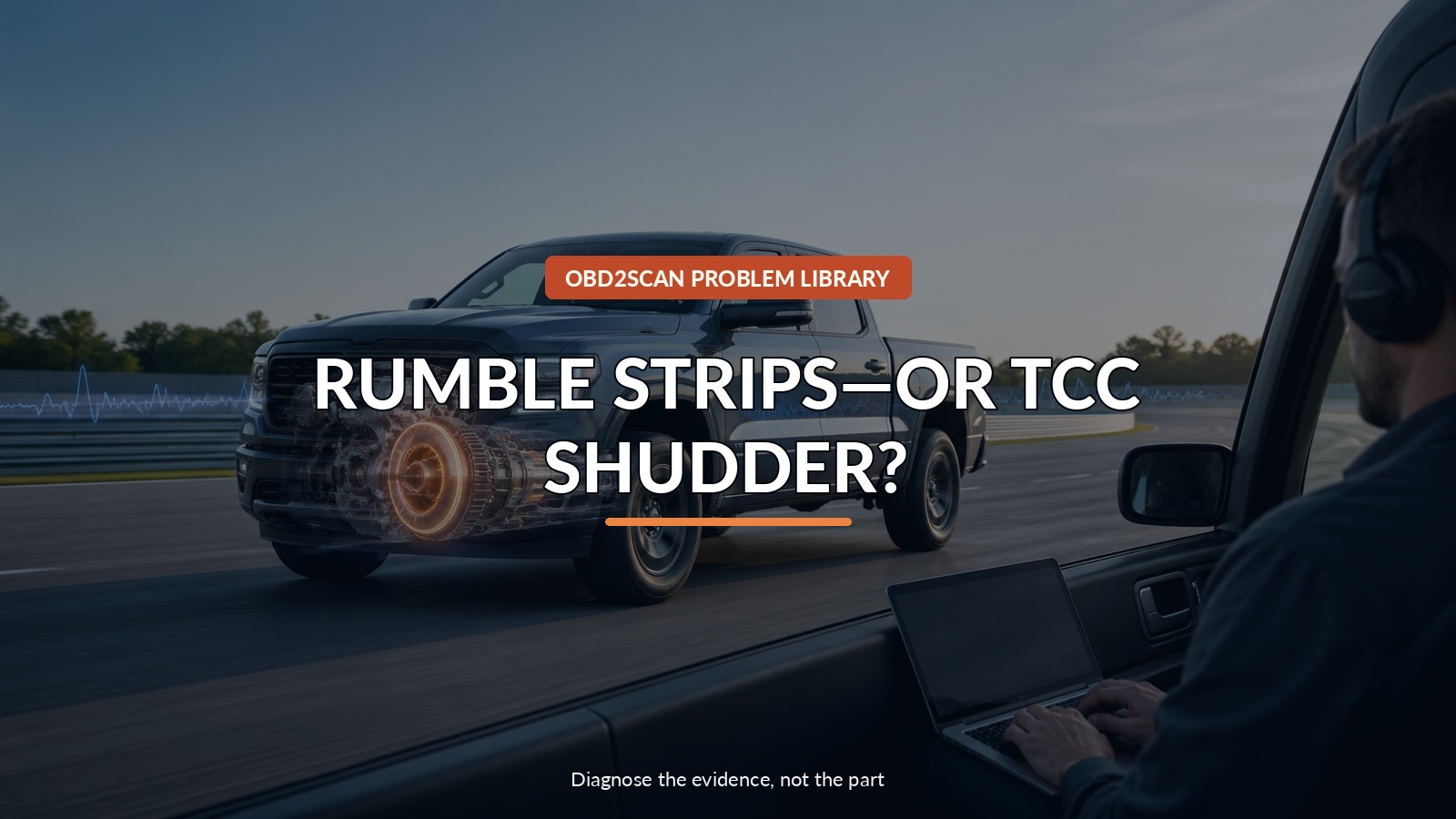
Rumble Strips—Or Tcc Shudder?
A light-throttle shake in a GM vehicle with an 8L45 or 8L90 can feel exactly like driving over rumble strips. That sensation is not yet a torque-converter diagnosis. Tire force variation, driveline vibration, engine firing, surge, and torque-converter-clutch behavior can overlap in the driver’s seat, so describe the event before naming the part.
Mechanical transmission pressure can become useful after the road-test branch identifies a hydraulic question. The AUTOOL PT650 transmission oil-pressure gauge can add approved-port pressure evidence with the correct adapter and specification. It cannot command the torque-converter clutch, capture the bulletin’s vibration frequency, distinguish engine firing from driveline shake, or justify a fluid service on its own.
GM’s revised bulletin 18-NA-355 uses a three-mode comparison on a smooth road: normal control, TCC commanded open, and TCC commanded locked. The change—or lack of change—between those modes carries more diagnostic weight than the word “shudder.”
Quick answer: Reproduce the shake on a smooth road in the correct temperature window, then compare normal, TCC-open, and TCC-locked behavior with scan and vibration data.
In this guide
- Describe the event without naming the converter
- Open the transmission and build-date gate
- Reproduce the exact operating window
- Run normal, open, and locked comparisons
- Overlay vibration and slip instead of guessing
- Add line pressure only when it changes the branch
- Separate fish-bite, surge, and road input
- Verify on the same smooth-road window
Describe the event without naming the converter
Ask the driver to describe speed range, throttle position, grade, gear, road surface, engine temperature, transmission temperature, load, and whether the sensation stops with more or less throttle. Record whether it is a steady buzz, repeated fish-bite, single clunk, steering-wheel shake, seat/floor vibration, or engine surge.
Save all DTCs and freeze frames before clearing adaptations or disconnecting the battery. Inspect tire condition and pressure, wheel damage, obvious driveline looseness, fluid leaks, and engine misfire data. A flashing MIL, severe slip, burning odor, or abnormal mechanical noise is a stop condition, not an invitation to keep reproducing the event.
Open the transmission and build-date gate
GM 18-NA-355 contains a specific matrix of vehicles, engines, 8L45/8L90 applications, regions, model years, and production breakpoints. Verify VIN, transmission RPO, engine, build date, current fluid and repair history, and the latest GM service information.
The familiar symptom does not place every GM eight-speed vehicle inside the same fluid or repair path. An 8L transmission outside the bulletin fence still needs diagnosis; it simply loses the bulletin shortcut.
Reproduce the exact operating window
The bulletin’s test window is roughly 25–80 mph (40–128 km/h), light throttle, transmission fluid at 50–70°C (122–158°F), on a smooth road. Exact current instructions control. Use a trained driver and a second technician for data capture; do not operate a laptop while driving.
Choose a safe, repeatable section of smooth pavement. Hold the event steady long enough to mark speed, gear, input/output speed, engine RPM, throttle, calculated load, TCC command and slip, misfire counters, and vibration. A rough road contaminates the comparison.
Run normal, open, and locked comparisons
Only a capable bidirectional scan tool and the current GM procedure should command clutch states. Observe three passes under nearly identical load:
| TCC state | If the vibration changes | If the vibration does not change |
|---|---|---|
| Normal control | Establishes the baseline event | No verdict yet |
| Commanded open | A disappearing event supports TCC involvement | Look harder at non-TCC sources |
| Commanded locked | A stable locked state refines slip-related evidence | Persistent vibration may be engine, wheel, or driveline |
Do not treat a command on the screen as proof that the clutch achieved the state. Compare commanded state with slip and input/output behavior. If the vehicle or tool cannot safely execute the test, hand it to a shop equipped for the procedure.
Overlay vibration and slip instead of guessing
GM’s technical workflow pairs scan data with vibration-frequency evidence. A professional NVH sensor can show whether frequency follows engine speed, turbine speed, driveshaft speed, or wheel speed. Mark the exact second the driver feels the event, then align that mark with TCC slip and frequency.
A vibration that remains at wheel order while TCC state changes points away from the converter. A fish-bite caused by cylinder torque variation can mimic clutch cycling, so review misfire and fuel-control data even when no misfire code is stored.
Add line pressure only when it changes the branch
Use mechanical pressure only when the service information provides a rated test port, adapter, temperature, gear, RPM, and specification. Secure the gauge away from exhaust and rotating parts. Expect hot fluid and residual pressure; wear eye and hand protection.
Pressure can corroborate a hydraulic control problem, but a normal line-pressure value does not prove the converter clutch surface is healthy. An abnormal value also requires command, electrical, valve-body, fluid-level, and internal-leak context. Keep this measurement downstream of the three-mode road test.
Separate fish-bite, surge, and road input
If the shake persists with the TCC open, inspect tires and wheels for force variation, propeller-shaft and axle condition, mounts, engine torque irregularity, and road dependence. If RPM rises and falls with throttle or fueling rather than clutch slip, follow the engine-control branch. If it occurs only on one pavement, change roads before changing parts.
Also confirm correct fluid level and condition by the specified temperature method. Do not mix, flush, or add fluid based solely on symptom folklore; the correct procedure depends on the exact application and repair history.
Verify on the same smooth-road window
After the evidence-led repair, repeat the three-state comparison on the same road, temperature band, speed, gear, and light-throttle load. Confirm normal shift quality, stable TCC behavior, no new leaks or codes, and no return of the marked vibration frequency.
“Feels better” on a different road is weak verification. A matched before-and-after capture closes the case.
Give the shop one marked event
Export or photograph a short data window with the felt event clearly marked. Include VIN, transmission RPO, build date, fluid history, road, speed, gear, temperature, throttle, TCC command, slip, misfire data, and the dominant vibration order. A concise matched trace helps a transmission specialist repeat the same condition without beginning with a fluid change or converter order. It also preserves a non-TCC result when the vibration remains unchanged through all three clutch states.



Comments 0
Questions, fixes, and real-world diagnostic notes from readers.
Be the first to share a diagnostic result or ask a follow-up question.