
Jeep Thermostatic-Valve Coolant Leak? Inspect Warm, Repair Cold

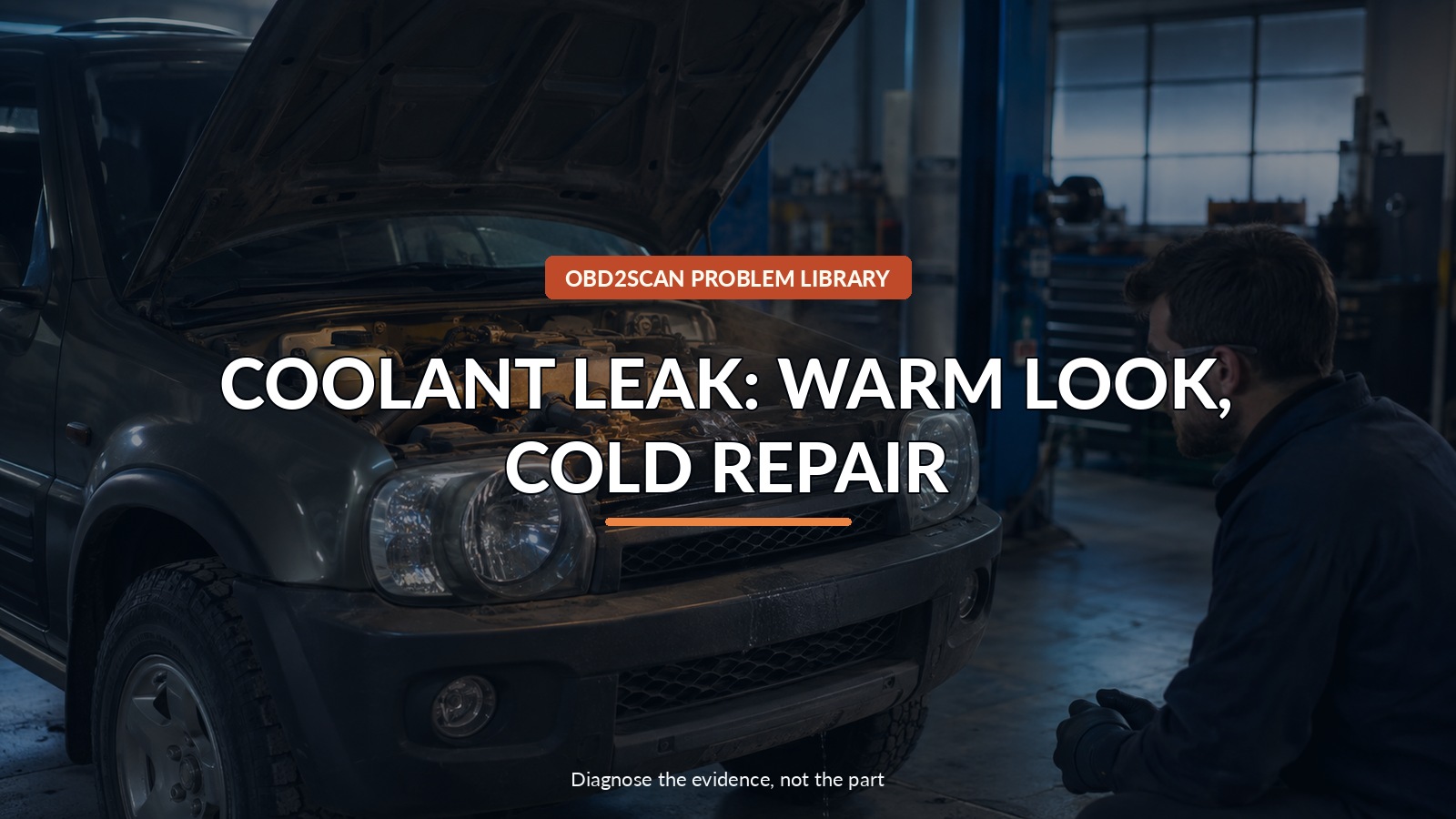
Coolant Leak: Warm Look, Cold Repair
Treat a coolant leak as two different temperature states: the evidence may become visible when the engine is warm, but hands-on work belongs after the system is cold and depressurized. For the tightly scoped Jeep bulletin, a technician warms the engine to verify leakage at the thermostatic valve, then cools the vehicle before gasket service. Never open a hot reservoir to “get a better look.”
Once the system is cool, a pressure-and-vacuum service tool can help answer whether a compatible circuit holds pressure and can be refilled without trapping air. The AUTOOL SC301 fits that supporting role when the correct adapter and Jeep limits are known. It cannot make hot coolant safe, replace the bulletin’s warm location check, prove the gasket is the only leak, or choose the correct coolant chemistry.
Use the warm engine only to locate the symptom; use the cold engine to touch, open, test, and repair. That two-temperature rule preserves evidence without turning a small seep into a burn injury.
Quick answer: Inspect the thermostatic-valve area while evidence is visible, but let the cooling system become safe before opening or pressure-testing it.
In this guide
- Separate the warm inspection from the cold repair
- Confirm that this is not a US-or-Canada bulletin
- Match MDH and engine sales code before the part
- Photograph the first wet point—not the puddle
- Inspect the thermostatic-valve area at the controlled temperature
- Let a dry result close this bulletin branch
- Cool, pressure-check, and refill within specifications
- Verify level and leakage through a full heat cycle
Separate the warm inspection from the cold repair
Hot coolant can remain pressurized even after the engine is switched off. Steam and liquid released from a loosened cap can cause severe burns. If the temperature warning appears, cabin heat suddenly disappears, or coolant is pouring out, stop in a safe place, shut the engine down, and arrange recovery rather than attempting to “top it up and make it home.”
The OEM inspection condition does not weaken that rule. Jeep’s procedure warms the engine so a trained technician can observe the exterior of the thermostatic-valve area without opening the system. Removal, pressure connection, gasket work, and refilling happen only after the vehicle has cooled to the applicable safe-service condition.
Confirm that this is not a US-or-Canada bulletin
TSB 07-002-25 Rev. A lists 2024–2026 Renegade, 2025–2026 Commander, and 2025–2026 Compass vehicles, but it explicitly says the bulletin is not for the United States or Canada. It applies to specified 1.3L engine sales codes and vehicles built from July 1, 2024 through February 2, 2025, subject to VIN/RSU status.
That creates an important boundary:
| Vehicle or finding | Sensible next step |
|---|---|
| US- or Canada-market vehicle | Use current local Jeep service information; do not import this repair automatically |
| Other market, wrong engine or build period | Diagnose the leak normally |
| Correct scope, no verified leak at the thermostatic valve | Close this bulletin branch and inspect other sources |
| Correct scope, verified leak at that valve | Follow the gasket repair and current VIN instructions |
A similar-looking component on a different market vehicle does not prove identical parts, calibration, cooling layout, or campaign eligibility.
Match MDH and engine sales code before the part
The build date is expressed through the vehicle’s manufacturing information and the bulletin’s MDH fence. Renegade lists 1.3L EYF or EYH configurations; Commander and Compass list specified EYF or EYJ configurations. Check the VIN and build record rather than estimating from the registration year.
This step prevents two common mistakes: ordering a gasket for an engine that merely looks similar, and promising a no-cost campaign repair before VIN eligibility is confirmed. A TSB or rapid service update describes a service path. It does not, by itself, prove that an individual vehicle has the condition or that every owner receives the same coverage in every country.
Photograph the first wet point—not the puddle
Coolant travels. Airflow can push it rearward, gravity can carry it to a lower seam, and rotating parts can spray it far from the source. A puddle under the center of the engine therefore tells less than the highest fresh wet point. With the engine cold, note reservoir level, coolant color, odor, dried residue, hose condition, and the path of any fresh trace.
Do not wash the engine before taking an as-found photo. If cleaning is needed to distinguish an old stain from an active leak, document the area first, clean it, then observe again under a controlled condition. Keep pets away from spilled coolant and collect leakage according to local environmental rules.
Inspect the thermostatic-valve area at the controlled temperature
Jeep directs the technician to remove the under-engine protection if fitted, start the vehicle, and bring coolant temperature to 90°C/194°F. The task is to inspect the thermostatic valve and surrounding area for visible leakage. The cap stays closed; the technician watches from a safe position and keeps clear of fans, belts, and hot surfaces.
This is a location gate, not simply proof that the cooling system loses pressure somewhere. A fresh trace at a hose joint, radiator, pump, reservoir, or another housing remains a different repair. If the level is too low to run safely, the vehicle overheats, or the leak rate is heavy, normal safety and diagnosis take priority over recreating the bulletin condition.
Let a dry result close this bulletin branch
The official flow is refreshingly direct: if no leak is found at the thermostatic valve, the active service-action inspection can be closed and the vehicle returns to normal diagnosis. Do not replace the gasket “while we are here” solely because the bulletin exists.
A dry result should still answer the owner’s original complaint. Pressure-test a cooled system to the exact vehicle limit, inspect the cap and all accessible joints, and consider whether leakage occurs only during cooldown, after a drive, or under a particular heater load. Internal leakage, heater-core loss, and combustion-gas intrusion require different evidence. One dry valve is not proof that the whole system is sealed.
Cool, pressure-check, and refill within specifications
When the thermostatic-valve leak is verified, the bulletin removes the valve and replaces its gasket under the current service procedure. Respect cleanliness: debris at a sealing surface can recreate the leak. Replace single-use clamps or fasteners only where the parts information and local repair manual require them.
After the assembly is closed and cool, pressure testing can confirm that the repaired system holds without exceeding its rated limit. Vacuum filling may reduce trapped air when approved, but it does not replace the Jeep bleed sequence or prove coolant circulation. Use the specified coolant; mixing by color is unreliable because different chemistries can look alike.
Verify level and leakage through a full heat cycle
Run the vehicle through a complete controlled warm-up. Confirm stable temperature, normal cabin heat, appropriate fan operation, and no fresh wet trace at the valve. Let the system cool fully and recheck the level at the specified cold mark. Inspect the under-engine protection before reinstalling it so hidden coolant does not drip later and mimic a returning leak.
The useful handoff is concise: exact market and build eligibility, where the leak was visually confirmed, whether the gasket was replaced, the cold pressure-hold result, and the level after cooldown. If coolant drops again, that record gives the next technician a real starting point instead of another bottle of top-up fluid.






Comments 0
Questions, fixes, and real-world diagnostic notes from readers.
Be the first to share a diagnostic result or ask a follow-up question.