
Clicking Noise When Turning? Confirm the Motion Before Blaming a CV Joint

A repeated click-click-click that follows wheel speed during a tight turn under light power is a classic outer-CV-joint clue, but it is not proof. First establish whether the car must be moving, whether throttle makes it louder, which turn direction reproduces it, and whether the sound is rhythmic. Stop driving if the noise becomes a heavy clunk, steering binds, vibration appears, a wheel is loose, grease covers the brake/tire, or a boot/axle is visibly failing.
What to do first
- Inspect the tire and wheel area for contact, loose trim, obvious hardware damage, and grease spray without crawling under an unsupported car.
- Do not hold full steering lock against the stop longer than needed to describe the symptom.
- Record left/right turn, forward/reverse, throttle/coast, speed, temperature, and rhythm.
- Use a tow if clicking escalates to clunking, binding, vibration, or visible axle/boot displacement.
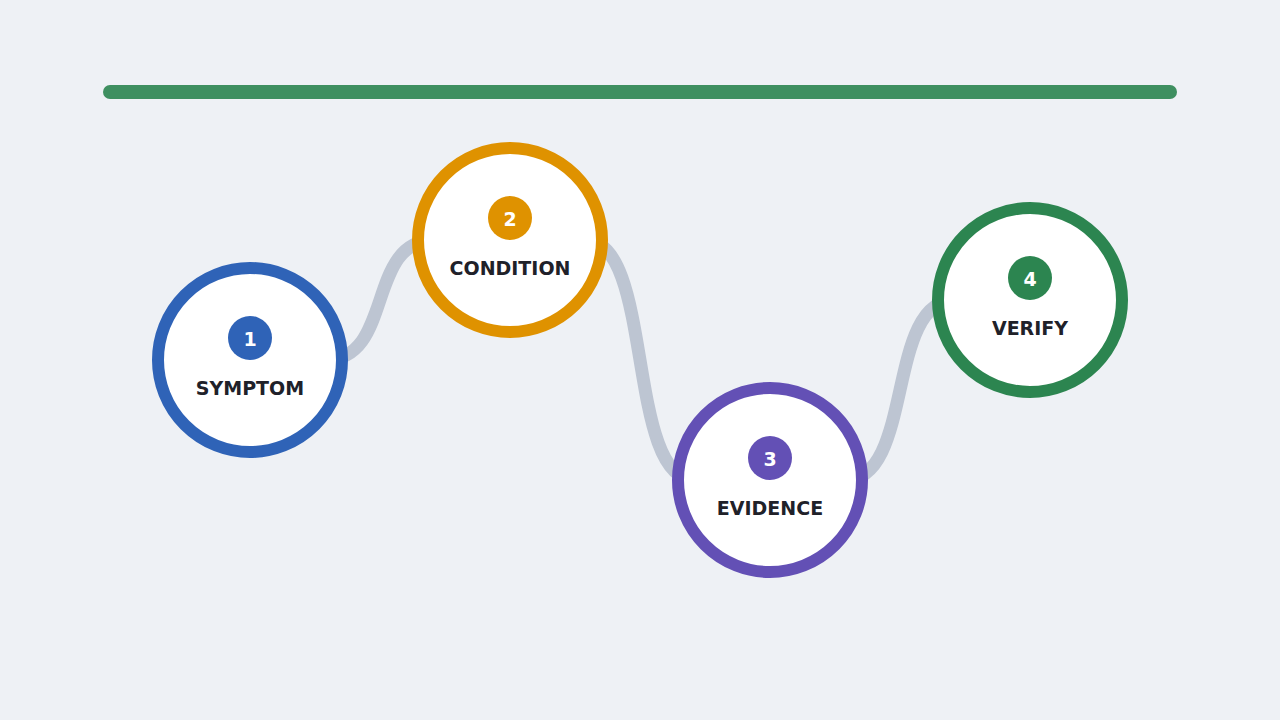
In this guide
1. What the symptom means—and does not prove
Outer CV joints articulate most during steering and transmit torque, so worn tracks can click rhythmically on tight powered turns. Inner joints more often create shudder or vibration under acceleration. But tire contact, brake hardware, wheel fasteners, hub/bearing play, ball joints, tie rods, strut mounts, steering shafts, shields, and model-specific axle conditions can make a click in the same neighborhood.
It does not independently prove
- that the outer CV joint is the source;
- that the noisy side always matches the turn direction;
- that an intact-looking boot means the joint is healthy;
- that a cracked boot always requires a complete axle;
- that stationary steering clicks come from a CV joint;
- that both axles should be replaced;
2. Save the evidence and make only low-risk checks
- moving or stationary;
- left/right and steering angle;
- forward/reverse and throttle/coast;
- click rhythm relative to wheel speed;
- grease pattern, boot condition, recent axle/brake/suspension work;
Preserve this record before resets, repeated starts, part swaps, or fluid additions change the condition. Related background: suspension clunk condition map wheel/tire service checklist.
3. Use the pattern to choose the next test
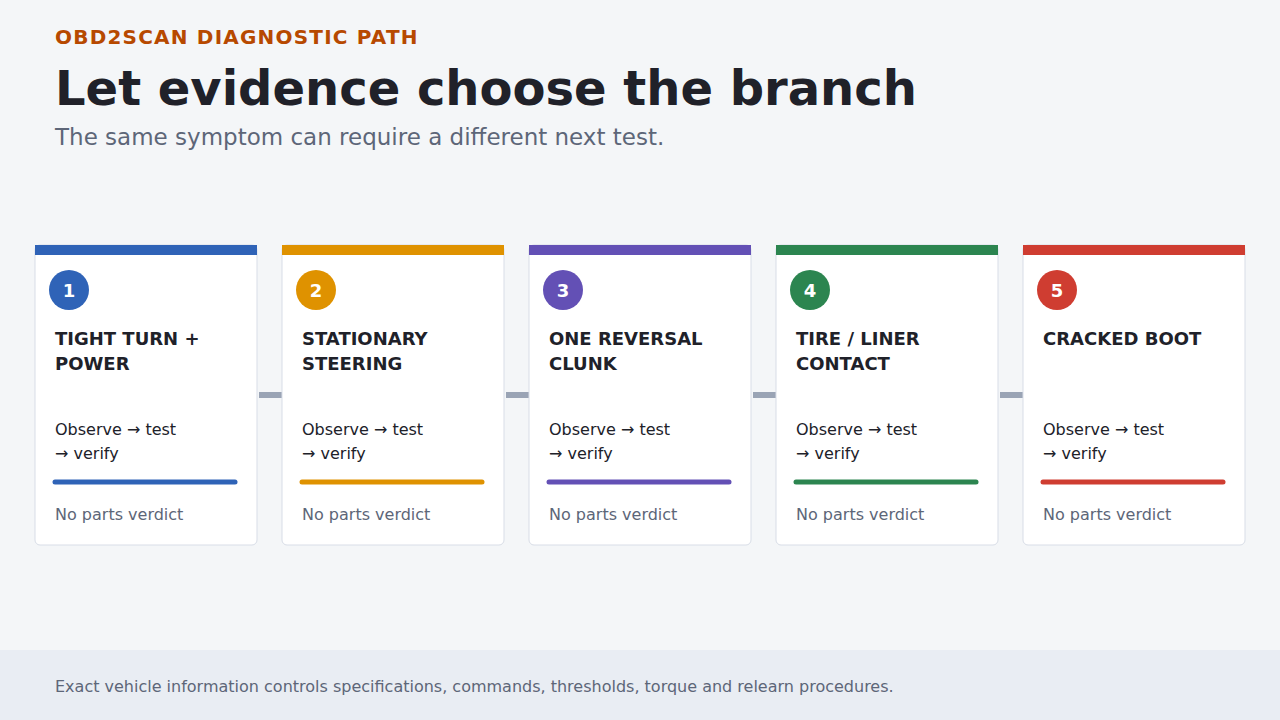
1. Rhythmic click occurs only moving, tight-turn, under power
What the pattern changes: Outer-CV articulation and torque are strongly correlated with the complaint.
Next proof: Inspect boot, grease loss, shaft/joint play and model-specific bulletins, then confirm the side with a controlled test rather than replacing both.
2. The click happens while stationary steering
What the pattern changes: A rotating CV joint is less likely; strut mount, spring seat, tie rod, ball joint, steering shaft/rack, or hose/shield contact moves ahead.
Next proof: Observe component movement safely with the vehicle supported according to service information.
3. The sound is one clunk on load reversal
What the pattern changes: Mount, inner joint spline, axle nut/hub interface, control-arm bushing, differential, or fastener movement is more plausible than repeated outer-joint clicking.
Next proof: Audit torque and movement using current procedures; do not re-torque critical axle/suspension fasteners by a generic value.
4. The tire or liner shows contact marks
What the pattern changes: Wrong tire size/offset, loose liner, suspension damage, ride-height change, or steering-stop issue can create repeating contact.
Next proof: Correct the physical interference and inspect the tire structure before further road testing.
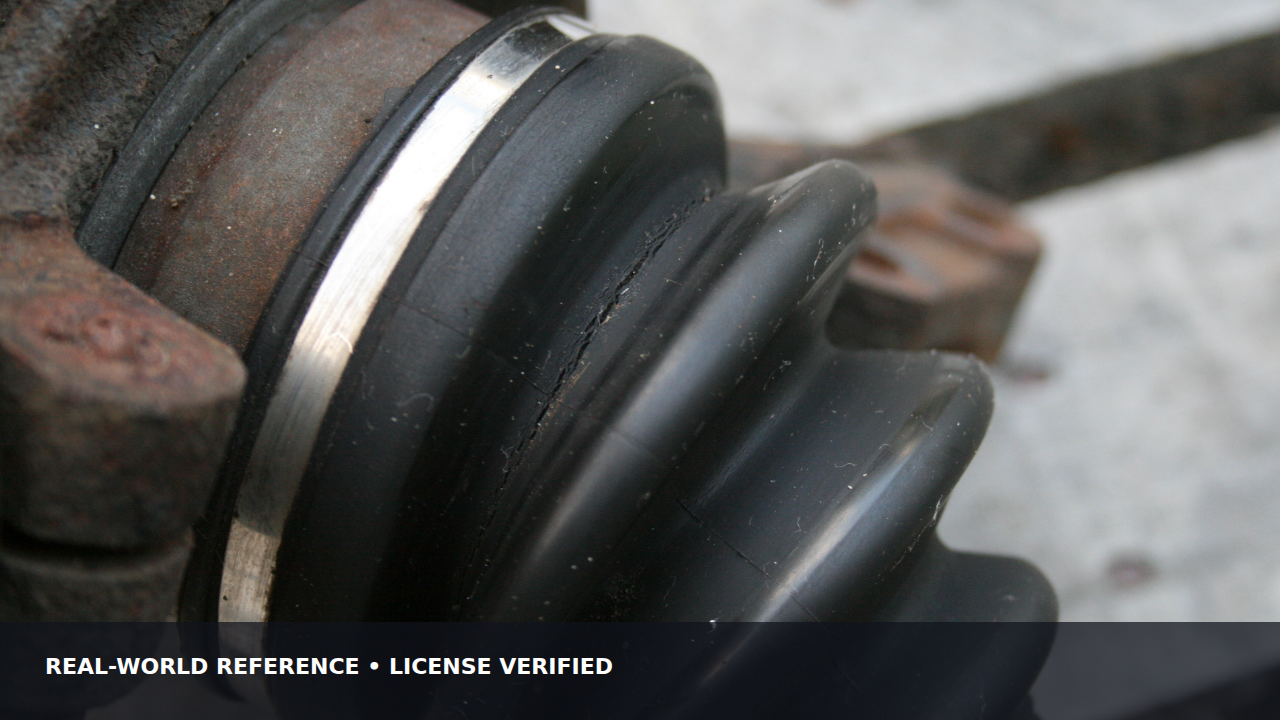
5. A boot is cracked and grease is escaping
What the pattern changes: Loss of sealing allows lubricant out and contamination in, shortening joint life, but joint condition still determines boot-versus-joint repair.
Next proof: Repair promptly and keep grease off friction surfaces; a professional should judge wear, contamination, and application-specific repair options.
Safety boundary
Exact service information controls specifications and invasive procedures. Fuel/refrigerant systems, hot or rotating parts, brake hydraulics, lifted vehicles, high-current circuits, pressure testing, forced commands, and road reproduction belong with trained personnel and the correct equipment.
4. Give the shop a reproducible handoff
- moving/stationary trigger;
- turn direction/angle;
- throttle and wheel-speed rhythm;
- boot/grease/contact evidence;
- side-confirmation, play and torque findings;
Ask for the failed test and the before/after result—not only the name of the installed part. A model-specific bulletin is useful only after VIN, engine, software, code set, and symptom applicability match.
5. Verify the repair under the original condition
Repeat the exact forward/reverse, turn direction, steering angle, speed, and light-throttle condition that produced the click. The noise, binding and vibration should be absent; boots and clamps should remain sealed; critical fasteners should be documented to exact specification; and no grease or contact should reach the tire or brakes.
Official and primary technical references
- Toyota bulletin T-SB-0106-20 Rev1 — Toyota / NHTSA
- Honda bulletin 10-042 — Honda / NHTSA
- GKN driveshaft boot guidance — GKN Automotive
The useful outcome
You should finish with the original condition precisely recorded, the unsafe possibilities controlled, one failed path proven, and a repeat test showing the symptom or warning is genuinely resolved.




Comments 0
Questions, fixes, and real-world diagnostic notes from readers.
Be the first to share a diagnostic result or ask a follow-up question.