
Car A/C Warm at Idle but Cold While Driving? Test Airflow Before Charging

When cabin A/C is warm at idle but becomes colder as the car moves, the change in condenser airflow is the first clue—not proof that the fan is the only fault. Record ambient temperature, vent temperature, idle time, fan behavior, engine temperature, and whether airflow volume or only air temperature changes. Check the heat-rejection path and fan control before anyone adds refrigerant.
What to do first
- Stop using the A/C and address cooling-system safety if the engine temperature rises or a temperature warning appears.
- Keep hands, tools, and clothing away from electric fans; they can start without warning.
- Do not vent refrigerant, open a line, bypass a pressure switch, or add a can without identifying refrigerant and measuring the system.
- Compare the same vents, mode, recirculation setting, ambient condition, and stabilized test time.
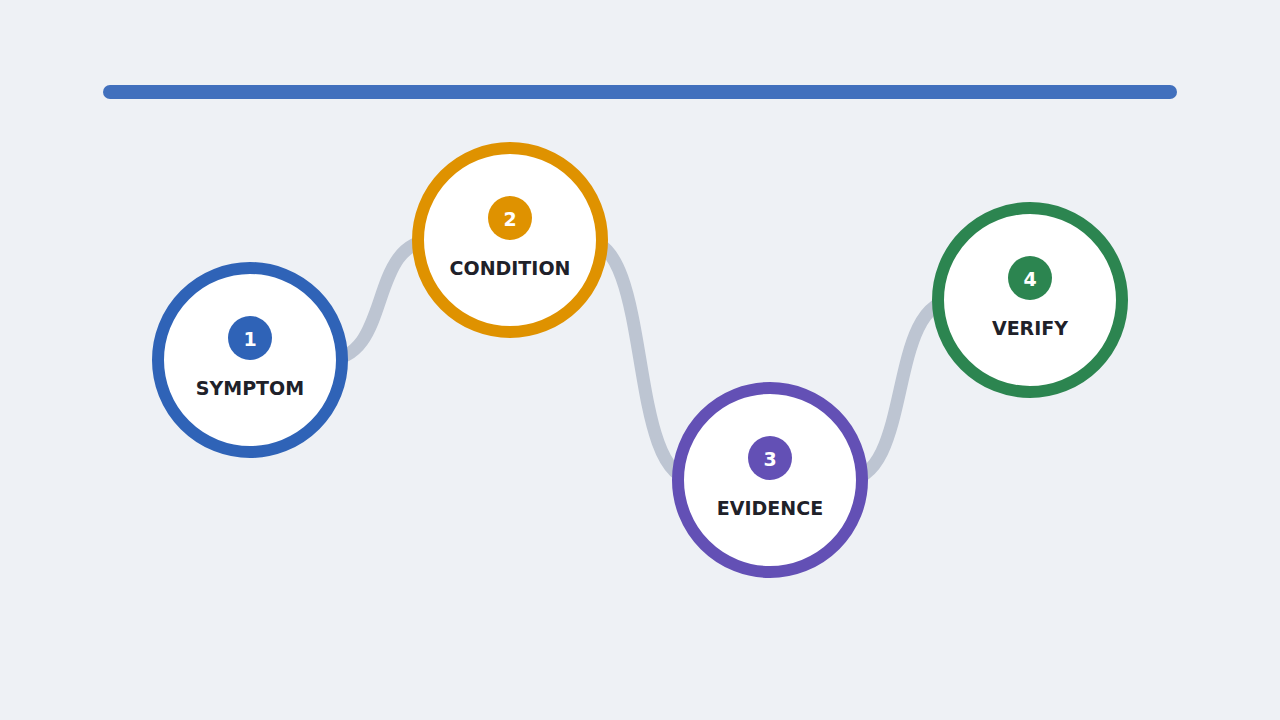
In this guide
1. What the symptom means—and does not prove
Road speed increases air through the condenser even if an electric fan is weak or not commanded. That makes airflow a high-value first branch. However, low or excessive charge, compressor displacement/control, pressure-sensor input, contaminated heat exchangers, air-mix doors, cabin filter restriction, and engine cooling behavior can also change performance between idle and motion.
It does not independently prove
- that the condenser fan is completely inoperative;
- that the system is low on refrigerant;
- that a recharge is routine maintenance;
- that strong blower airflow means the condenser has airflow;
- that cold air during one highway trip proves correct charge;
- that pressure values from another refrigerant or vehicle apply;
2. Save the evidence and make only low-risk checks
- ambient humidity/temperature and sun load;
- vent temperature after the same stabilization time;
- idle versus road behavior and engine temperature;
- blower volume versus air temperature change;
- fan command/speed, recent front-end work, refrigerant service, and leak history;
Preserve this record before resets, repeated starts, part swaps, or fluid additions change the condition. Related background: engine-overheating response engine-bay inspection route.
3. Use the pattern to choose the next test
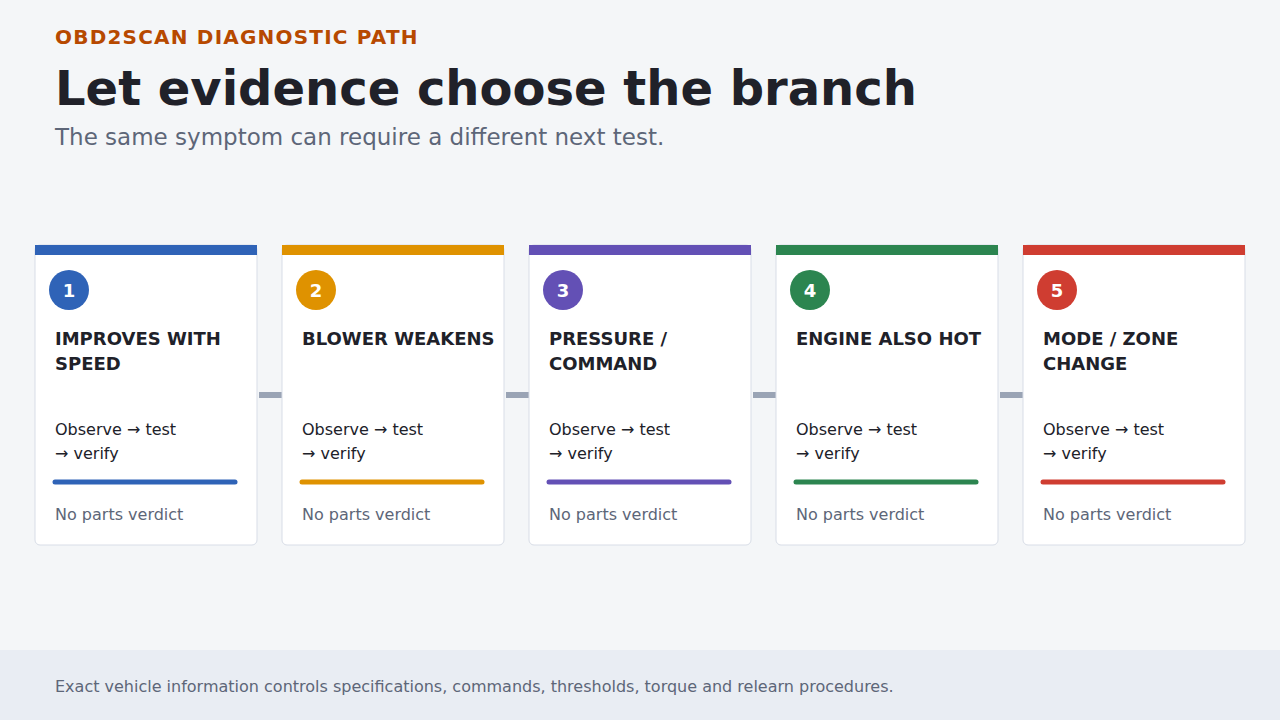
1. Cooling improves promptly with vehicle speed
What the pattern changes: Condenser airflow, fan stage/control, shrouding, debris, or heat-exchanger stacking moves to the front of the test order.
Next proof: Compare commanded and actual fan speed and inspect condenser/radiator airflow with the vehicle stationary and safely secured.
2. Blower airflow becomes weak, not merely warmer
What the pattern changes: Cabin filter restriction, evaporator icing, blower control, recirculation door, or duct/mode operation is more relevant than condenser airflow alone.
Next proof: Record airflow recovery after shutdown and inspect the cabin-side path before refrigerant conclusions.
3. Pressures or compressor command are abnormal at idle
What the pattern changes: Charge quantity, refrigerant identity, compressor control valve/clutch, pressure sensor, or excessive condenser temperature may be controlling output. When airflow has been checked and refrigerant-side measurements are justified, the MRCARTOOL L505 digital refrigeration gauges can compare high- and low-side pressure behavior at idle and raised speed before the system is charged or a compressor is condemned.
Next proof: Recover, identify, weigh, leak-test, and charge only with certified equipment and exact specifications.
4. The engine also runs hot at idle
What the pattern changes: The A/C symptom may share a fan, airflow, belt, or cooling-control problem with the engine.
Next proof: Prioritize engine-temperature safety and diagnose the full cooling/airflow system before continuing A/C performance tests.
5. Temperature changes with mode or left/right zone
What the pattern changes: Blend-door, actuator, heater-valve, sensor, or HVAC calibration evidence moves ahead of charge quantity.
Next proof: Use actuator commands and outlet-temperature comparisons for the exact HVAC configuration.
Safety boundary
Exact service information controls specifications and invasive procedures. Fuel/refrigerant systems, hot or rotating parts, brake hydraulics, lifted vehicles, high-current circuits, pressure testing, forced commands, and road reproduction belong with trained personnel and the correct equipment.
4. Give the shop a reproducible handoff
- ambient and stabilized vent temperatures;
- idle/road timing;
- blower volume and mode/zone behavior;
- fan command versus actual;
- refrigerant identity/weight, leak and pressure/control results;
Ask for the failed test and the before/after result—not only the name of the installed part. A model-specific bulletin is useful only after VIN, engine, software, code set, and symptom applicability match.
5. Verify the repair under the original condition
Repeat the same ambient, mode, blower, recirculation, vent, and stabilization procedure at idle and during the original road condition. Vent performance should remain within exact service criteria, fan and compressor commands should match actual operation, engine temperature should stay controlled, and any opened system must pass the prescribed leak and charge verification.
Official and primary technical references
- DENSO: Seven essential steps of an A/C service — DENSO
- DENSO: A/C compressor thermal-load guidance — DENSO
- Ford overtemperature owner guidance — Ford Motor Company
The useful outcome
You should finish with the original condition precisely recorded, the unsafe possibilities controlled, one failed path proven, and a repeat test showing the symptom or warning is genuinely resolved.










Comments 0
Questions, fixes, and real-world diagnostic notes from readers.
Be the first to share a diagnostic result or ask a follow-up question.