
Hyundai N P1326 After a Car Wash or Heavy Rain: Listen Before Clearing

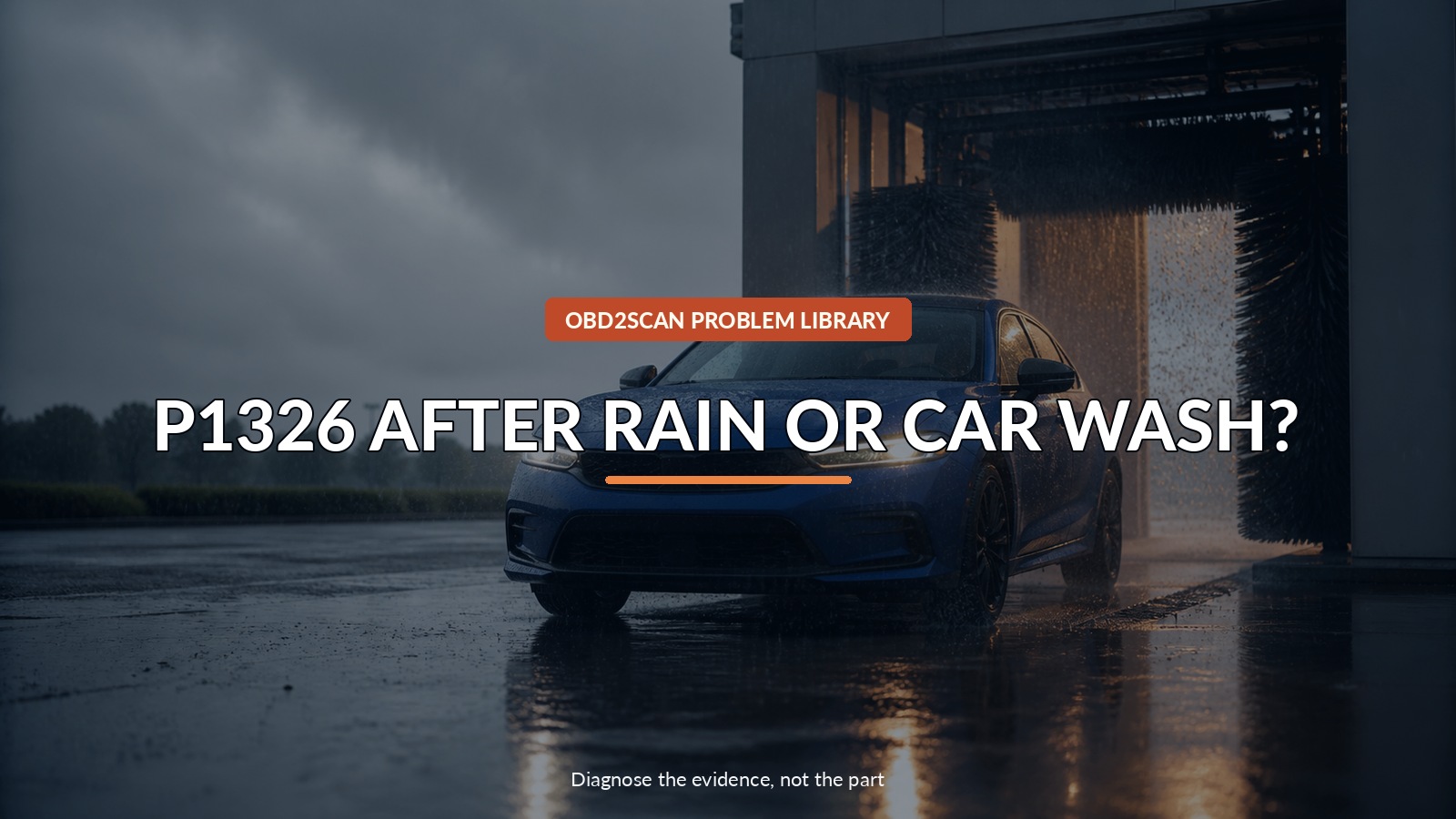
P1326 After Rain Or Car Wash?
A Hyundai N that enters limp-home mode with P1326 after heavy rain or a car wash has two gates, and sound comes first. If there is abnormal knocking, pounding, or other new engine noise, stop the engine and arrange transport. Do not use the water-intrusion bulletin to explain away a possible mechanical failure.
When the engine is quiet and the exact circuit has been identified, a meter/scope can help a qualified technician compare sensor wiring against Hyundai service information. The AUTOOL DM303 automotive multimeter and oscilloscope can support that known-circuit check. It cannot decide whether a noise is bearing damage, make an unknown back-probe safe, or make Hyundai TSB 24-EM-010H apply.
The second gate is a matched wet event: the code follows heavy rain or washing, the vehicle is within the listed N models and years, and connector evidence supports water intrusion. Preserve that event before it dries; clearing P1326 first removes the very context needed to choose the branch.
Quick answer: Abnormal engine noise is the first safety gate; if the engine is quiet, preserve the rain/wash event and exact N-model scope before following the connector branch.
In this guide
Let engine sound open the first gate
Do not rev the engine to “see if the knock clears.” With the car in a safe place, record whether the sound exists at initial start, warm idle, or light load. Note oil level, oil-pressure warning, vibration, smoke, and whether the MIL flashes. A phone recording from a safe position can help a technician compare the complaint.
Hyundai’s bulletin describes the wet-connector condition with no abnormal engine noise present. That negative condition is not fine print—it is the boundary. Noise, metal in oil, very low oil, or severe running should move the case to professional mechanical diagnosis and towing.
Preserve the wet-event evidence
Write the event as a sequence: wash type or rainfall intensity, where water was directed, time until start, time until warning, code, limp-mode behavior, and drying time. Photograph standing water, splash paths, connector-area dampness, and the exact dashboard message.
Save all current, pending, permanent, and history codes plus freeze data. Do not disconnect the battery or clear adaptive memory. If the car returns to normal after drying, that strengthens event correlation but does not prove the connector or eliminate a mechanical risk.
Check the exact N-model fence
TSB 24-EM-010H lists all 2022–2025 Elantra N, all 2022–2023 Kona N, and all 2019–2022 Veloster N vehicles. Confirm the VIN, model—not N Line—and current Hyundai service information. A later model year, different engine, or ordinary trim with P1326 needs its own diagnostic route.
Also check the VIN for campaigns or warranty extensions through Hyundai’s official system. A technical bulletin is not automatically a recall, and an online code match does not guarantee coverage.
Read P1326 as protection, not a parts label
P1326 is associated with the knock-detection/engine-protection strategy. The code tells you the control system saw a condition it could not accept. It does not by itself distinguish real bearing vibration, connector water, sensor failure, harness interference, or another signal problem.
Use the combination of engine sound, event timing, freeze data, and inspection. Do not clear the code simply to restore power. Limp-home mode exists to reduce risk while the cause is unresolved.
| Gate | Evidence present | Next direction |
|---|---|---|
| Abnormal engine noise | Knock/pound plus P1326 | Stop and evaluate mechanical condition |
| No abnormal noise + recent wet event | Exact model/year and connector moisture clues | TSB water-intrusion path becomes plausible |
| No wet correlation | Quiet engine but unrelated P1326 | Normal Hyundai diagnostic path |
| Drying makes symptom vanish | Intermittent moisture influence possible | Preserve, inspect, and reproduce safely—not proof |
Inspect the connector branch
Hyundai’s bulletin identifies the knock sensor and connector repair path. Access involves components around the engine and intake; let a trained technician follow the current removal, torque, sealing, splice, and post-repair procedure. Do not spray water toward the connector to reproduce the fault.
Before disturbance, inspect for moisture, corrosion, backed-out terminals, damaged seals, harness tension, and earlier repairs. Photograph both sides. Water outside a connector does not prove it crossed the seal, and a dry surface after several days does not disprove an intermittent entry.
Measure a known circuit without adding damage
Use only the exact Hyundai diagram and terminal test method. Check reference, ground, continuity, resistance, or signal as the procedure requires. Back-probe with non-damaging adapters; spread terminals can create the fault you are trying to find.
A clean-looking waveform at idle is a snapshot. Temperature, vibration, wetting, and harness position may change it. Compare before and after repair under safe controlled conditions, while keeping the mechanical-noise gate open.
Give the shop both positive and negative evidence
Provide VIN/model/year, exact code status and freeze data, whether abnormal engine noise was present, oil level and warning state, wash/rain description, time to fault, photographs, drying behavior, and any prior knock-sensor or engine campaign work. State what you did not do—no code clearing, no revving, no artificial wetting.
That negative evidence matters because the TSB depends on what is absent as well as what is present. Ask the dealer to document why the vehicle follows the wet-connector branch or why it does not.
Verify through a dry and wet follow-up
After approved repair, verify a quiet start, normal oil warnings, full power, and no returning P1326 under the required drive cycle. Inspect the connector repair and harness routing. A code clear alone is not a result.
For wet verification, use ordinary environmental exposure or the controlled Hyundai procedure—never pressure-wash an electrical connector. The useful endpoint is no repeat after the type of rain or wash that formerly triggered it, with the engine still quiet and scan data clean.


Comments 0
Questions, fixes, and real-world diagnostic notes from readers.
Be the first to share a diagnostic result or ask a follow-up question.