
Subaru Legacy P0304 After an Engine Swap: Prove the Leak Before Swapping Parts

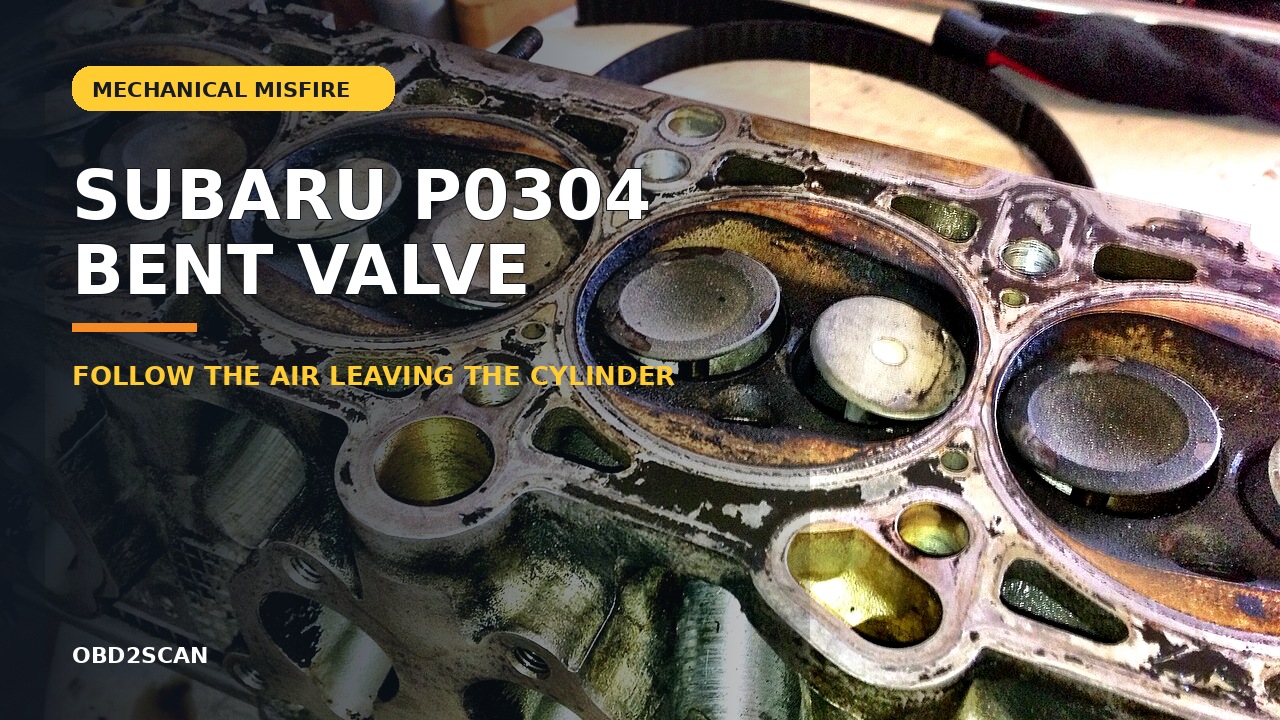
Bottom line: A cylinder-four misfire diagnosis that moves from ineffective ignition and fuel swaps to leak-down evidence and a subtly bent exhaust valve.
In this case
- Case at a glance
- The answer: cylinder 4 could not seal its exhaust valve
- Use swaps to classify the fault, not to create a parts pile
- Leak-down location matters more than a single percentage
- A valve can look nearly normal and still fail
- Cylinder-head work requires exact repair information
- Verification must prove more than a quiet idle
- The reusable decision
- Minimum record to retain
Case at a glance
| Field | Case detail |
|---|---|
| Vehicle | 2008 Subaru Legacy 2.5 SOHC, about 164,000 miles |
| History | Used engine installed after the original engine developed a knock |
| Complaint | Cylinder 4 misfire and ticking at idle |
| Parts that did not help | Spark plug, coil and injector |
| Decisive test | Leak-down air heard strongly at the exhaust |
| Repair | Cylinder head replacement after a bent exhaust valve was found |
| Verification | Smooth idle and successful road test |
The answer: cylinder 4 could not seal its exhaust valve
The plug, coil and injector were not the cause of the persistent P0304. Cylinder 4 leaked heavily into the exhaust during a leak-down test. Removing the head revealed an exhaust valve that was only slightly out of line but could not seat. Replacing the cylinder head restored a smooth idle and normal road operation.
This result explains why the misfire softened with speed and load yet returned at idle. More airflow and rotational momentum can mask one weak combustion event; they do not make the cylinder mechanically sound.
Evidence boundary: The numeric values in this article belong to the documented vehicle unless an official applicability statement says otherwise.
Use swaps to classify the fault, not to create a parts pile
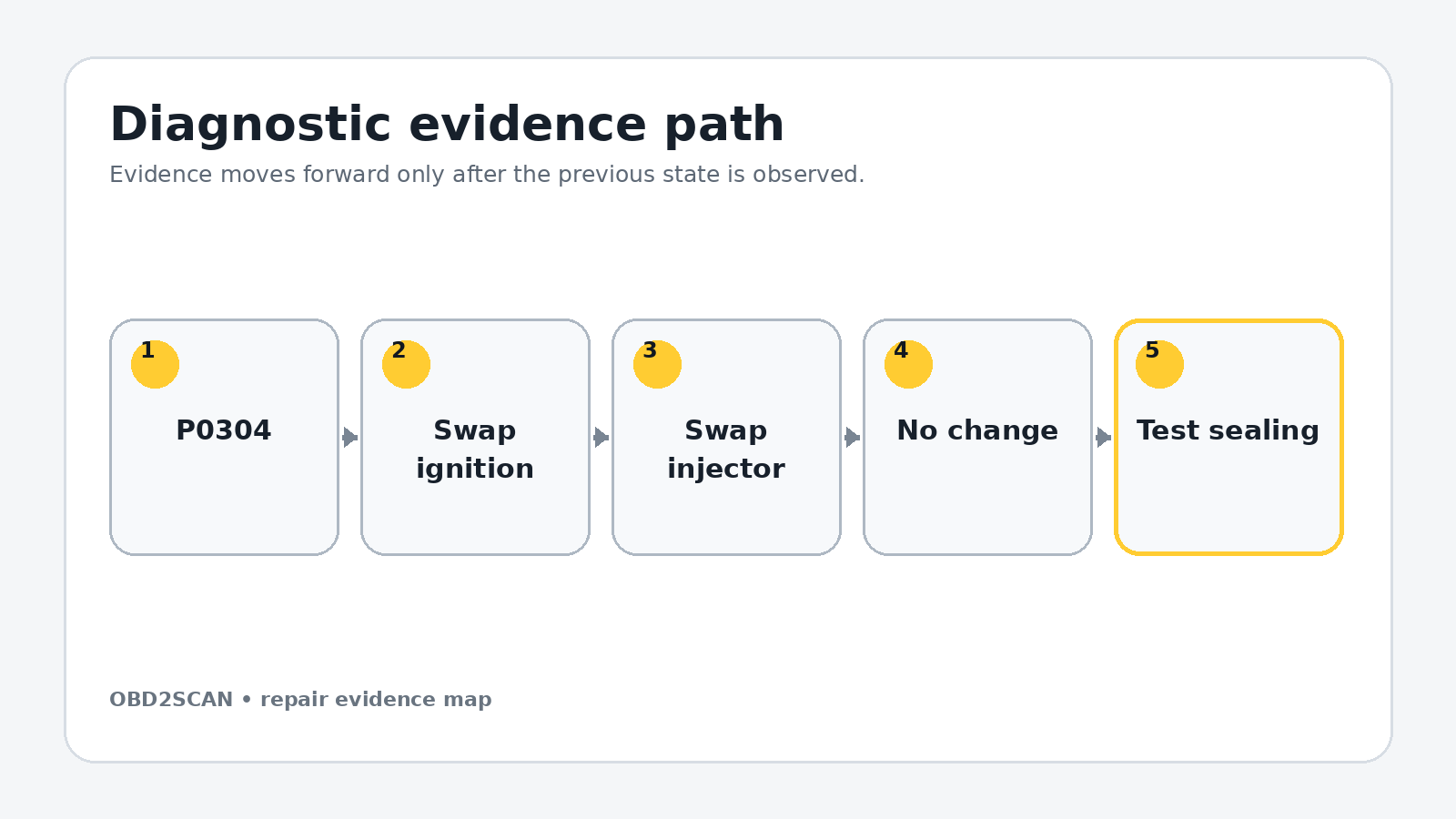
Moving a known-good coil, plug or injector can be an efficient isolation test when cylinder access and part identity are controlled. In this case, those substitutions produced no meaningful change. Repeating them would only confirm the same negative result.
The misfire-pattern workflow treats ignition, fuel, air and mechanical integrity as separate branches. Once two branches fail to move the symptom, test the remaining branch directly.
Leak-down location matters more than a single percentage
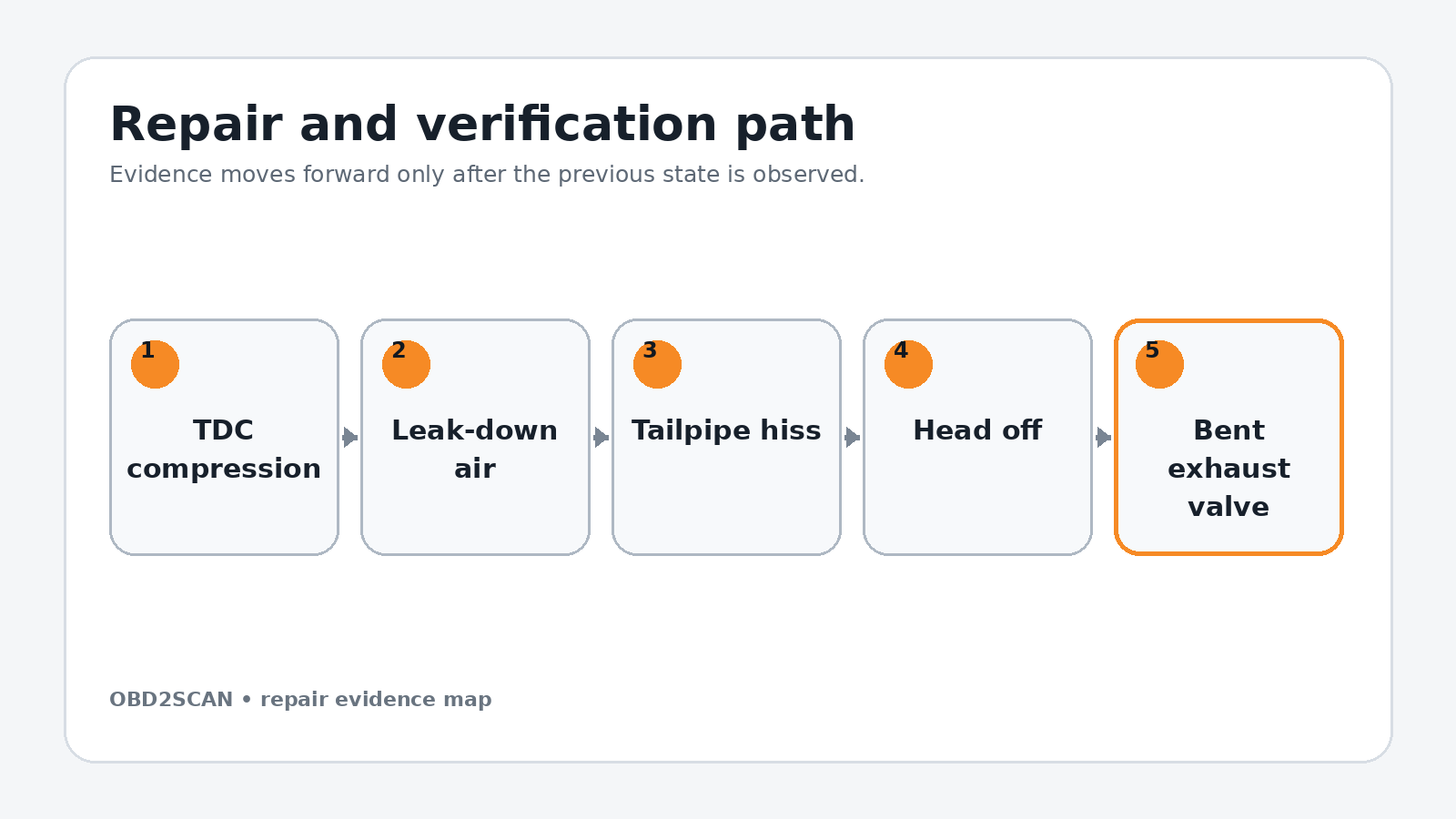
Bring the suspect cylinder to top dead center on its compression stroke and secure the crankshaft with the approved method. Air at the throttle points toward an intake valve; air at the tailpipe points toward an exhaust valve; air at the crankcase points toward rings or piston damage; bubbles in coolant raise a sealing concern across the head gasket or casting.
Cylinder 4 produced strong exhaust-path leakage. That location evidence was decisive even before the exact bent valve became visible. Compare with a known-good cylinder at the same regulated pressure and control crank position carefully.
Safety boundary: Use current vehicle-specific service information, approved support and the correct test load before opening a circuit or assembly.
A valve can look nearly normal and still fail
The guide position did not immediately look catastrophic, and the valve face did not advertise a dramatic bend from above. Once the head was removed and the valves could be compared, one exhaust valve sat at a subtle angle. A tiny runout at the stem becomes a large sealing gap at the seat.
Spark-plug appearance can support the record, but use the cylinder-comparison guide without treating color as a verdict. The pressurized leak path was stronger evidence than appearance.
Cylinder-head work requires exact repair information
Timing alignment, cam handling, tightening order, torque-angle stages, gasket selection and one-time-use fasteners are engine-code specific. Use the current service procedure and replace hardware where specified. Do not rotate the engine with a starter bump while a hand tool is attached, and do not substitute remembered head-bolt habits for published instructions.
Protect open cylinders and oil passages, inspect the replacement head for flatness and sealing, and correct the original reason the donor engine arrived with a bent valve before assembly.
Safety boundary: Use current vehicle-specific service information, approved support and the correct test load before opening a circuit or assembly.
Verification must prove more than a quiet idle
After assembly, confirm oil and coolant levels, establish oil pressure, clear only documented faults, and watch misfire counters from cold start through hot idle. Check fuel trims, coolant stability and leaks. A road test should include the operating range that previously masked the fault and the idle state that exposed it.
The smooth idle and successful road test closed this case. A follow-up compression or running relative-compression capture would make the permanent record even stronger.
Verification boundary: A cleared code is not a result by itself. Repeat the original operating condition and retain the measured before-and-after evidence.
The reusable decision
If a cylinder-specific misfire stays on the same hole after controlled ignition and fuel tests, stop buying those parts. Measure compression, then localize loss with leak-down. Let the escaping air choose the next disassembly.
Mechanical defects often become expensive because they are tested last. Here, one careful pressure test would have prevented every repeated coil, plug and injector guess.
Minimum record to retain
Keep the initial scan before clearing anything, the exact ambient and operating condition that reproduces the complaint, and one labeled result for every branch tested. Save photographs or waveforms at their original resolution and identify the measurement point, scale, engine state and tool setup. A future technician should be able to distinguish a direct observation from an inference without reconstructing the whole visit from invoices. Retain exact vehicle identification with every saved measurement.
- Plug, coil and injector replacement did not change P0304.
- Leak-down at compression TDC sent air out the exhaust.
- One exhaust valve was subtly tilted and failed to seal.
- Cylinder-head replacement restored a smooth idle and road operation.
This case includes a repair result, but the same-condition retest is still the reason the result is credible. Record what changed, what did not change, and which test was repeated after the work. Also retain any programming, adaptation or calibration report and a final whole-vehicle scan. If the symptom is intermittent, define a monitoring window instead of treating one successful start or one short drive as permanent proof.





Comments 0
Questions, fixes, and real-world diagnostic notes from readers.
Be the first to share a diagnostic result or ask a follow-up question.