
2019 Silverado No-Crank in Park: Why “P” on the Dash Wasn’t Enough

Bottom line: A no-code Silverado diagnosis that uses the Neutral-start comparison and a redundant park/neutral signal to isolate the internal range switch.
In this case
- Case at a glance
- The answer: one valid Park message did not prove start permission
- Use Neutral as a controlled A/B test
- Read crank request and range data, then look for disagreement
- Prove the redundant circuit before condemning the switch
- What this evidence lets you stop replacing
- Repair boundary: diagnosis was complete; repair verification was not
- What to do next on a similar truck
- Minimum record to retain
Case at a glance
| Field | Case detail |
|---|---|
| Vehicle | 2019 Chevrolet Silverado Z71, about 34,000 miles |
| Complaint | No crank in Park; starts normally in Neutral |
| Scan result | No useful DTC; displayed range still showed Park |
| Decisive test | Redundant park/neutral ground present in Neutral but absent in Park |
| Outcome | Internal transmission mode/range switch diagnosed; repair not documented |
The answer: one valid Park message did not prove start permission
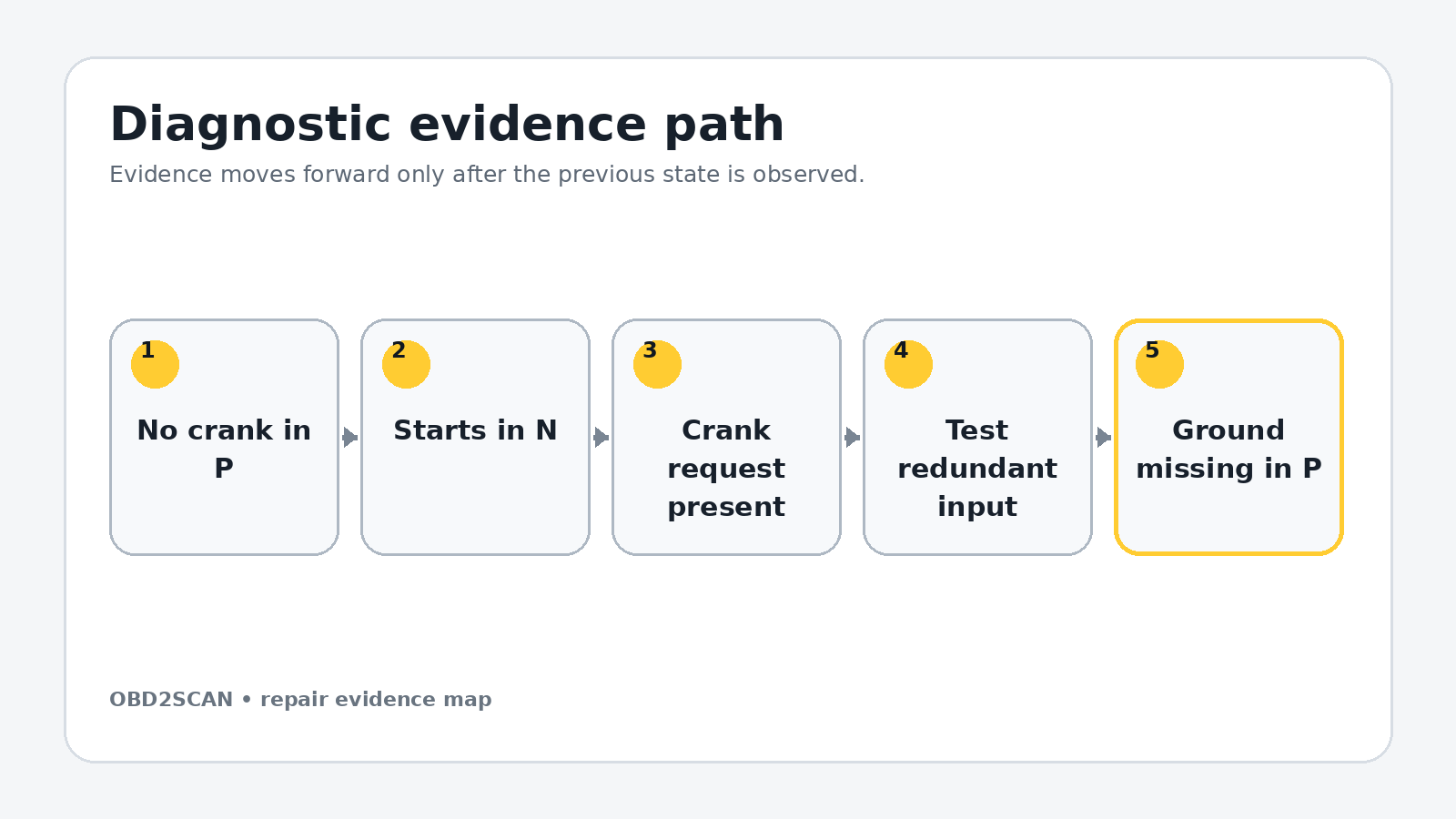
The truck was not refusing to crank because the starter, battery, or crank relay failed. It cranked normally as soon as the selector moved to Neutral. The failed item was the internal transmission mode/range switch path that supplies a separate park/neutral permission signal. Park appeared correctly on the instrument cluster and in ordinary scan data, yet the redundant circuit needed by the start strategy was missing in Park.
That distinction matters because a modern truck can publish several versions of what looks like the same gear-position fact. One module can display P while another required input remains open. A scan screen that says Park is evidence, not proof that every start interlock agrees.
Evidence boundary: The numeric values in this article belong to the documented vehicle unless an official applicability statement says otherwise.
Use Neutral as a controlled A/B test
A vehicle that is silent in Park but cranks strongly in Neutral gives away an unusually efficient clue. Battery state, starter motor, heavy cables, engine mechanical freedom and most of the crank-control path do not change between those two attempts. Selector position does. That makes the Park-versus-Neutral comparison more valuable than replacing a battery because the complaint sounds electrical.
Repeat the comparison with the brake applied, wheels secured and the area clear. Record whether the starter is completely silent, whether the dash resets, and whether moving or lightly loading the selector changes the response. Never rock a vehicle or work beneath it as a substitute for proper restraint.
Read crank request and range data, then look for disagreement
The scan tool confirmed that a crank request existed and that the reported range reached Park. No useful fault code appeared. Those findings removed two easy explanations—an absent start request and an obviously wrong displayed range—but they did not close the diagnosis.
This is where a good evidence-led scan workflow moves from code reading to circuit logic. Locate the exact start-enable inputs in vehicle-specific wiring information. On this truck, the useful circuit was a redundant park/neutral ground not exposed as an ordinary data parameter.
Prove the redundant circuit before condemning the switch
Back-probing the relevant signal with an appropriate low-current test method showed a clean state change in Neutral and no ground in Park. Because powertrain state, crank request, and the rest of the start path were already demonstrated, that missing Park ground isolated the fault inside the transmission range/mode-switch assembly or its immediate connection.
Do not apply a generic test light to an unknown module circuit. Confirm terminal identity, expected logic level and allowable test load in current service information. Check connector tension, contamination and harness continuity before turning a local signal failure into a parts order.
Safety boundary: Use current vehicle-specific service information, approved support and the correct test load before opening a circuit or assembly.
What this evidence lets you stop replacing
A battery can still be weak on another Silverado, but it cannot explain a strong, repeatable Neutral start while every Park attempt remains silent. A starter can still be intermittent, but selector-dependent success points elsewhere first. The same logic protects the relay, ignition switch and control modules from guesswork.
If the neutral start is slow or the dash collapses, return to voltage-drop and capacity testing. The battery test without overreading voltage is the right branch when the starter performance changes, not when the selector alone determines permission.
Repair boundary: diagnosis was complete; repair verification was not
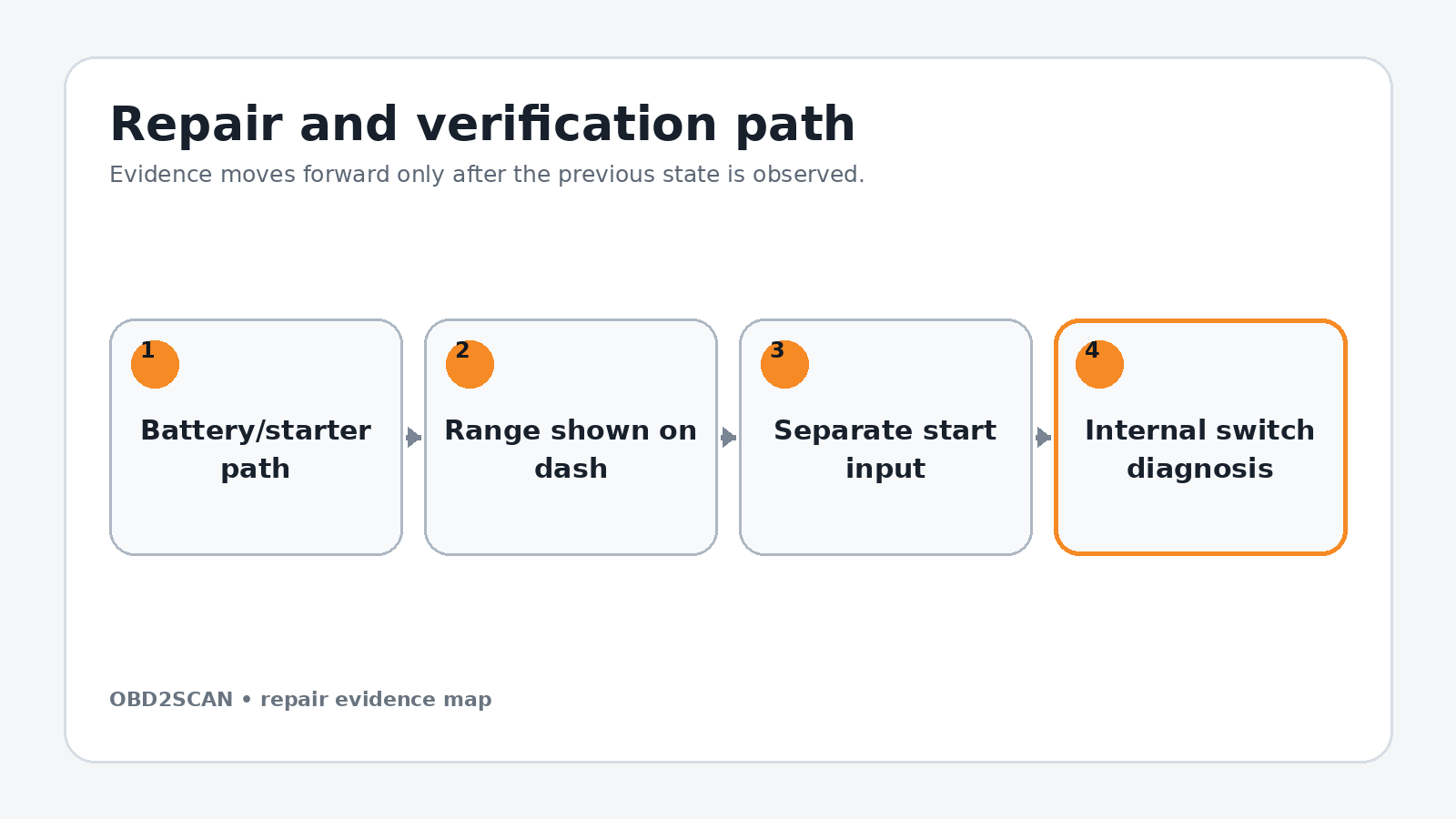
The evidence supports an internal range-switch diagnosis, but the switch replacement and final verification were not captured. That means this is not a “fixed by replacement” claim. Transmission-internal access, adjustment, fluid handling and relearn requirements depend on the exact build and service procedure.
A complete repair record should add cold and hot starts in Park and Neutral, live range transitions through every position, a fresh network scan, leak inspection and confirmation that reverse lamps and shift interlocks behave correctly.
Verification boundary: A cleared code is not a result by itself. Repeat the original operating condition and retain the measured before-and-after evidence.
What to do next on a similar truck
First, reproduce the complaint safely in Park and Neutral. Second, capture crank request, range status and relevant start-permission data. Third, test the exact redundant input at the accessible connector with service information in front of you. Replace or open the transmission assembly only after the local circuit is proven.
The useful conclusion is simple: a letter on the dash is one witness. The start-enable circuit is another. When they disagree, test the witness that actually controls the crank decision.
Minimum record to retain
Keep the initial scan before clearing anything, the exact ambient and operating condition that reproduces the complaint, and one labeled result for every branch tested. Save photographs or waveforms at their original resolution and identify the measurement point, scale, engine state and tool setup. A future technician should be able to distinguish a direct observation from an inference without reconstructing the whole visit from invoices. Retain exact vehicle identification with every saved measurement.
- The truck started in Neutral but would not crank in Park.
- The cluster and scan data both displayed Park and there were no useful DTCs.
- The redundant park/neutral ground was present in Neutral and missing in Park.
- No completed switch replacement or post-repair start test was shown.
This case stops at a proven diagnosis, so the missing repair and post-repair tests must remain explicit. Record what changed, what did not change, and which test was repeated after the work. Also retain any programming, adaptation or calibration report and a final whole-vehicle scan. If the symptom is intermittent, define a monitoring window instead of treating one successful start or one short drive as permanent proof.




Comments 0
Questions, fixes, and real-world diagnostic notes from readers.
Be the first to share a diagnostic result or ask a follow-up question.