
2023–2024 Ducati Diavel V4 P1074 or P0476? Check the Cable Before the Motor

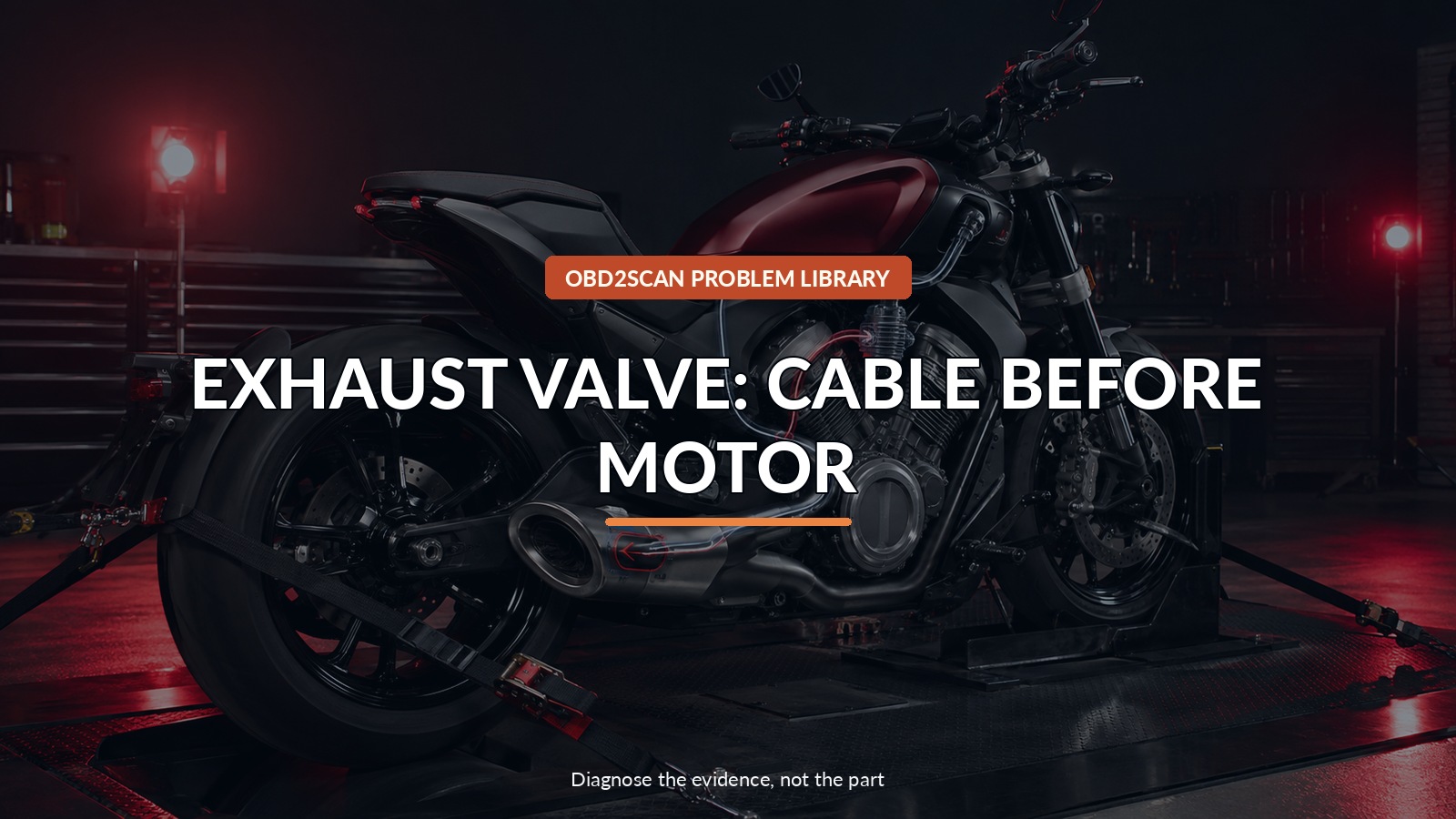
Exhaust Valve: Cable Before Motor
On a 2023–2024 Diavel V4, P1074 or P0476 can illuminate the MIL, freeze the exhaust butterfly at the position where the fault occurred, and—depending on ECU software—limit torque until the next key-off. Ducati’s instruction is unusually direct: do not replace the exhaust-butterfly motor. The dealer path begins with the updated Bowden cable, then a global scan, two deliberate key cycles, and DDS3.0 calibration.
A Ducati-compatible interface can preserve supported faults and available data before the mechanical state changes. The FXTUL M4-DUC motorcycle diagnostic tool is one possible early record. It cannot perform or guarantee Ducati’s DDS3.0 exhaust-valve calibration, establish cable production status, prove motor health, replace the Bowden cable, or override the Youtech process.
Think of motion traveling through a chain: control command, motor, cable, valve. Diagnosis follows that chain forward; calibration closes the loop on the way back.
Quick answer: With P1074 or P0476 present, keep the motor out of the first parts order; follow Ducati’s cable, global-scan, two-key-cycle, and DDS3.0 calibration loop.
In this guide
- Read the two codes as a motion complaint
- Protect the pre-repair global scan
- Keep the motor out of the first parts order
- Let the Bowden cable carry the mechanical branch
- Use two key cycles as a recognition step
- Reserve final calibration for DDS3.0
- Leave this path when the named codes are absent
- Verify valve motion, MIL state, and torque behavior
Read the two codes as a motion complaint
P1074 is described in the bulletin as exhaust-butterfly calibration with maximum position not found. P0476 describes faulty movement of the exhaust-butterfly motor. Neither translation alone says the motor windings have failed. A cable can prevent commanded movement from reaching the valve and make calibration impossible.
Save code status, occurrence count, freeze frame, software information, torque-limitation behavior, valve position if available, battery voltage, temperature, and whether a key cycle temporarily changes the symptom. Record exhaust noise and visible mechanical behavior without touching hot parts. Do not ride hard with unexpected torque limitation or a binding exhaust mechanism.
Stop riding if torque delivery becomes unpredictable, the motorcycle will not respond normally, or the exhaust mechanism binds; secure the bike and arrange qualified diagnosis.
Protect the pre-repair global scan
Ducati requires a global scan after the cable procedure, but the pre-repair scan is equally valuable. Export all control-unit faults before clearing anything. Photograph cable routing and actuator/valve positions as found, plus any abrasion, melted sheath, sharp bend, loose adjuster, or prior exhaust modification.
Confirm full VIN, 2023–2024 Diavel V4 version, frame number, installed cable identity, software, and latest Tips & Tricks/workshop information. The bulletin notes that the new Bowden cable entered production March 6, 2024 from a stated frame number; production context does not replace VIN and installed-part verification.
Keep the motor out of the first parts order
The bulletin explicitly asks dealers not to replace the exhaust-butterfly motor when the named codes are validated and to open a Youtech request. That instruction protects against replacing the device that generates movement when the transmission of movement—the cable—is the known repair path.
Do not power the motor directly, force the pulley, or erase calibration in an attempt to prove it. Heat, spring force, moving linkages, and incorrect electrical activation create injury and damage risks. Preserve whether the actuator attempts movement and whether the cable/valve follows, but let the dealer procedure control separation tests.
Let the Bowden cable carry the mechanical branch
Only when P1074 and/or P0476 is present does SRV-TTB-24-002 direct replacement of the Bowden cable with the stated updated part, following the workshop manual’s exhaust-system section. Cable removal, routing, adjustment, clearances, exhaust temperature, and fastener requirements make this trained-technician work.
The mechanic should compare old and new routing, retainers, bend radius, end fittings, and free movement. A kinked or high-friction cable can consume motor travel; a valve that binds independently must not be hidden by the cable replacement. Photograph both the as-found route and finished route.
| Link in motion chain | Evidence to preserve | Do not infer |
|---|---|---|
| ECU command | code/freeze frame and requested state | motor failure from code text |
| Motor output | guided actuation and pulley motion | cable health from motor sound |
| Bowden cable | routing, friction, ends, production identity | valve health from new cable alone |
| Butterfly valve | free/commanded travel under procedure | completed calibration from movement |
Use two key cycles as a recognition step
After a clean global scan, Ducati specifies turning the key on and off twice with a five-second pause between cycles. This allows the BBS control unit to recognize the maximum opening position and run its check. Count the pauses; do not rapid-cycle the key or operate controls that alter the sequence.
Maintain correct battery support and follow the exact ignition state in the current bulletin. The two cycles are a recognition event, not the complete calibration and not a universal reset for other Ducati faults.
Reserve final calibration for DDS3.0
The final bulletin step calibrates the exhaust butterfly valve through DDS3.0 in BBS control-unit adjustments. Preserve the calibration result and any failure reason. If calibration will not complete, return to mechanical movement, cable setup, voltage, connection, software, or guided diagnosis rather than repeating it indefinitely.
A third-party scan tool may read or clear supported codes but still lack this exact adjustment, security access, or report format. Clearing the MIL without completing the OEM calibration loop can leave the movement problem unresolved and erase useful evidence.
Leave this path when the named codes are absent
If P1074 and P0476 are absent, do not install a cable merely because exhaust sound or power changed. Other engine, ride-mode, exhaust, sensor, actuator, wiring, software, or mechanical conditions require their own diagnostic path. Similarly, a modified exhaust may change the system and bulletin applicability.
If the cable has already been replaced under the current procedure and the same code returns, save the new freeze frame, calibration report, installed-part identity, and movement video for Youtech. Avoid repeated motor or cable replacement without a new failed evidence gate.
Verify valve motion, MIL state, and torque behavior
After the cable, global scan, two key cycles, and DDS3.0 calibration, inspect routing and clearances cold. Run the guided actuation, confirm full smooth travel and returned position, then perform a post-repair global scan. Check for exhaust leaks or contact introduced by the work.
Only after static checks pass should a qualified rider repeat the original operating condition. The case closes when valve motion and calibration remain valid, P1074/P0476 do not return, the MIL stays off after monitoring, and unexpected torque limitation is absent. A single key cycle that restores torque without calibration is not a completed repair.



Comments 0
Questions, fixes, and real-world diagnostic notes from readers.
Be the first to share a diagnostic result or ask a follow-up question.