
2022 KTM 200 Duke Rough Idle? Check TPS Voltage at Both Ends

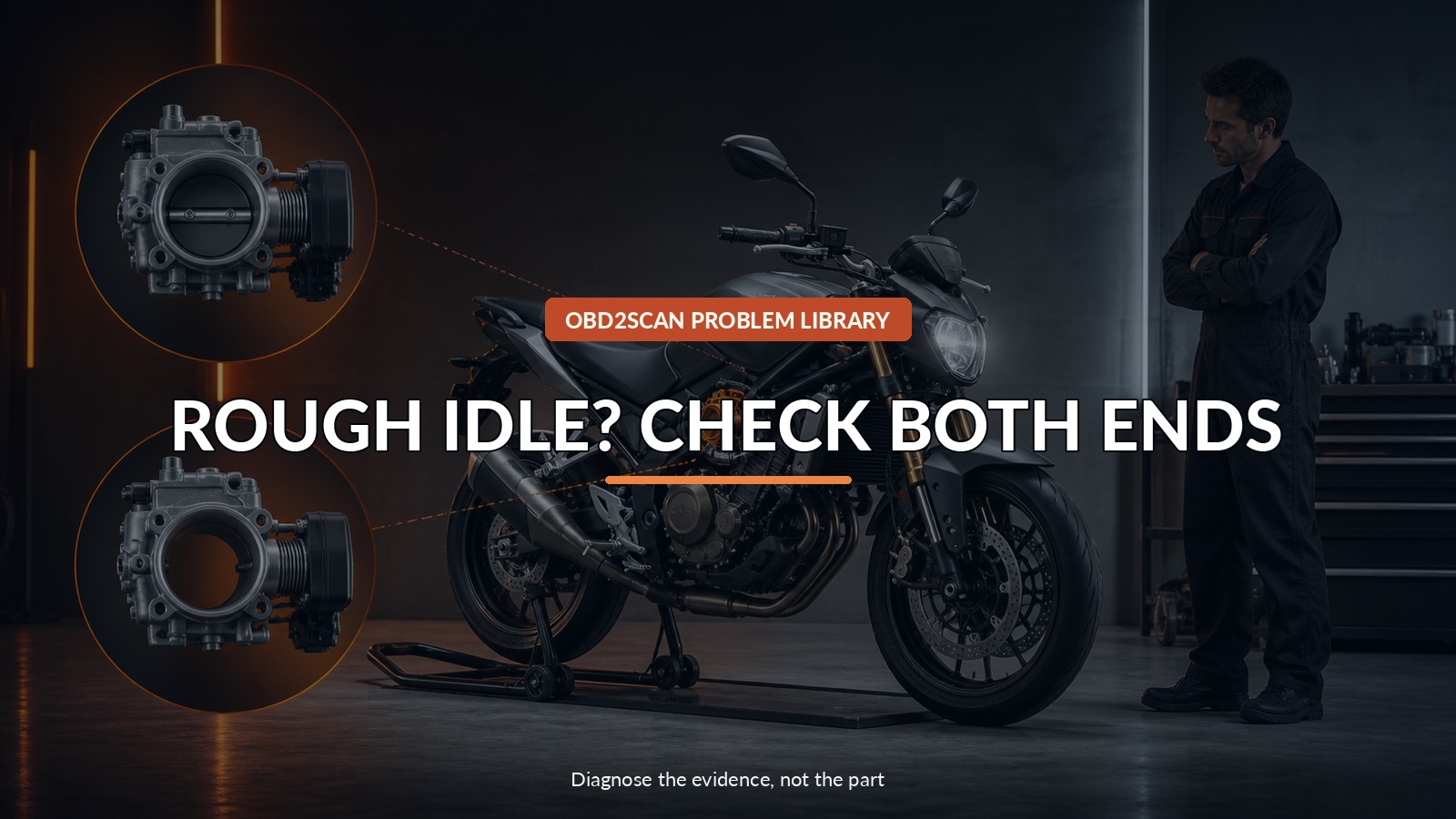
Rough Idle? Check Both Ends
A 2022 KTM 200 Duke that idles roughly or responds erratically to the throttle may fall inside KTB2301, but only if its VIN is linked to the bulletin in KTM Dealer.net. This is not a generic “adjust the TPS” recipe. For an affected motorcycle, KTM’s path is replacement by a trained mechanic, then a diagnostic check of both endpoints—0.3–0.7 V with the throttle closed and 4.2–4.6 V fully open—followed by the required initialization run.
A motorcycle interface may help preserve supported fault memory and live data before the bike is touched. The FXTUL M4-EU motorcycle diagnostic tool lists KTM among its supported brands. It cannot establish KTB2301 eligibility, guarantee the exact TPS parameter or initialization routine on every bike, adjust the sensor physically, or replace KTM’s diagnostic tool and repair manual.
For the rider, the two voltage endpoints are bookends. Everything important—smooth movement, secure hardware, and calibration—must fit between them.
Quick answer: Park the bike, verify KTB2301 VIN status, then let a trained mechanic validate the new TPS at 0.3–0.7 V closed and 4.2–4.6 V open before initialization.
In this guide
- Park the bike when throttle response becomes unpredictable
- Let the VIN open the bulletin
- Preserve the rider’s exact throttle story
- Treat closed and open as two bookends
- Adjust position only inside the KTM procedure
- Run initialization after the hardware state is valid
- Exit the bulletin when VIN or voltage story differs
- Verify idle, response, faults, and return-to-idle
Park the bike when throttle response becomes unpredictable
Do not ride a motorcycle that surges, hangs at rpm, stalls into traffic, or responds unpredictably to throttle. Secure it upright on appropriate stands, select neutral, allow it to cool, and keep hands and tools away from the chain, fan, exhaust, and throttle linkage. Arrange dealer transport if safe control is in doubt.
Before key cycling, record a cold-start video, idle speed/oscillation, stall frequency, throttle opening that triggers the issue, return-to-idle behavior, temperature, fuel age, rain/wash history, modifications, and warning lamps. Save fault codes and available freeze data. Do not clear the record or spray cleaner into the throttle body.
Let the VIN open the bulletin
KTB2301 affects only certain 2022 200 Duke VINs linked in KTM Dealer.net. The bulletin states that dealers should perform the update on affected inventory and contact affected owners. Ask a KTM dealer to check Motorcycle History and repair status using the full VIN.
A 2022 badge is not enough, and a rough idle on an unlisted bike may have a different cause. Check safety campaigns separately. If the VIN is linked, preserve the dealer result; if it is not, use ordinary diagnosis for intake leaks, fuel quality/delivery, ignition, valve clearance, battery voltage, wiring, software, or throttle-body condition.
Preserve the rider’s exact throttle story
Divide the complaint into three states: closed throttle/idle, opening transition, and steady/open throttle. Note whether the problem changes with handlebar position, engine temperature, gear, clutch, vibration, or electrical load. Inspect the throttle cable/free play and obvious connector damage only as the owner’s manual allows.
If diagnostic data is available, record TPS voltage or percentage engine-off at rest, during a slow continuous opening, fully open, and during a slow return. Look for dropouts, jumps, hysteresis, or failure to return. Do not command the bike to run at high rpm on a stand merely to create a graph.
Treat closed and open as two bookends
After the affected-bike TPS replacement is completed under KTM’s mechanical procedure, the motorcycle is connected to the diagnostic tool without needing to start the engine for the voltage check. The specified closed range is 0.3–0.7 V; the fully-open range is 4.2–4.6 V.
| Throttle state | KTB2301 value | What it confirms | What it does not prove |
|---|---|---|---|
| Fully closed | 0.3–0.7 V | Endpoint lies in bulletin range | Smooth signal through travel |
| Fully open | 4.2–4.6 V | Other endpoint lies in range | Correct initialization |
| Slow sweep | Observe continuity | Helps reveal dropouts | Mechanical safety under road load |
| Return to closed | Repeat value | Supports repeatability | VIN campaign completion |
These are bulletin-specific values, not universal TPS targets for other motorcycles.
Adjust position only inside the KTM procedure
KTM directs the technician to loosen the sensor screw connection, rotate the TPS slightly, recheck values, and tighten to specification if an endpoint is outside tolerance. The bulletin also requires new special screws and gives a defined torque. Access involves moving the throttle body and protecting the frame.
This is why the voltage numbers should not become a casual owner adjustment. Damaged screws, pinched seals, misaligned throttle body, incorrect clamp torque, or disturbed cables can create a serious new fault. A qualified mechanic must use the current repair manual and specified tools.
Run initialization after the hardware state is valid
KTB2301 calls for an initialization run after the TPS position and voltage endpoints are correct. This step lets the control system establish the intended relationship after hardware work. The exact menus, prerequisites, battery support, temperature, and completion confirmation come from the KTM diagnostic process.
Do not assume a code clear or key cycle is equivalent. If a third-party interface does not expose the exact supported procedure for this VIN/software, the dealer tool controls. Save the pre-scan, endpoint values, initialization result, and post-scan together.
Exit the bulletin when VIN or voltage story differs
If the VIN is not linked, endpoints and sweep are stable, or symptoms remain after a documented bulletin repair, stop rotating the sensor to chase the complaint. Inspect connector tension, grounds, charging voltage, intake leaks, injector behavior, fuel pressure/quality, ignition, mechanical condition, and ECU software as current KTM diagnosis directs.
Likewise, a value that changes when the harness is moved may indicate wiring or pin fit rather than TPS position. Preserve the exact movement that triggers it. Do not replace several parts at once; the bike’s small evidence trail disappears quickly.
Verify idle, response, faults, and return-to-idle
Begin with static verification: secure mounting, correct clamp/connector routing, no binding, endpoints in range, smooth sweep, repeatable closed return, successful initialization, and a clean scan. Start the engine only when the work area and bike are secure. Compare cold and warm idle without aggressive throttle snaps.
A controlled road test belongs to a qualified rider after all static checks pass. The case closes when the original rough idle/erratic response does not return, throttle closes predictably, faults remain absent, and dealer history records the VIN action when applicable. One smooth blip on a stand is not enough.






Comments 0
Questions, fixes, and real-world diagnostic notes from readers.
Be the first to share a diagnostic result or ask a follow-up question.