
Mercedes Sprinter OM654 Losing Coolant With No Puddle? Inspect the Charge-Air Cooler

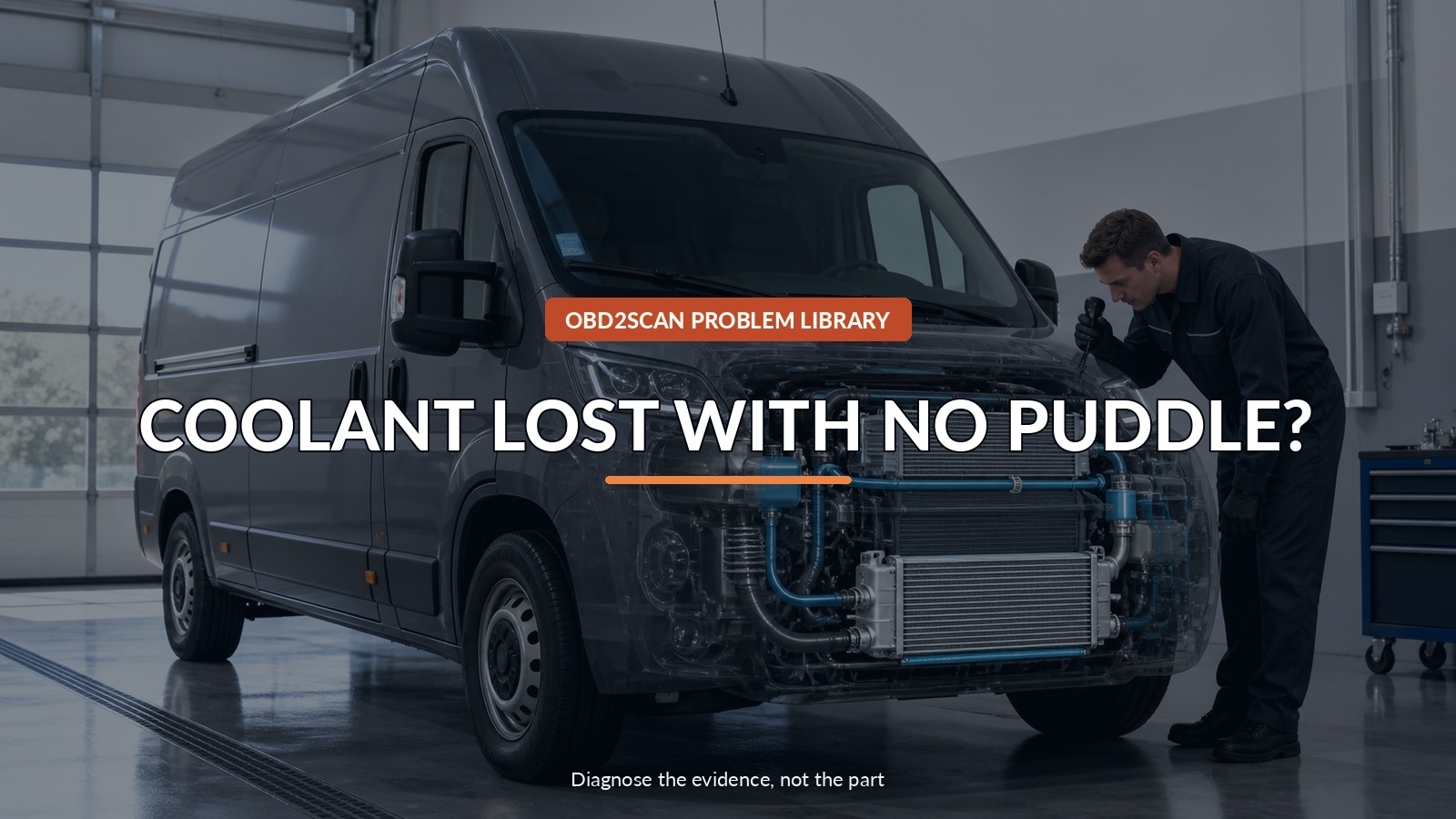
Coolant Lost With No Puddle?
A low-coolant warning with no puddle is not proof that an OM654 Sprinter is burning coolant. Mercedes-Benz LI09.41-N-079165 lays out three branches: another cooling-system leak, an internal leak in the charge-air cooler, or an unapproved coolant-system upfit. The pivot into the cooler is earned only when a cold pressure test loses pressure while the exterior and cabin remain dry.
Once approved access through the throttle valve or downstream charge-air temperature sensor is established, a slim camera can document the inside of the cooler. The MRCARTOOL N220 inspection camera is one option for that hidden view. It cannot pressurize the cooling system, identify a liquid visually, reach every passage, prove engine integrity, or substitute for the manual compression test required if coolant is found.
The key move is directional: exhaust the exterior search, then pivot inward once—not back and forth between guesses.
Quick answer: Pressure-test the cooled OM654 at no more than 1.5 bar; only pressure loss with a dry exterior earns inspection inside the charge-air cooler.
In this guide
- Stop for temperature or severe misfire
- Confirm OM654 and document every upfit
- Pressure-test cold and stay below 1.5 bar
- Search the full exterior before pivoting inward
- Inspect the charge-air cooler through the approved opening
- Protect the engine when coolant is found
- Keep aftermarket coolant circuits as a third branch
- Verify pressure, level, intake cleanliness, and running
Stop for temperature or severe misfire
If temperature rises, the red warning appears, steam escapes, cabin heat disappears, or the engine misfires severely, stop and shut down safely. Do not remove a hot cap or repeatedly start an engine that may be ingesting coolant. Recovery is cheaper than hydrolock, bearing damage, or a scald injury.
After a complete cold soak, photograph reservoir level and record every measured top-up, mileage, trip length, warning timing, exhaust appearance, misfire behavior, and relevant codes. LI09.41-N-079165 mentions P25567B for low coolant and P30040B related to the temperature sensor downstream of the charge-air cooler, but neither code alone proves the cooler leaks.
Confirm OM654 and document every upfit
Verify the VIN, OM654 engine, cooling layout, charge-air-cooler configuration, build data, and latest Mercedes-Benz WIS/TIPS information. Inspect the vehicle history for coolant heaters, auxiliary cabin heaters, camper or fleet conversions, spliced hoses, extra reservoirs, rerouted ducting, and earlier cooler work.
Mercedes treats unapproved coolant-system modification as its own branch because it can change flow, pressure, filling, leakage, or warranty handling. Photograph additions before disconnecting them. A professionally installed upfit is not automatically the cause, but it changes the system that must be evaluated.
Pressure-test cold and stay below 1.5 bar
The document specifies a cooling-system pressure test and warns not to exceed 1.5 bar. Current WIS and the vehicle cap/system specification control the actual setup. Use the approved tester cap and pump, increase pressure gradually on a cold engine, and record start pressure, stabilization, duration, loss, and adapter integrity.
More pressure is not a stronger experiment. Excess can create a leak, damage a component, or force coolant somewhere it would not travel normally. Never substitute regulated shop air. If the gauge falls, first prove the tool, cap adapter, and connection hold.
Search the full exterior before pivoting inward
Mercedes directs a visual check at the top and bottom of the engine compartment and inside the vehicle. Follow hoses, joints, radiator, reservoir/cap, pump area, heater connections, auxiliary/upfit circuits, underbody traces, and cabin evidence. Look for the highest fresh wet point, not merely the lowest stain.
Use a clean ground sheet and consistent light. If a forming bead appears, document and repair that external branch. If pressure holds, reconsider whether the apparent level change involved temperature, trapped air, a previous fill, or a test condition. Only pressure loss with no external sign earns the internal-cooler inspection.
| Pressure behavior | Visual evidence | Next branch |
|---|---|---|
| Stable | Dry | Recheck complaint and fill history |
| Falls | Fresh exterior leak | Repair that source and retest |
| Falls | Exterior and cabin dry | Inspect inside charge-air cooler |
| Variable | Upfit/modification present | Document and follow upfit review path |
Inspect the charge-air cooler through the approved opening
Current WIS determines whether the throttle valve or downstream charge-air temperature sensor is removed for access. The engine must be cool, intake openings protected, connectors released correctly, and contamination prevented. Establish orientation before advancing the camera and avoid scraping the core, sensor seat, or seals.
Record a wide landmark, the dry approach, suspected liquid, and a repeat view. Coolant may be wet or dried on nearby components, but oil mist and condensate can also exist in charge-air plumbing. Color, sheen, or one droplet is not enough; correlate with the pressure test and approved identification method.
Protect the engine when coolant is found
If coolant is confirmed inside the charge-air cooler, stop running the engine. Mercedes requires a manual compression test to confirm the absence of internal engine failures, plus removal and cleaning of coolant from the charge-air system, intake system, and cylinders. The document also calls for cooler/glow-plug replacement and an oil-and-filter change under its professional procedure.
This is not a driveway rinse. Cranking a cylinder containing liquid can cause damage, and incorrect cleaning can move coolant deeper. A technician should preserve plug/glow-plug condition by cylinder, compression results, cooler date code, oil evidence, and photographs before repair.
Keep aftermarket coolant circuits as a third branch
If the cooler interior is dry, return to the modification record. Mercedes’ Body and Equipment Guidelines prohibit certain aftermarket changes to OM654 cooling components, ducting, hoses, and related parts. The document instructs dealers to involve the appropriate field/business-development contact when non-approved changes affect warranty handling.
Do not quietly reconnect an upfit to make the symptom disappear. Map where it takes supply and return, how it is isolated, its pump/valve states, and whether its joints leak. The vehicle owner and upfitter need a shared evidence packet.
Verify pressure, level, intake cleanliness, and running
After the approved repair, restore all seals, clamps, sensors, wiring, charge-air joints, and shields. Fill and bleed with the correct coolant procedure, repeat the same cold pressure test, and inspect both exterior and internal access areas as appropriate. Confirm the intake tract and cylinders are clean and engine oil/service steps are complete.
Then verify a stable fully cold level over representative heat cycles, normal temperature, clean running, no returning misfire, and no relevant codes. A dry floor is only one quadrant of the result; pressure, internal cleanliness, cold level, and combustion behavior must agree.





Comments 0
Questions, fixes, and real-world diagnostic notes from readers.
Be the first to share a diagnostic result or ask a follow-up question.