
2024–2025 Jeep Compass or Meridian A/C Blows Warm? Let the Vacuum Cycle Choose the Branch

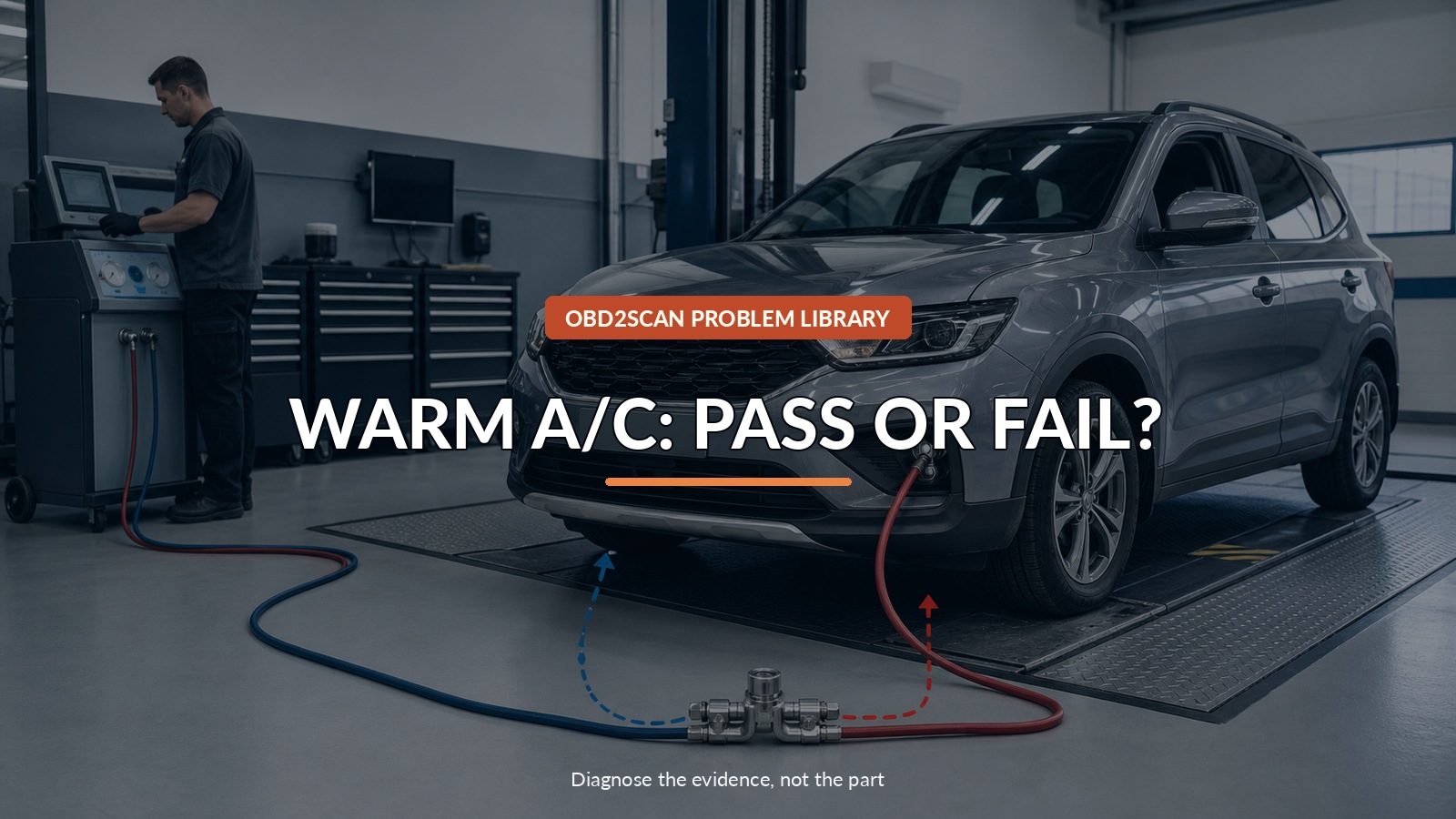
Warm A/C: Pass Or Fail?
Before applying this A/C bulletin to a Jeep Compass, check the market. Stellantis TSB 24-002-25 covers certain 2024–2025 Compass and Meridian vehicles with the 2.0L EBS turbo-diesel in a specified build window, and its market matrix does not include North America. Inside that fence, the decision is deliberately binary: a qualified technician recovers refrigerant and runs the prescribed vacuum cycle; a pass closes this bulletin, while a failure opens its discharge-line replacement branch.
During that controlled service, a compatible digital manifold can preserve pressure, temperature, and vacuum behavior. The AUTOOL LM120 digital manifold gauge is one way to record those states. It cannot recover refrigerant, identify a leak location, prove discharge-line failure from vacuum loss alone, or make an out-of-market VIN eligible.
The value of this article is not a universal A/C shortcut. It is knowing when a strict pass/fail gate applies—and when it does not.
Quick answer: Verify this non-North-America diesel VIN/build fence, recover refrigerant professionally, then let the specified vacuum-cycle pass or fail control the discharge-line branch.
In this guide
- Reject the bulletin before testing if the market is wrong
- Record the cooling complaint as an operating state
- Recover refrigerant before pulling vacuum
- Run the specified vacuum cycle unchanged
- Let pass close this bulletin
- Let fail open only the discharge-line branch
- Keep vacuum loss from becoming a universal leak locator
- Verify charge mass and cabin cooling after repair
Reject the bulletin before testing if the market is wrong
Confirm the VIN, market, model code, 2.0L EBS turbo-diesel, equipment, and build date from April 8, 2024 through March 8, 2025. Check current Stellantis information because campaign and repair status can change. A gasoline Compass, a North American Compass, another model year, or a vehicle outside the build range should not inherit this discharge-line decision.
TSB 24-002-25 also references a Rapid Service Update for applicable VINs. A symptom does not create eligibility. Conversely, a VIN status may require inspection even if the owner describes the problem differently. Keep the administrative VIN gate and the physical leak evidence as separate records.
Record the cooling complaint as an operating state
“Warm” needs test conditions. Record ambient temperature, sun load, humidity, engine speed, requested temperature, blower speed, recirculation state, vent selection, start-up soak, center/side vent temperatures, and how long cooling lasts. Save HVAC and powertrain faults before clearing anything.
Inspect condenser airflow, cabin filter condition, door movement, belt/compressor behavior, frost, oil or dye evidence, impact damage, and service-port caps without releasing refrigerant. If the compressor makes abnormal noise, a line is damaged, or refrigerant identity is uncertain, stop normal operation and move to professional containment.
Recover refrigerant before pulling vacuum
The bulletin first directs recovery with an approved recovery/recycling/charging station. Refrigerant must not be vented. The technician should identify refrigerant from the underhood label and current service data, record recovered mass and oil handling, and check for contamination before connecting a vacuum pump.
U.S. Section 609 rules illustrate why mobile A/C service is trained work; outside the United States, the applicable national and local laws control. A standalone manifold does not recover, recycle, identify, or accurately weigh refrigerant. Never loosen a line simply to “let the pressure out.”
Run the specified vacuum cycle unchanged
Use the recovery station, adapters, and timing specified in current Service Library information. Document starting vacuum, evacuation duration, stabilization period, final result, ambient condition, hose configuration, and any station warning. Verify couplers and service equipment do not leak before blaming the vehicle.
Do not shorten the stabilization time, warm a joint, or repeat with a different hose arrangement until the first result is saved. Vacuum loss can reflect the vehicle, service couplings, hoses, valves, machine, moisture behavior, or procedure. The controlled cycle is a gate because these variables are held as constant as possible.
| Vacuum-cycle result | TSB 24-002-25 direction | What remains unproved |
|---|---|---|
| Pass | Close this bulletin/inspection branch | That every A/C complaint is fixed |
| Fail | Proceed to the named discharge-line branch | Exact leak location from vacuum alone |
| Invalid/equipment leak | Correct setup and repeat | Any vehicle part failure |
| Vehicle outside scope | Use normal diagnosis | That this bulletin’s line is suspect |
Let pass close this bulletin
Stellantis says a passing vacuum testing cycle completes the bulletin. Respect that exit. Do not replace the discharge jumper line “while it is here” or because another similar vehicle needed one. If the cabin still does not cool, continue ordinary diagnosis for charge accuracy, airflow, blend doors, compressor control, sensors, condenser performance, expansion device, or a leak too condition-dependent for this single screen.
Record why the article path ended: valid pass, correct VIN and procedure, yet complaint remains or is resolved. An exit is not a failure of diagnosis; it prevents an unsupported part replacement.
Let fail open only the discharge-line branch
Within the exact fence, a valid failed cycle directs the technician to the A/C discharge-line procedure. Current service information controls line identification, seals, fasteners, oil balance, contamination precautions, recovery, installation, evacuation, and charging.
The bulletin notes that its RSU is specific to this discharge-line leak. If evidence points elsewhere, dealer/warranty authorization may be needed before another part is replaced. Do not use the branch to justify a condenser, evaporator, compressor, or hose that was never localized.
Keep vacuum loss from becoming a universal leak locator
Vacuum answers whether the prepared circuit and service setup held a low-pressure condition for the prescribed test. It does not tell you where gas would escape under operating pressure. A seal can behave differently under vacuum, pressure, temperature, vibration, or shaft motion.
When ordinary diagnosis is required, use the method approved for the refrigerant and suspected area: quantified recovered mass, calibrated electronic detection, approved dye, trace gas, nitrogen where authorized, or close visual inspection. Keep each method’s result separate. Gauge pressure describes system operation; a detector or visible evidence helps locate a source.
Verify charge mass and cabin cooling after repair
After the confirmed repair, evacuate and leak-check again, then charge the exact refrigerant mass with approved equipment. Restore service caps, route lines and harnesses correctly, and check condenser airflow and compressor operation. Repeat the original vent-temperature map under similar ambient, blower, recirculation, and engine-speed conditions.
The release gate combines a valid final leak test, correct charge by mass, stable high/low-side behavior, dry repaired connections, and repeatable cabin cooling. Cold air for five minutes after an unmeasured top-up is not equivalent evidence.








Comments 0
Questions, fixes, and real-world diagnostic notes from readers.
Be the first to share a diagnostic result or ask a follow-up question.