
Honda Prologue Whistles When Heat Turns Cold? Map the Transition Before Charging

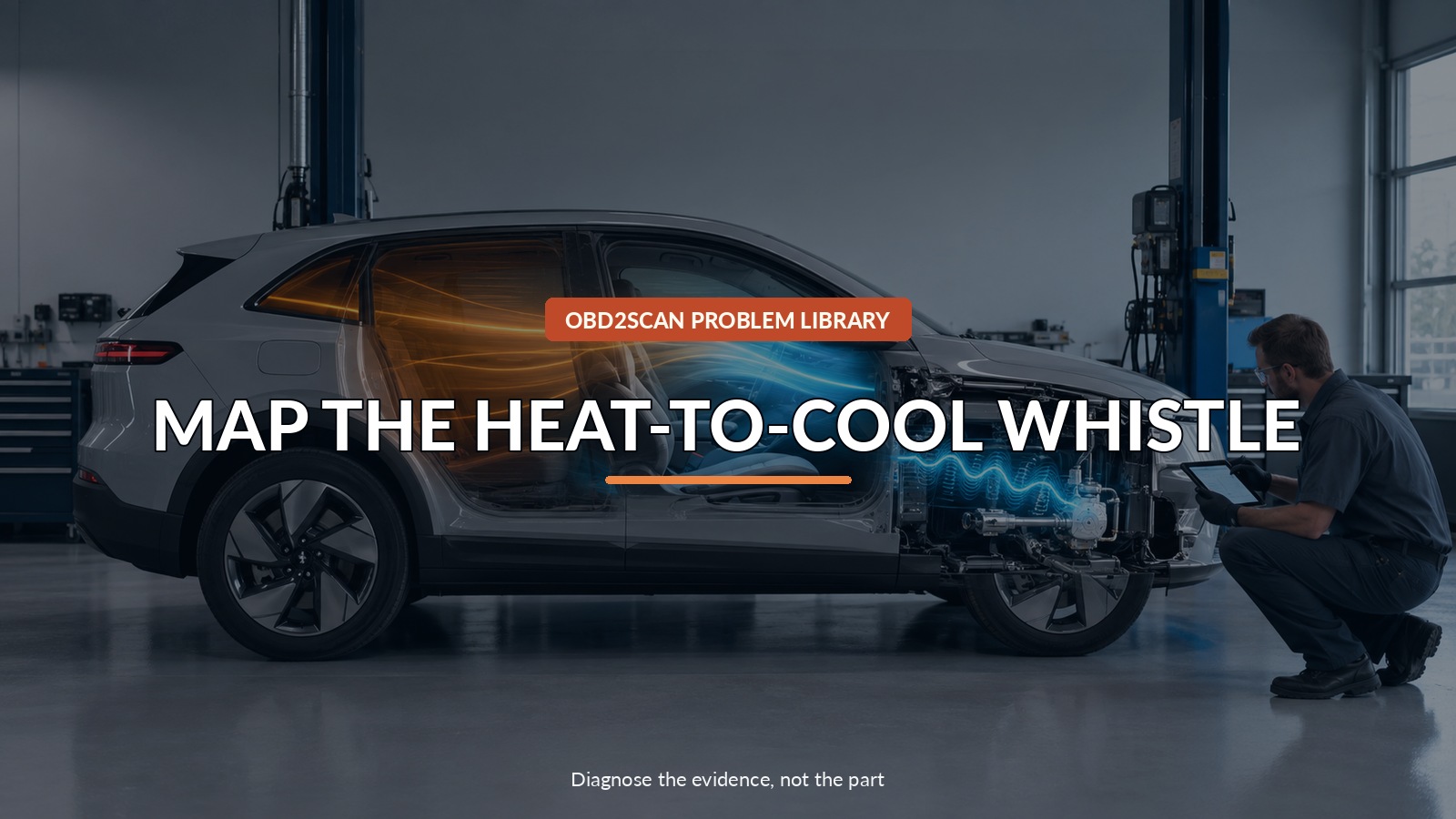
Map The Heat-To-Cool Whistle
Record the exact heat-to-full-cool transition, whistle timing, blower change, vent temperatures, and P0530/P0534 before anyone adds refrigerant; Honda’s repair path requires a qualified R-1234yf/BEV technician to inspect the condenser check valve and the lower A/C line opening. Honda treats the heat-to-cool transition itself as the clue, so preserve that short event instead of judging one later vent reading.
The useful tool category here is a temperature-capable digital manifold used within an R-1234yf service procedure, but only after the safe test point and question are clear. The MRCARTOOL L505 is one practical route for that bounded measurement. L505 can document compatible refrigerant pressures and temperatures when used by a trained technician with the correct adapters and Honda procedure; it cannot recover or recharge R-1234yf, command Prologue valves, verify the check-valve orientation, or repair an undersized opening.
Because the Prologue is a battery-electric vehicle using R-1234yf and POE oil, this is qualified-shop work. The reader can safely preserve the transition; recovery, valve commands, and line correction belong to trained personnel.
Quick answer: Record the Prologue’s heat-to-full-cool transition before charging; Honda’s branch checks the condenser valve and lower A/C line opening.
In this guide
- Capture the ten seconds when heat becomes cooling
- Treat P0530 and P0534 as context, not a charge order
- Keep EV and refrigerant work inside the trained boundary
- Inspect check-valve installation before condemning charge
- Listen for damage instead of trusting appearance
- Measure the lower line opening at the repair gate
- Return to normal diagnosis when the branch closes
- Verify heat, full cooling, airflow, noise, and codes
Capture the ten seconds when heat becomes cooling
Start with the cabin already producing heat, then record the climate settings, outside temperature, state of charge, and vehicle operating state. Move to full cooling with A/C on once, and note the second the whistle starts, where it sounds loudest, whether blower sound or actual airflow drops, and whether warm air unexpectedly becomes cold while driving. Do not repeat the transition many times if warnings appear. A phone video showing control inputs and sound—without distracting the driver—can be more useful than ‘it whistles sometimes.’
| Transition moment | Record | Why it matters |
|---|---|---|
| Before full cooling | Vent temperature, blower level, heat stability | Establishes the starting state |
| At A/C command | Whistle onset and location | Reproduces the bulletin symptom |
| During the next minute | Airflow drop, heat turning cold, warning/code | Connects the symptoms in time |
| After restart | Whether behavior resets | Helps separate persistent hardware from state-dependent behavior |
Treat P0530 and P0534 as context, not a charge order
P0530 names the refrigerant-pressure-sensor circuit; P0534 describes low refrigerant charge. Neither sentence alone proves low charge, a bad sensor, or a leaking check valve. Save current, pending, and history status plus freeze frame before clearing. Record other climate, powertrain, or low-voltage faults because the system’s command state matters. Adding refrigerant by code label can overcharge a system or conceal a leak, and clearing the codes can erase the transition conditions the shop needs to reproduce.
Keep EV and refrigerant work inside the trained boundary
High-voltage systems, electrically driven compressors, POE oil cleanliness, and R-1234yf handling change the risk. Honda specifies trained technicians, an approved recover/recycle/recharge machine, MDI2 with TLC, and service commands during the procedure. Do not open a line, vent refrigerant, use a hydrocarbon can, or substitute oil. Even pressure observation requires the correct ports, fittings, personal protection, and procedure. Owner-level work should stop at settings, symptom timing, VIN/code records, and arranging service.
Inspect check-valve installation before condemning charge
Honda first asks whether the condenser check valve was installed correctly, then has the technician remove it and note the as-found orientation. That order preserves evidence. A valve placed incorrectly can alter flow without looking broken after it is moved. Ask the shop to record orientation before removal rather than simply reporting ‘valve checked.’ This bulletin applies to all 2024–2025 Prologues, but applicability does not prove that a particular vehicle has the described valve or line condition.
Listen for damage instead of trusting appearance
Once removed under the refrigerant procedure, the valve is inspected for visible damage and a rattle sound. Appearance and sound answer different questions: a part may look intact yet contain a loose internal element. Conversely, a rattle heard elsewhere in the HVAC case does not identify this valve. Keep the original whistle recording beside the removed-part result. If the valve is correctly installed, undamaged, and passes the specified check, do not stretch the bulletin to make it the cause.
Measure the lower line opening at the repair gate
The lower A/C line mating opening must be checked for being undersized or off-center. Honda’s procedure uses specific access, component commands, sensors, and a 6 mm reamer when correction is necessary; it is not an invitation to drill a connected refrigerant line. The opening must be protected from debris, corrected only as directed, and reassembled with the specified seals and POE oil. Measurement and workmanship here determine whether the valve can seat and flow as designed.
Return to normal diagnosis when the branch closes
If the check valve, orientation, and line opening do not match the bulletin condition, return to normal HVAC diagnosis. That may include actual charge weight and leak testing, pressure-sensor circuit evidence, air-mix operation, blower command versus airflow, software status, or thermal-management faults. Keep the transition diary as the test target. One unrelated fault can coexist with the whistle, and a quiet test after the cabin has already cooled does not disprove a state-dependent complaint.
Verify heat, full cooling, airflow, noise, and codes
Recover, evacuate, and recharge by specified weight; restore every connector and service valve; then reproduce heat followed by full cooling. Record vent temperatures, blower behavior, whistle absence, pressures/temperatures, and P0530/P0534 status. Test more than once and include a controlled drive only when safe. The repair is complete when heat remains heat until commanded otherwise, cooling arrives normally, airflow stays consistent, the whistle does not return, and the system remains leak-free—not merely when the codes clear.
A transition diary gives the technician a moving picture of the fault. It also protects the owner from the most common shortcut: treating a code containing ‘charge low’ as a command to add refrigerant before the valve and line geometry have been examined.





Comments 0
Questions, fixes, and real-world diagnostic notes from readers.
Be the first to share a diagnostic result or ask a follow-up question.