
Malibu P0299 After Extreme Cold? Separate CAC Ice From a Boost Leak

P0299 In Extreme Cold: Ice Or Leak?
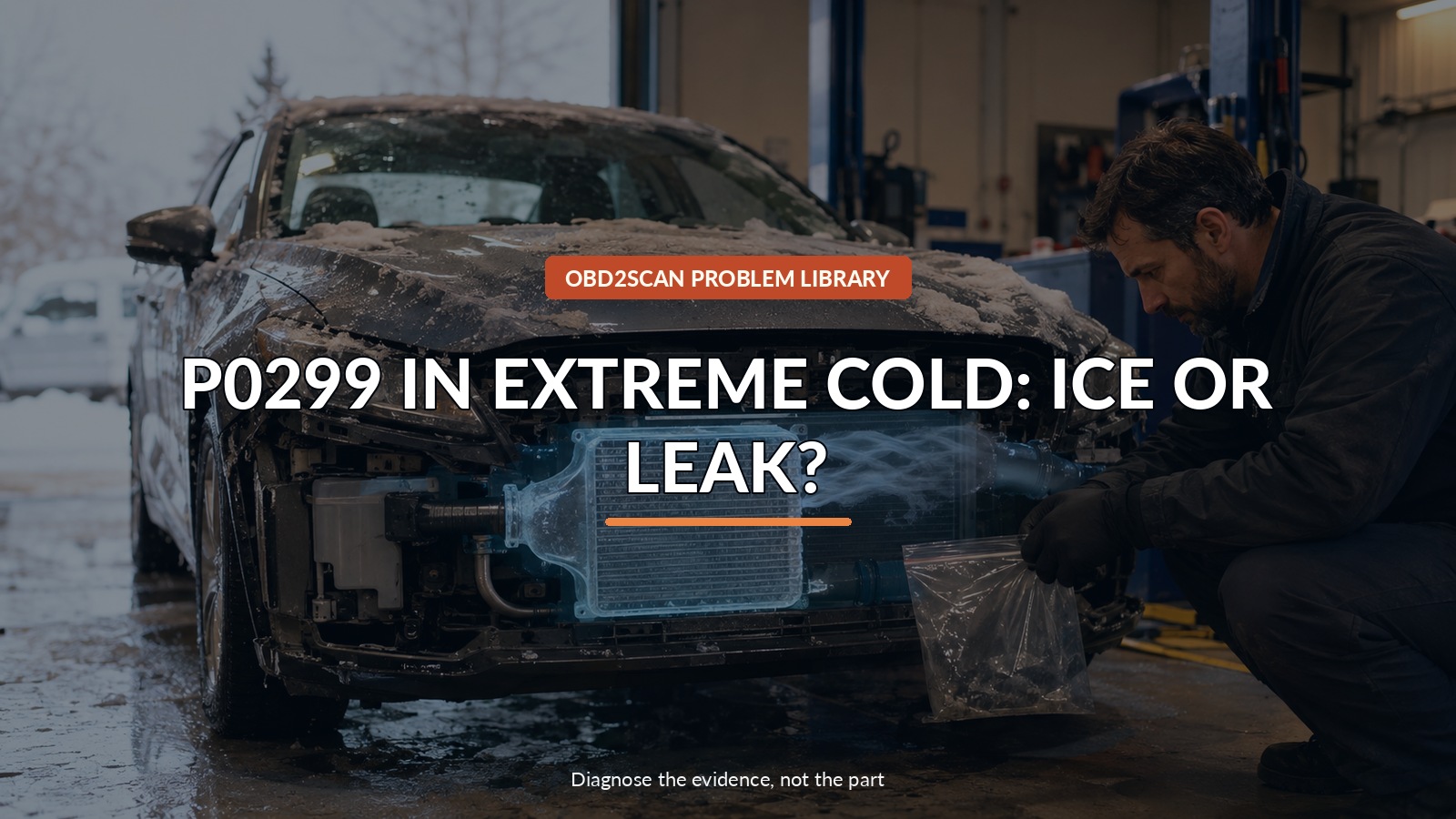
Save the exact ambient temperature, trip pattern and codes before thawing the car. GM’s Malibu icing route is tied to extreme cold at or below 0°F (-18°C), a verified charge-air system without leaks and other confirmation evidence. If the piping leaks, repair the leak first; visible moisture alone does not prove CAC icing.
If the route reaches an ordinary charge-air leak check, it needs a controlled low-pressure smoke source used only on a compatible, non-running system. The AUTOOL SDT205 can fill that narrow role. SDT205 can introduce regulated smoke to a compatible, depressurized charge-air path when GM’s procedure and component limits allow it; it cannot safely pressure-test a running turbo system, prove ice formed, measure drained water, update the ECM or justify replacing the CAC.
The distinction matters because thawing can erase the restriction, while opening the intake can erase a leak. Preserve the weather and failure record first, then test each explanation in an order that leaves evidence intact. Use three columns—weather, sealing and water quantity. CAC icing becomes persuasive only when the columns agree; any one of them alone is too weak to buy parts.
Quick answer: Save ambient and freeze-frame evidence, thaw and measure moisture, then prove the charge-air path is leak-free before calling Malibu P0299 CAC icing.
In this guide
- Write down how cold it really was
- Save the complete code family
- Let the car thaw without erasing evidence
- Inspect the charge-air path for ordinary leaks
- Measure drained moisture instead of guessing
- Check whether the cold-climate parts are already installed
- Separate a frozen turbo control valve from CAC ice
- Verify on the next comparable cold trip
Write down how cold it really was
Record the coldest ambient temperature, how long the car sat, trip length, highway versus city use and whether power returned after warming indoors. Download freeze-frame before clearing codes. GM ties this bulletin’s icing diagnosis to conditions at or below 0°F (-18°C), not merely a chilly morning. A code set at 35°F belongs on the normal underboost path unless other current service information says otherwise. A phone weather app can help reconstruct the day, but the vehicle’s freeze-frame and owner timeline are better evidence than a regional daily low that occurred hours after the event.
Save the complete code family
P0299 underboost is common in this condition, but GM also discusses P0234, P2227 and P00C7. Record every active, pending and history code with load, rpm, pressure and temperature data. Overboost, sensor rationality and insufficient charge-air cooling do not all accuse the same part. Look for a pattern rather than letting the most familiar code become the diagnosis. If there is severe engine noise, smoke, oil loss or a persistent stall after thawing, stop and diagnose those symptoms directly; an icing bulletin must not be used to normalize possible turbo or engine damage.
Let the car thaw without erasing evidence
Move the vehicle into a suitable warm area and allow the charge-air cooler and plumbing to thaw. Do not pour hot water on plastic ducting or run the engine in an unventilated room. Before draining anything, photograph frost and pooled liquid where accessible. Then collect rather than wipe away the water so its volume can be measured. GM’s confirmed route includes more than 100 mL drained along with the code and cold-weather gates. Condensation film or a few drops is not equivalent evidence. Note any oil content because a separate turbo-control or crankcase issue may need attention.
| Finding | Icing route stronger? | Next branch |
|---|---|---|
| Event above 0°F / -18°C | No | Normal underboost diagnosis |
| Charge-air leak found | No | Repair and retest the leak |
| More than 100 mL plus scoped codes/extreme cold | Yes | Check installed cold-climate remedy |
| Moisture film only | Not by itself | Continue evidence gathering |
Inspect the charge-air path for ordinary leaks
An intake boot, clamp, split duct, loose sensor or cooler leak can create the same underboost complaint. Visually inspect first, especially any connection recently serviced. Follow GM’s current sealing test at the allowed pressure; cap the correct openings and protect sensors or valves that should not see smoke. Bubbles, smoke or a pressure decay must be isolated and repaired before icing is declared. After repair, repeat the same test. Never use shop air without regulation: charge-air components designed for operating flow can still be damaged or launched when statically overpressurized.
Measure drained moisture instead of guessing
Measure the drained amount in a clean marked container and record where it came from. GM’s threshold is part of a bundle, not a universal statement that every cooler holding 101 mL is defective. The vehicle must also fit the engine/model scope, the recent weather must be extreme enough, the expected codes must be present and the charge-air system must pass its leak check. Moisture without symptoms may be normal condensation; symptoms without sufficient moisture remain an ordinary airflow, sensor, turbo-control or engine diagnosis.
Check whether the cold-climate parts are already installed
Check the repair history and part numbers before ordering another cooler. GM’s cold-climate route evolved across model years and can involve a revised CAC configuration, shields or grille-cover changes. A car may already have the service cooler, in which case the bulletin says not to replace it again merely because moisture is visible. Confirm grille-cover use and modifications against current instructions; blocking airflow casually can create warm-weather cooling risk. The VIN and installed parts—not memory of a similar Malibu—choose the eligible configuration.
Separate a frozen turbo control valve from CAC ice
The turbocharger control valve can contain an oil-and-water mixture that freezes during the same weather, creating a concurrent control problem. Inspect and test it through the current SI branch rather than assuming every loss of boost lives in the cooler. Sensor plausibility and wiring also deserve attention if P2227 or P00C7 persists after thawing. The strongest repair order is leak integrity first, quantified icing evidence second, specific control-valve evidence third and software/parts applicability last. That order keeps one winter event from becoming a wholesale turbo-system replacement.
Verify on the next comparable cold trip
Verification should include a leak-free charge-air system, correct code clearing and a controlled drive after the engine reaches normal conditions. Compare desired and actual boost without creating unsafe loads or speeding. A warm-day pass proves sealing and basic control but cannot fully reproduce an extreme-cold event, so explain that limit on the invoice. If practical, follow up after the next comparable cold spell and ask about power, warning lamps and trip pattern. The best record shows exactly which evidence was confirmed and which seasonal condition could not yet be repeated.
A winter P0299 is not a choice between believing the bulletin and ignoring it. It is an evidence stack. Save the temperature and code snapshot, thaw without wasting the water record, prove the piping is sealed, measure what drains and identify which parts/software are already present. The result may be a cold-climate correction—or a simple leak that would otherwise have survived under a new intercooler.


Comments 0
Questions, fixes, and real-world diagnostic notes from readers.
Be the first to share a diagnostic result or ask a follow-up question.