
2016 Chevrolet Malibu Brake Drag or Pull? Split Vacuum From Hydraulics

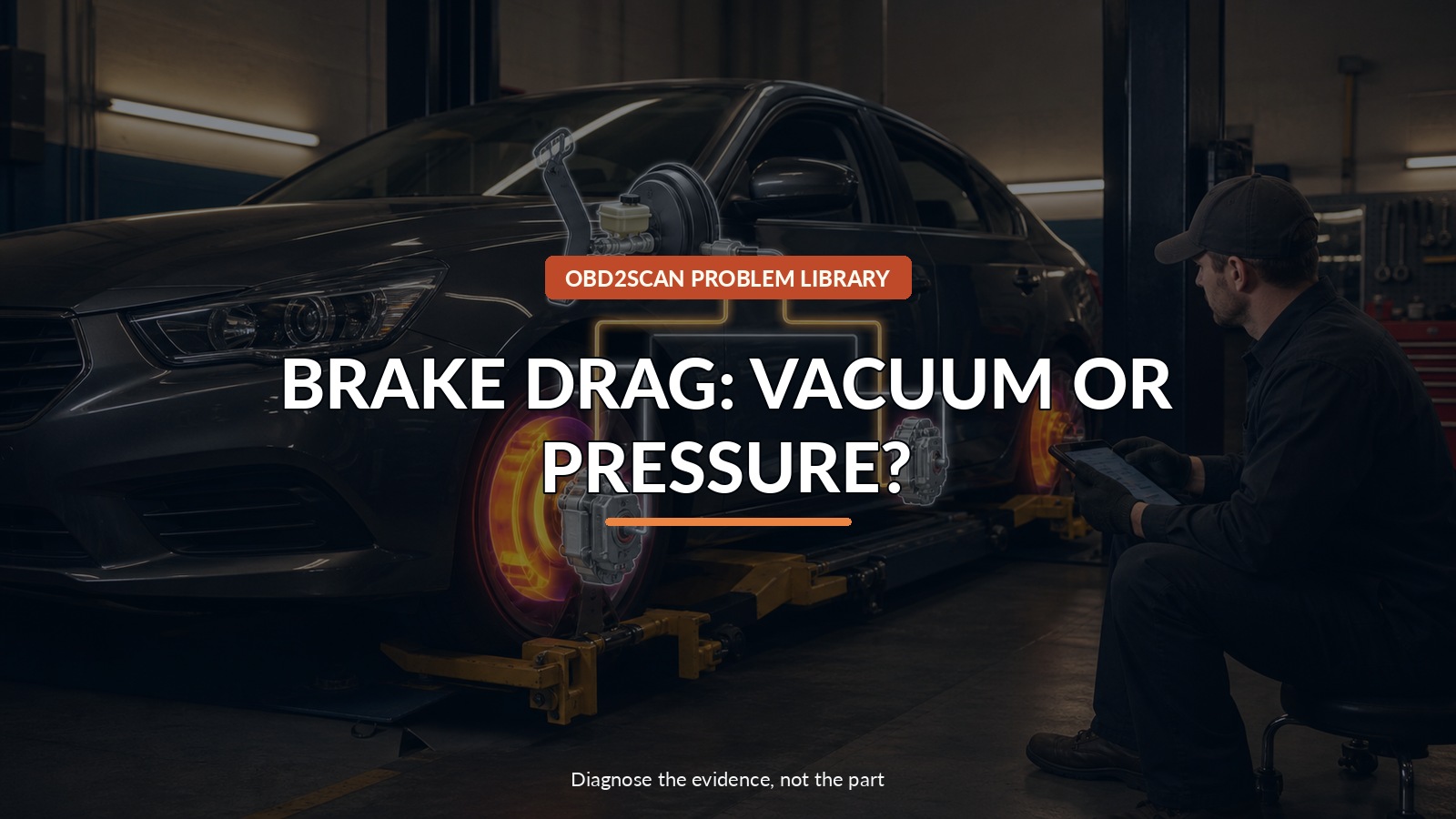
Brake Drag: Vacuum Or Pressure?
A 2016 Malibu that pulls, grabs, or refuses to roll freely has a safety problem before it has a parts question. Park it. A dragging brake can overheat fluid, damage a bearing or tire, reduce braking consistency, and start a fire. Do not keep driving to make one wheel “hot enough” for diagnosis.
After the car is safely lifted and the hydraulic test points are confirmed from GM service information, a dual-channel brake-pressure gauge can compare whether residual pressure remains in more than one circuit. The AUTOOL PT660 brake pressure gauge is one route for that controlled comparison. It cannot identify a failed booster, hose, ABS valve, or caliper from pressure alone, and it cannot make a dragging vehicle safe to road-test.
GM bulletin 16-NA-029 hinges on a split that is easy to miss: first prove that more than one brake is dragging; then determine whether changing booster/pedal input releases the brakes. A single hot corner belongs on a different branch.
Quick answer: Stop driving, determine whether one or multiple brakes drag, then separate booster/pedal input from residual hydraulic pressure before naming a component.
In this guide
- Park the car before heat becomes damage
- Prove whether one wheel or several drag
- Check the VIN fence and preserve codes
- Use temperature only as a locator
- Run the vacuum-and-pedal fork safely
- Compare residual hydraulic pressure
- Leave the bulletin for a single-corner fault
- Verify cold release and controlled stops
Park the car before heat becomes damage
If the vehicle pulls sharply, needs unusual throttle to move, smells hot, smokes at a wheel, or has a soft/low pedal, stop in a safe place and arrange transport. Do not touch the rotor, caliper, or wheel. Do not spray water on a hot brake. Keep combustibles away and call emergency services if fire is suspected.
Record when the drag begins: first start, after several brake applications, after highway driving, after rain, or only once hot. Note any pedal change, ABS/StabiliTrak warning, recent brake or booster work, and whether the condition clears after the car sits. Save the complete scan before clearing codes.
Prove whether one wheel or several drag
On a safely supported, cooled vehicle, a professional can compare free rotation at all four wheels under the same transmission and parking-brake state. Record which corners resist, whether the resistance builds after pedal applications, and whether it releases with time. Account for normal driveline drag.
A single corner directs attention toward its caliper slides or piston, flex hose, parking-brake mechanism, bearing, pad fit, or local hydraulic control. Two or more corners—especially a repeatable axle or diagonal pattern—raises a common upstream input. Do not bring a one-wheel case into a multi-wheel booster bulletin simply because the title sounds familiar.
Check the VIN fence and preserve codes
The GM bulletin applies to 2016 Chevrolet Malibu VIN Z from start of production through VIN ending GF199622. Verify the full VIN, installed brake equipment, production data, previous repairs, open programs, and current GM service information.
Record every module’s codes, not just ABS. Photograph warning messages, brake-fluid level and appearance without opening a hot system, and as-found pedal position. A TSB supplies a diagnostic route; it is not automatic recall or warranty eligibility.
Use temperature only as a locator
Measure rotor or wheel temperature from consistent distance and location with an infrared instrument after a short controlled shop event—never an unsafe public-road demonstration. Emissivity, shiny surfaces, airflow, sunlight, and different brake work can distort comparisons.
| Pattern | Strong next question | What temperature cannot prove |
|---|---|---|
| One corner much hotter | Is that corner mechanically or hydraulically trapped? | Which local component failed |
| Both fronts rise together | Is pedal/booster/master-cylinder input remaining applied? | Booster failure by itself |
| Diagonal pair rises | Does circuit architecture or ABS routing match? | ABS hydraulic unit failure |
| All readings similar but rotation is tight | Was the measurement timing or location valid? | That drag is absent |
Temperature locates where energy became heat. It does not identify why the pad stayed applied.
Run the vacuum-and-pedal fork safely
GM’s bulletin tells trained technicians to determine whether altering vacuum influence or lifting the brake pedal slightly releases a multi-wheel drag. Follow the exact current procedure, including engine state, support, access, and brake checks. Do not disconnect a vacuum line beside moving or hot components without that method.
If the brakes release when the specified booster/pedal input is changed, the common input branch has evidence and the bulletin directs the corresponding booster repair. If they remain applied, restore the system correctly and exit to normal service diagnosis. A change caused by disturbing a hose or connector must be distinguished from a genuine controlled result.
Compare residual hydraulic pressure
At approved test ports with correct adapters, zero both gauges, apply and release the brake as specified, then record both pressure channels against time. Keep the vehicle stationary. Open hydraulic connections only with contamination control, protective equipment, fluid capture, and the required bleeding procedure afterward.
Pressure that remains after pedal release confirms trapped hydraulic force at that measurement point. Moving the approved measurement upstream or downstream can narrow the trap. No residual pressure at a hot, resistant corner shifts attention toward mechanical binding. A gauge cannot decide which valve, hose, master-cylinder port, or booster input caused the pressure without that isolation map.
Leave the bulletin for a single-corner fault
If only one wheel drags, inspect pad movement, hardware, caliper slides and piston, rotor condition, parking-brake mechanism, and the flex hose under the exact Malibu procedure. A deteriorated hose can act as a restriction, but cracking a line as a casual test risks fluid loss and an incomplete brake system.
If warning lamps or codes identify an electronic/hydraulic-control concern, diagnose it with GM scan functions and circuit tests. Do not replace the booster just because a multi-wheel bulletin exists, and do not replace the ABS modulator merely because two circuits retained pressure.
Verify cold release and controlled stops
After repair and proper bleeding, confirm a firm pedal, no external leakage, correct fluid level, free wheel rotation cold, and no residual pressure beyond the specification. Perform a low-speed controlled brake test in a safe area, then a staged road verification only after base brakes are proven.
Recheck all four temperatures using the same method, scan for returning faults, and inspect for abnormal odor or heat after cool-down. The car passes when it releases after repeated applications and stops straight under comparable conditions—not when a warning lamp alone stays off.






Comments 0
Questions, fixes, and real-world diagnostic notes from readers.
Be the first to share a diagnostic result or ask a follow-up question.