
2003 Explorer P0305 Plus P0340 After Coil Work: Verify the Two Similar Connectors

Quick answer: A new cam-sensor code after coil work can be an installation clue. On the reported engine, adjacent similar connectors were swapped; confirm connector identity before ordering another sensor or coil.
Before another parts order, compare what the Explorer did before the coil job with what it does now. A new code that appeared immediately afterward deserves an installation review. You need the correct engine information and connector identification, not a collection of plugs that happen to reach.
In this guide
Separate the original fault from the new one
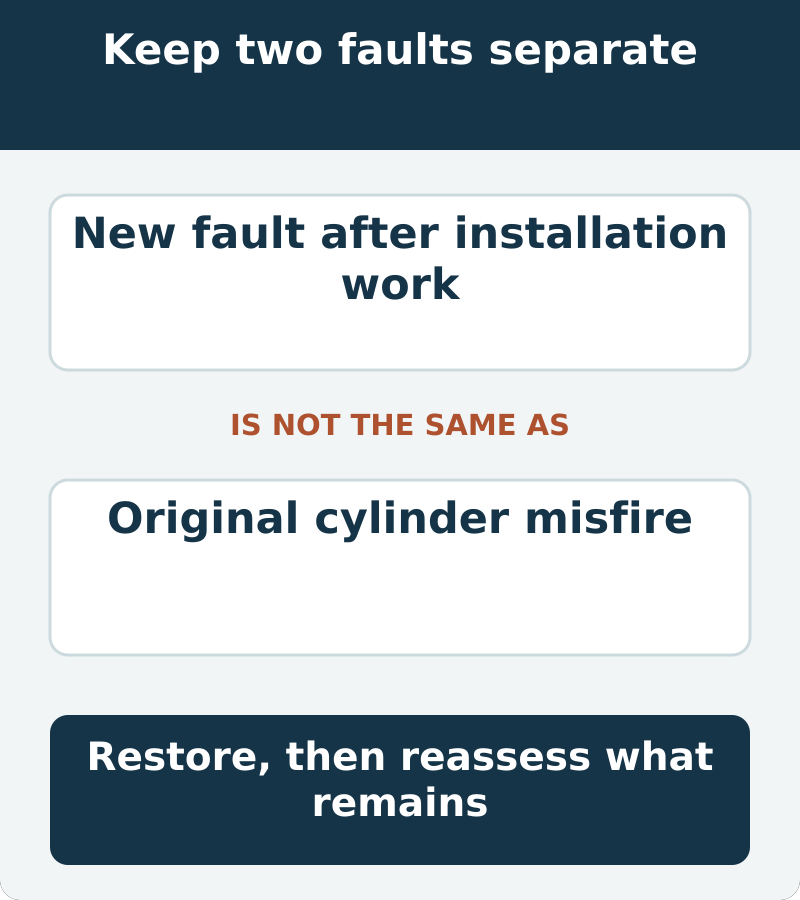
There are two timelines to preserve. The original misfire prompted work; the behavior after that work may contain a new problem. Record the earlier codes, the parts touched and the codes now present. Do not merge them into a single assumed failure.
If the engine has a hard misfire or a flashing warning light, stop unnecessary running and arrange prompt assessment. Do not continue driving simply to find out whether the light will clear. The first safe diagnostic question is whether the installation matches the intended circuit connections. That question can be answered without presuming that the new coil, the old coil or the cam sensor must be defective.
Why a connector that clicks can still be wrong
A connector’s latch confirms mechanical engagement. It does not certify that the connector belongs to the component receiving it. Similar shapes and nearby locations can create a convincing but wrong match.
This is especially worth considering after work in a crowded area. A harness may appear tidy while its destinations have been exchanged. The useful comparison is between the circuit identity and the component identity, not between plug shape and socket shape alone.
The historical case is specific to the reported 4.6L Explorer arrangement. It is not a universal claim about every Explorer engine or permission to swap similar connectors experimentally. The correct diagram and component identification determine the match on the vehicle in front of the technician.
In the ALLDATA published case, after attempted cylinder-five coil replacement, the Explorer had a hard misfire and both P0305 and P0340. The coil and cam-sensor connectors had been exchanged. Restoring them to their correct components removed the misfire, and neither code returned during the reported drive check.
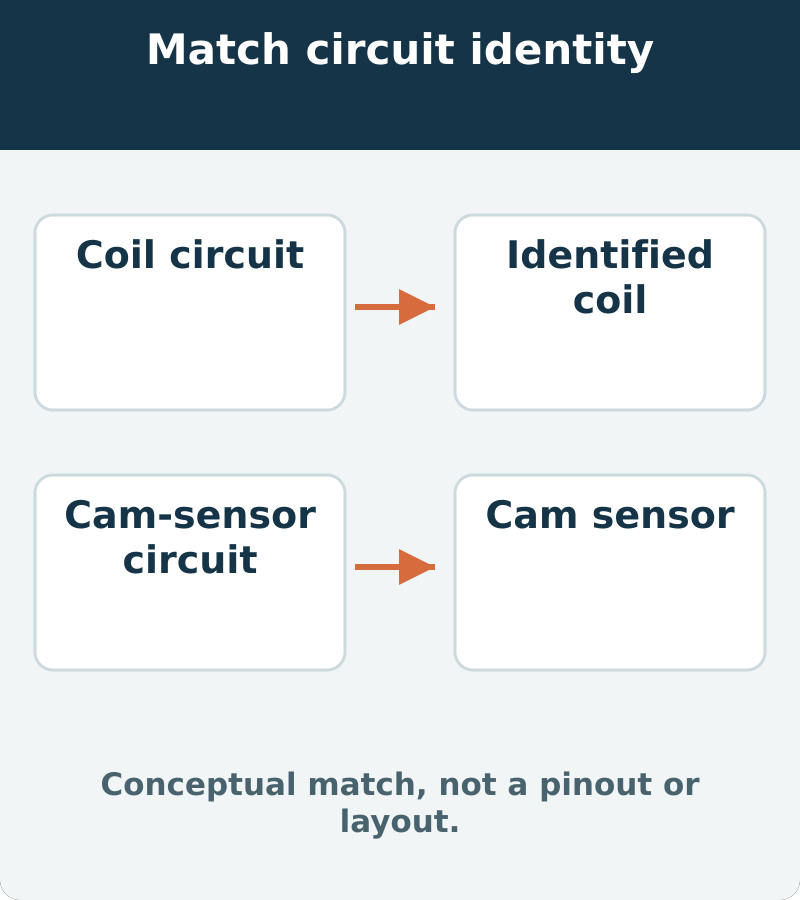
Use identity, not reach, to match the plugs
Have the shop identify both ends explicitly: which harness connector serves the relevant coil, and which serves the cam sensor? The answer should come from the correct engine’s wiring and component-location information, with the actual installation inspected against it.
| Harness identity | Intended destination |
|---|---|
| Coil circuit | The identified coil |
| Cam-sensor circuit | The cam sensor |
This is a correspondence map, not a pinout. It deliberately supplies no wire colors, terminal numbers or left/right shortcut. Those details can be misleading without the exact configuration and viewing orientation.
Do not unplug ignition equipment while the engine runs. Inspection needs a switched-off, cooled engine and appropriate electrical precautions; ignition high-voltage testing is outside this check.
Restore the installation before judging another part
If connector identity is wrong, restore the installation by the appropriate procedure before judging the replacement part’s performance. Otherwise, the test is asking whether a component works while it is connected to the wrong circuit.
The repairer should also assess connection condition and routing rather than merely moving plugs until the engine sounds better. A strained wire, damaged latch or poorly retained harness can leave another concern after the destinations are corrected.
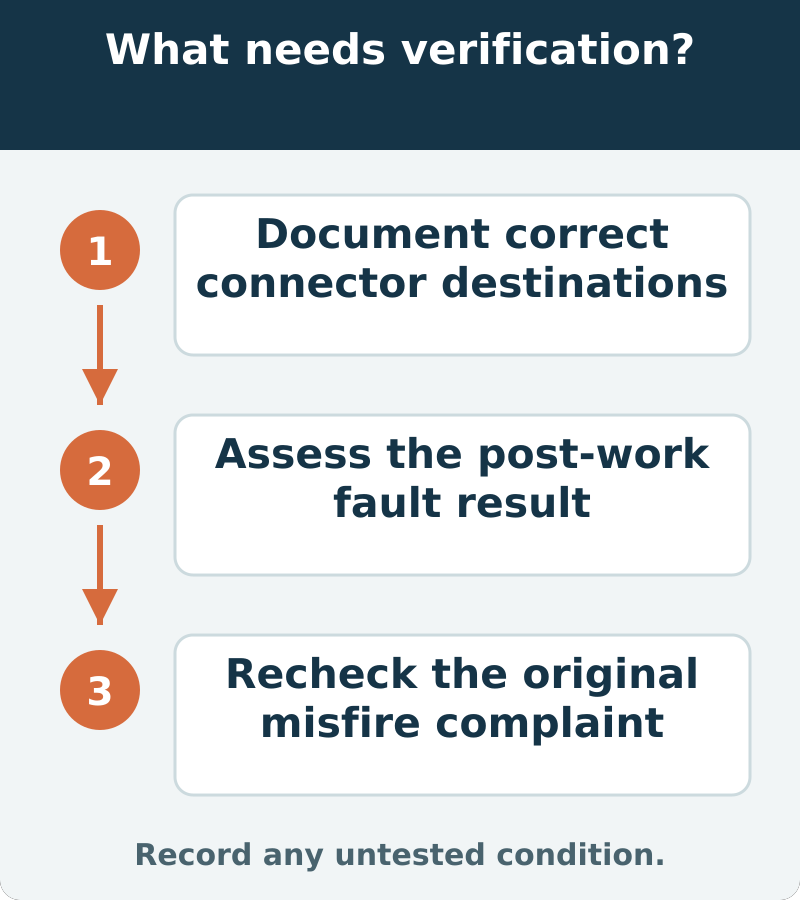
This restoration-first approach is not an accusation about the earlier work. It is a way to establish a known installation before continuing diagnosis. Ask that the finding and correction be documented so a later technician does not have to reconstruct the same history from a list of parts.
What if P0305 remains afterward?
If the cam-related fault disappears but a cylinder misfire remains, the original misfire question is still open. Correcting an installation error does not prove that every preceding fault was imaginary. The remaining symptom needs its own appropriate diagnosis.
Ask which symptoms changed and which codes returned under the conditions of the follow-up assessment. A mixed result can be useful: it separates the added problem from the earlier complaint. Avoid responding to that uncertainty with another immediate coil purchase unless the new evidence supports it.
Likewise, a successful correction does not retrospectively prove whether the original coil was good or bad. Keep the final explanation limited to what the measurements and restored behavior actually establish.
Keep the restored routing in the service record
The final record should name the corrected connection identities, note any connector or harness work and describe the running and fault-status checks. An entry saying plugs changed over may make sense today but be ambiguous at the next visit.
Ask whether the assessment included both the severe post-work behavior and the original complaint. A quiet idle alone may not cover the circumstances in which the first misfire occurred. The workshop should decide what further operation is safe and useful, rather than handing the owner an instruction to drive until it happens again.
The practical lesson is small but valuable: mechanical fit is not electrical identity. Establish the intended connections, then evaluate the components in a correctly assembled system.








Comments 0
Questions, fixes, and real-world diagnostic notes from readers.
Be the first to share a diagnostic result or ask a follow-up question.