
2014 Fusion A/C Still Blows Warm After P0073 Repair: Check the Other Input That Can Block Cooling

Quick answer: Correcting one implausible A/C input does not confirm the others. If the compressor remains off, compare the remaining pressure and temperature information with independent conditions before adding refrigerant or replacing the compressor.
This is an input-checking problem before it is a compressor-shopping problem. Passive circuit checks with a tool such as the MRCARTOOL B550 can support the electrical assessment at permitted test points; scan data and independent refrigerant-system checks still have different jobs. Do not inject power into sensor wiring.

In this guide
Why did the code disappear but the hot air stay?
It is entirely possible to complete one valid repair and still have warm air from the vents. The repair may have corrected a bad input while another condition continues to prevent cooling. That makes the disappearance of P0073 a narrower result than restoration of the A/C system.
When speaking with the workshop, separate the two outcomes: has the temperature information become plausible, and has cooling returned? If the answer is yes to only the first, the next job is to explain the remaining inhibition or lack of output. It is not necessary to declare the first repair pointless, nor is it reasonable to call the whole complaint fixed because the warning is gone.
Record whether airflow itself is normal. Weak airflow and normal airflow that remains warm lead to different questions, even though both can feel like inadequate air conditioning.
Three questions between the A/C button and cold air
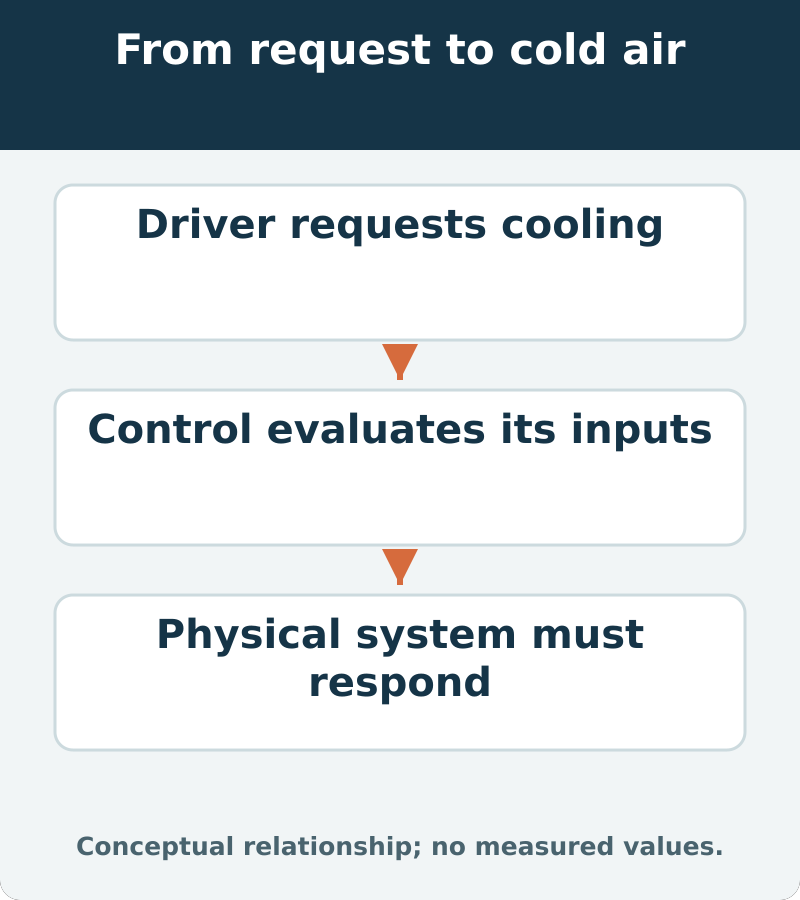
The dashboard button expresses a request. The control system then evaluates operating information, and the physical refrigeration system must produce a useful result. These are related stages, not interchangeable observations.
Ask which stage is failing. Does the vehicle recognize the cooling request? Does it permit compressor operation under the conditions of the test? If operation is commanded, does the system respond as expected? This framing is more informative than being told only that the compressor is not running.
It also explains why forcing an output would be a poor shortcut: making a component operate externally would not establish that its normal control conditions were correct. The technician needs the relevant service information and live observations to locate the unresolved stage.
In the ALLDATA published case, this Fusion had P0073 and an implausibly cold ambient reading. Ambient-sensor replacement removed the code but did not restore cooling. The pressure transducer then proved stuck at a low reported value despite changing conditions. Circuit checks preceded its replacement, after which A/C operation returned without the reported code.
Compare reported conditions with physical conditions
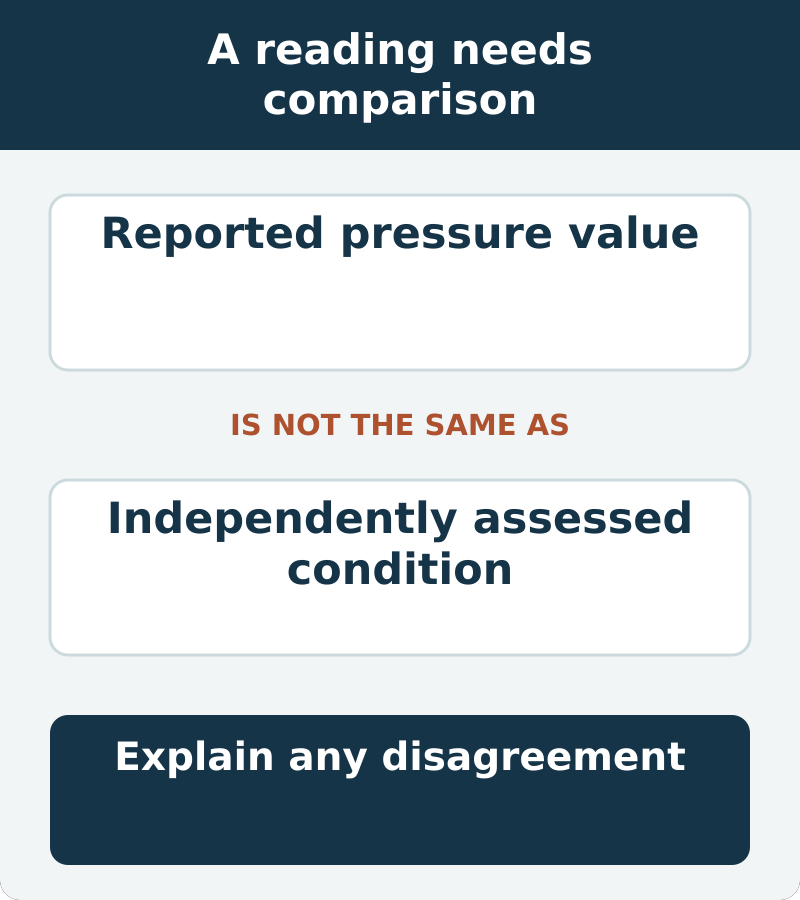
A displayed number is a report about a condition, not the condition itself. The useful check is whether that report agrees with an appropriate independent observation and responds when the real condition changes. A value that remains fixed deserves explanation, but not an automatic sensor order.
The electrical path matters too. Before condemning a transducer, the workshop should distinguish the sensor’s behavior from supply, connection and signal-path problems using the vehicle’s procedure. Ask what comparison supported the conclusion and whether the circuit was checked before replacement.
Do not use this case as a refrigerant-charge guide. A low reported pressure is not a measured recovered quantity, and no universal pressure number can be borrowed from this discussion. Ambient conditions, operating state and the correct refrigerant-system method all affect interpretation. Adding refrigerant merely to move a suspicious reading can leave the original diagnostic question unanswered.
Do not force the compressor to settle the argument
An A/C compressor that remains off is inconvenient, but the control system may be withholding operation for a reason. Bypassing a protection or applying external power is not an owner-level way to prove the compressor good. It can also obscure which input originally stopped normal operation.
The same boundary applies to sensor connectors: do not bridge terminals or simulate a pressure signal to see whether cold air returns. A tool with an active output does not make that output appropriate for this circuit. Here, measurement and comparison are the relevant capabilities.
Keep refrigerant connections closed. Recovery, identification, charging and leak assessment require suitable equipment and training. If the estimate includes both a sensor and refrigerant work, ask which finding supports each item; a combined invoice should still explain the distinct reasons for the work.
Check the whole cooling request at handover
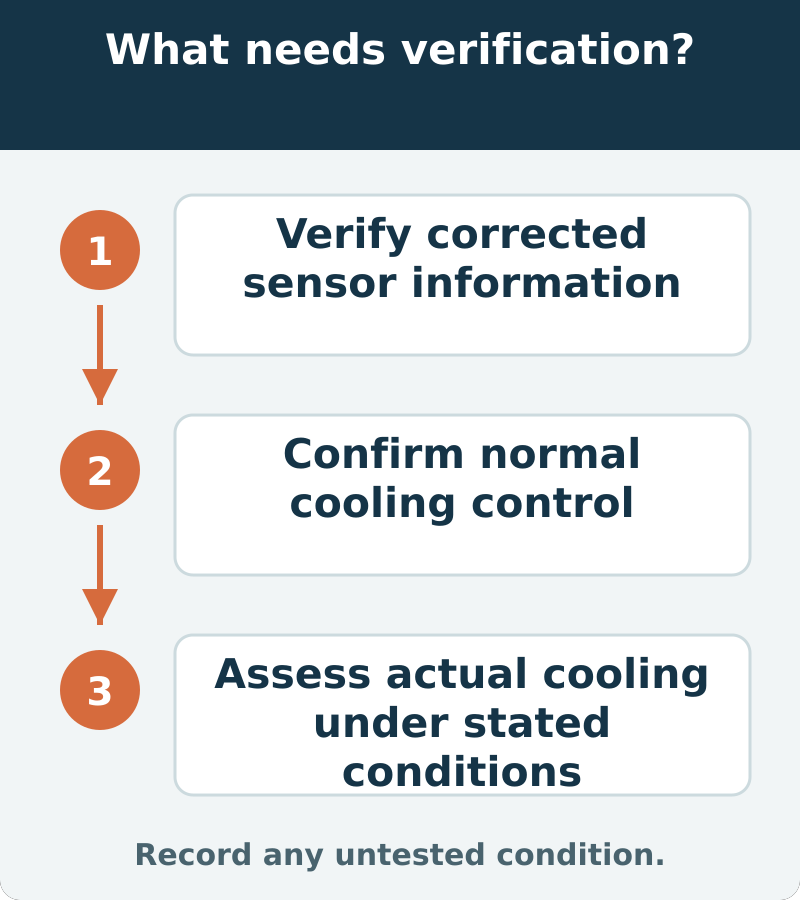
At collection, request a demonstration of cooling under documented conditions, with the normal controls operating the system. The final explanation should cover the corrected input, the remaining-input assessment and the restored response. A pleasant moment of cold air is useful, but it does not describe every operating condition.
Bring the original complaint back into the conversation. If cooling previously failed after a particular period, or the displayed outside temperature was obviously wrong, ask whether those observations were included in the check. Do not demand an invented all-weather guarantee; ask which conditions were actually tested.
If the code is absent but the air is still warm, leave that distinction on the job record. The case’s main lesson is that a resolved code and a resolved function are two claims, and each needs its own evidence.










Comments 0
Questions, fixes, and real-world diagnostic notes from readers.
Be the first to share a diagnostic result or ask a follow-up question.