
2016 Ford Expedition Shudder: What Improvement After a Fluid Service Does—and Does Not—Prove

Quick answer: A shudder that disappears after fluid and filter service is a useful outcome, not proof that every similar vibration needs a transmission flush.
If the vibration is severe, control changes, the transmission slips or an overheating warning appears, stop and obtain a safety assessment. Do not power-brake the SUV or repeat a high-speed event to demonstrate the complaint.

In this guide
Was it maintenance, diagnosis or both?
Before authorizing work, ask what you are buying. A scheduled service addresses a maintenance requirement. A diagnostic test is chosen to separate possible causes. Sometimes a service is reasonable and its result also provides information—but those two reasons should be explained separately.
For a vehicle with an uncertain service history, the distinction matters financially. You may reasonably approve the correct maintenance while accepting that a vibration could remain. That is different from accepting a guaranteed cure. Put the uncertainty into the conversation before the work, while it is still possible to agree on a sensible next step if the SUV drives exactly as it did before.
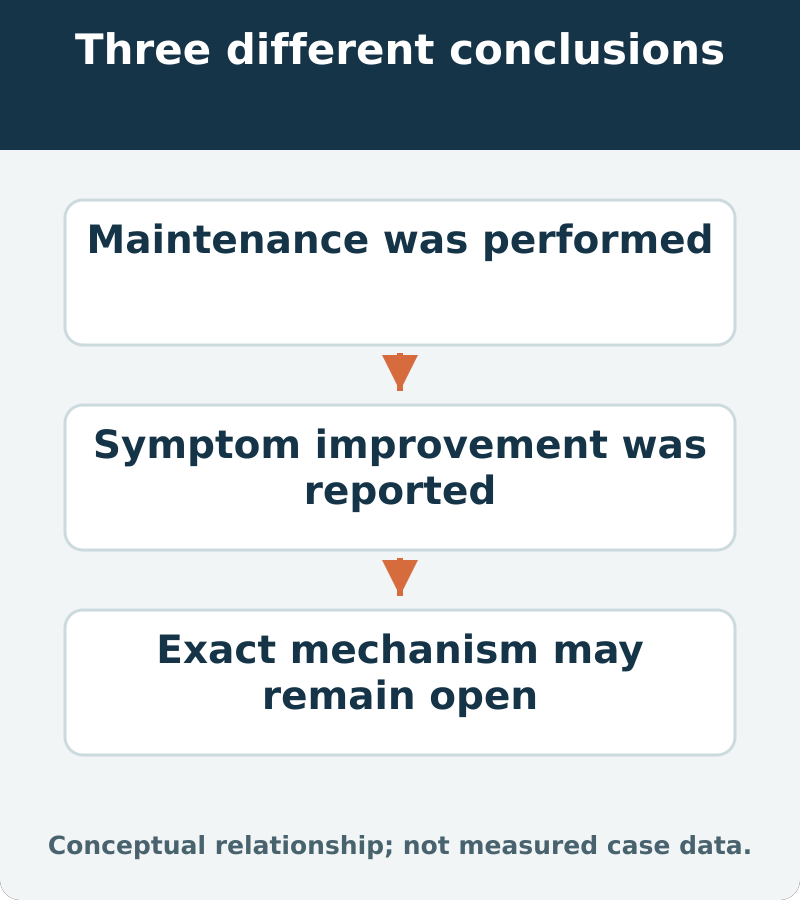
What changed in the reported truck
In ALLDATA’s Expedition account, a 2016 four-wheel-drive 3.5L SUV developed a pedal-area vibration associated with road speed. Several driveline possibilities were discussed. The technician first serviced the transmission fluid and filter with the specified materials, after which the shudder disappeared. The report gives no measured slip data, fluid analysis or extended follow-up.
The outcome deserves credit. A practical problem reportedly went away after an intervention. But the missing measurements limit the explanation: the account cannot identify one internal mechanism with the same confidence that it reports the driver’s improvement. Neither dismissing the success nor expanding it into a universal remedy helps the next owner.
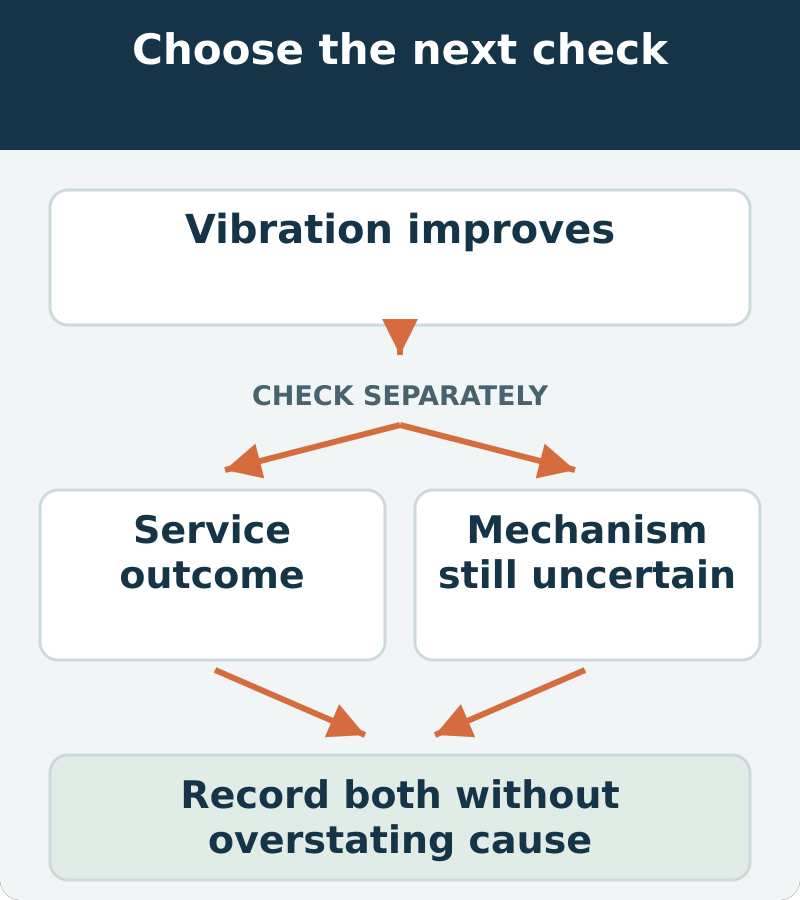
A successful service leaves some questions open
“The shudder stopped” answers whether the symptom was present during the check. It does not, by itself, establish why it stopped, how long the improvement will last or whether a different vehicle has the same fault. A complete explanation would need evidence relevant to those additional claims.
This is not an argument for endless testing after a satisfactory repair. It is a reason to keep the conclusion proportionate. The invoice can accurately say that service was performed and the complaint was not present during a defined evaluation. It should not automatically become a statement that all similar vibrations come from dirty fluid, or that an aggressive flushing procedure is required.
Build the vibration description before spending again
The next appointment becomes more productive when “it shakes” is replaced with a small, consistent set of observations. Record what you already noticed in ordinary use; do not conduct a road experiment.
- Where was it felt: pedal, seat, steering wheel or throughout the body?
- Was it associated with acceleration, steady travel or slowing down?
- Was the vehicle cold or already warm, and was it carrying its usual load?
- Did a warning, unusual sound or change in shifting accompany it?
Those details help the technician select a safe evaluation and compare the before-and-after experience. They do not identify a component on their own. A sensation felt through the pedal is a location reported by the driver, not a map pointing directly to the failed part.
When recurrence changes the plan
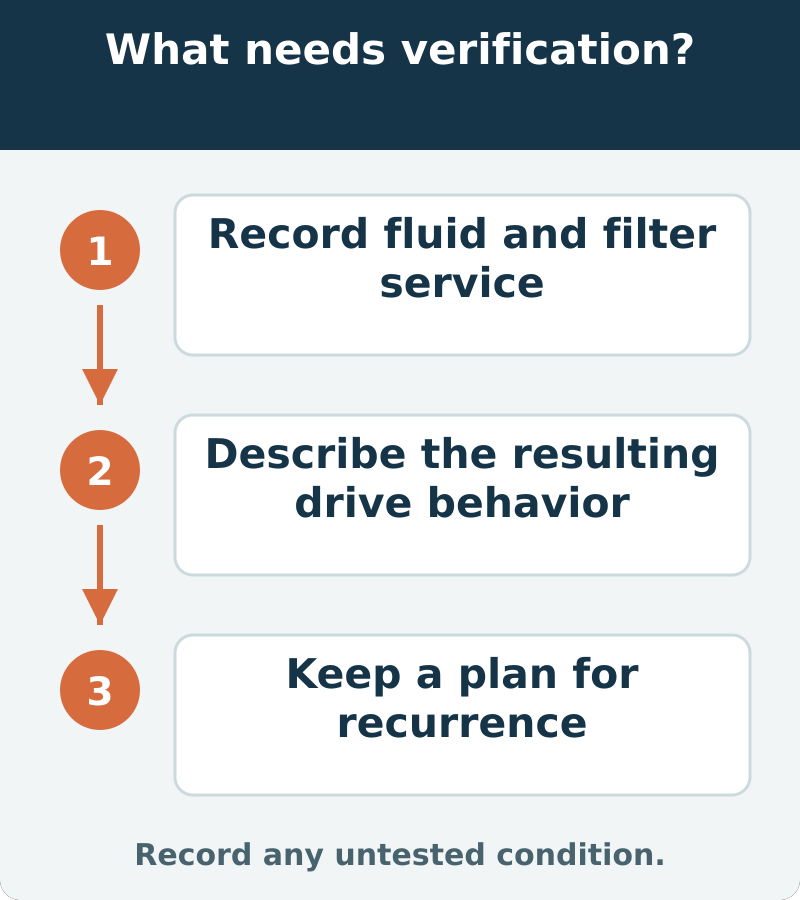
If the vibration returns, bring the service record rather than simply requesting the same work again. The correct response depends on whether the returning complaint matches the earlier one, whether any new symptoms appeared and what evidence is now available. A temporary improvement can be important without justifying an indefinite cycle of repeat services.
Ask for the next discriminating check: what would favor a transmission-related explanation, and what would redirect attention elsewhere? The workshop should use the vehicle’s actual configuration and findings to answer. No account of a single successful service can clear other driveline, wheel or mounting possibilities on your SUV, particularly if the character of the vibration has changed.
Keep the invoice useful for the next visit
Request a record of the materials and procedure used, the original complaint and the conditions under which improvement was evaluated. There is no need for an invented universal service interval or a guessed “normal” vibration reading. What matters is enough specificity for another technician to understand what was changed and what was observed.
After collection, note whether ordinary use remains smooth and report any recurrence promptly. A symptom-free period adds practical confidence; it does not retroactively supply measurements that were never taken. The useful conclusion is modest and actionable: the service helped this reported vehicle, and your own spending decision should rest on its maintenance needs and diagnostic evidence.









Comments 0
Questions, fixes, and real-world diagnostic notes from readers.
Be the first to share a diagnostic result or ask a follow-up question.