
2020 Ford Transit Shows 149.5 PSI at Every Tire: Check the Shared Receiver

Quick answer: Four identical implausible scan values can mean missing information, not four overinflated tires. This Transit had broken power wiring at the radio transceiver module.
Four matching numbers can look convincing on a scan screen. But when all four conflict with a physical measurement, agreement is not accuracy. The useful question becomes whether the vehicle is receiving valid information from the wheels at all.
That receiving path needs electrical support as well as working wheel sensors. A circuit meter such as the AUTOOL DM301 can help check identified module supply circuits. It does not activate TPMS sensors, read their radio transmissions or replace a tire-pressure gauge.
Start with tire safety, not module replacement. Check cold inflation against the vehicle’s placard and applicable load instructions. If a tire is visibly damaged, rapidly losing air or unsafe to drive on, stop and address that condition even when the electronic warning is confusing.
In this guide
First, trust a real pressure measurement
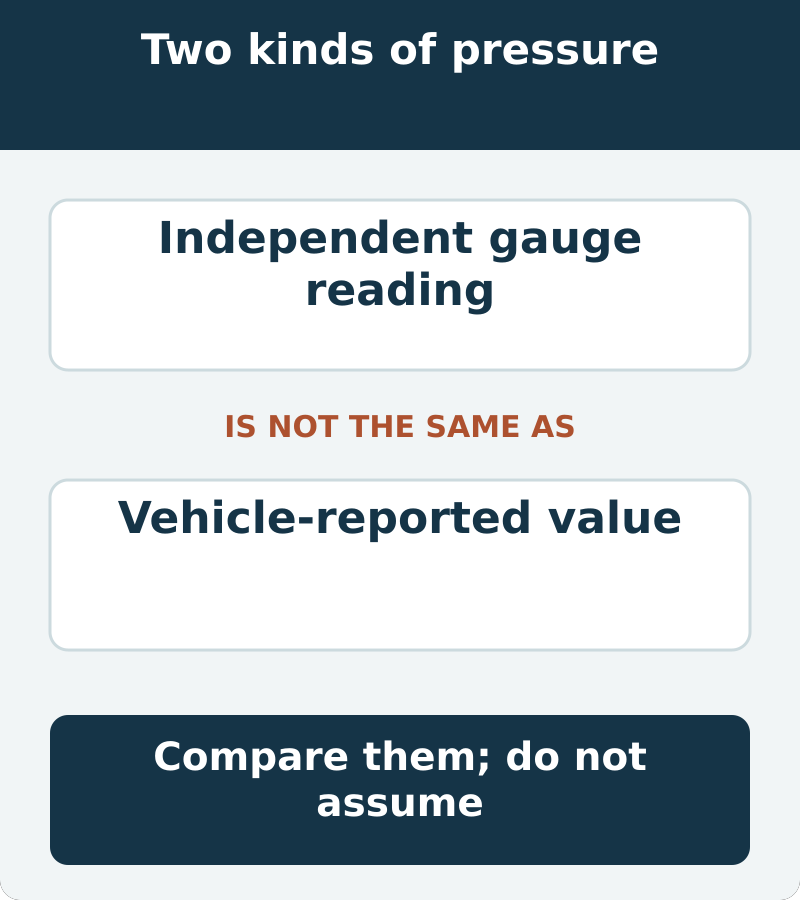
Use a suitable gauge on each tire and record the results by wheel position. Include whether the tires were cold and whether you had just driven. That simple record establishes what the tires are doing independently of the vehicle’s display.
Do not deflate a tire merely to make it match an implausible scan value. Do not assume a number from somebody else’s van is your inflation target, either. Front and rear requirements can differ, and the correct reference is the vehicle’s own approved inflation information.
The four readings that did not describe the tires
The documented ALLDATA case involved a 2020 Transit 250 RWD, 3.5L. B124D-02 and B1182-00 accompanied four scan readings of 149.5 psi, while direct measurements showed 35 psi. Broken power wires near the radio transceiver module, or RTM, left it unpowered. Wiring repair restored sensor activation, followed by a successful test drive.
Here, 35 psi is only the reported observation—not inflation advice. Likewise, 149.5 psi is not a universal Ford fault marker that identifies one failed part.
One receiver serves several wheels
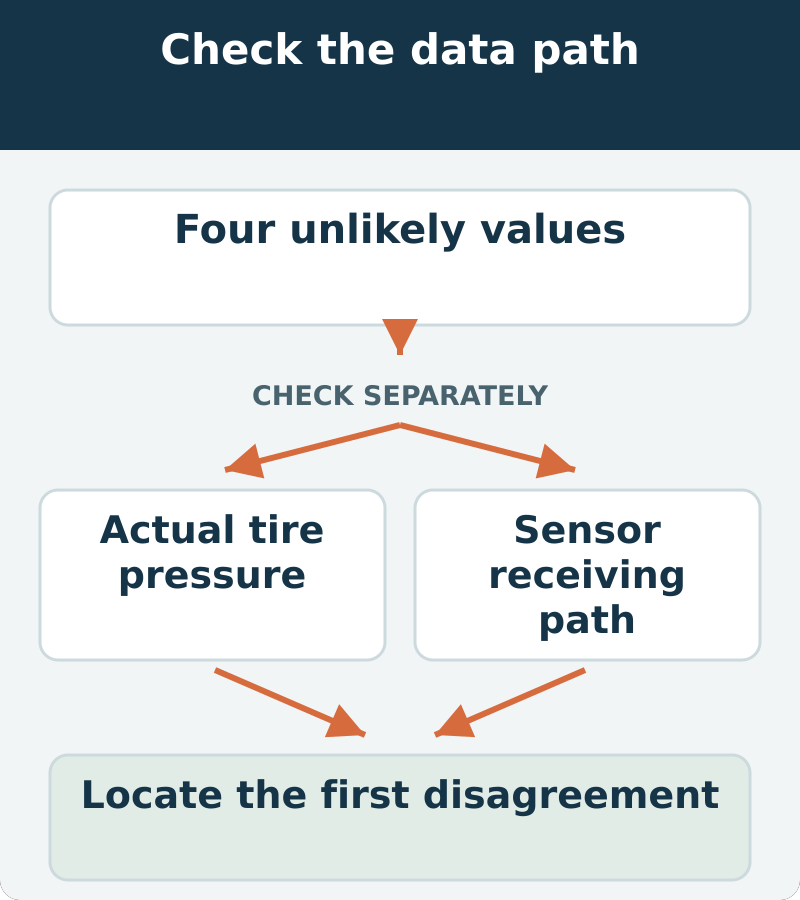
Think of the measurement path as a chain: pressure at the tire, information transmitted from the wheel, information received by the vehicle, then a value made available to a display or scan tool. A problem at a shared point can affect several downstream values.
This does not prove the shared point is faulty whenever several readings are wrong. It gives the technician a sensible question to test before four separate sensor purchases. The number of affected wheels is a clue about the pattern, not a substitute for checking the path.
Split a dead sensor from a dead receiving path
Ask the shop to distinguish a wheel sensor’s response to a compatible activation tool from the vehicle’s ability to recognize that sensor. These are related but different observations. Record sensor identity and wheel position where the applicable procedure requires them.
| Observation to establish | Question it answers |
|---|---|
| Independent gauge reading | What pressure is physically present? |
| Compatible sensor activation result | Is a wheel-side response available? |
| Vehicle recognition and updated data | Does that response reach the vehicle correctly? |
Avoid turning a missing scan value into a claim that a wheel sensor’s battery is dead. That conclusion needs its own evidence.
Test the RTM supply without disturbing the network
A technician should identify the correct module and wiring for the van before checking feeds, grounds or connectors. Module names and locations from a similar Ford are not enough. Preserve the original fault information before unplugging components or performing relearns that may change the evidence.
Physical inspection should look beyond whether a connector appears latched. Follow the service procedure for terminal inspection and electrical checks, using suitable probes that do not spread contacts. Do not apply battery power to an unidentified communication wire. If the defect is intermittent, an inspection with the wiring undisturbed may be more informative than immediately moving everything out of the way.
Restore data, then check inflation again
Electronic recovery is only one finish line. Verify that the system recognizes the intended sensors and updates the correct wheel information through the prescribed process. Then compare the readings with actual inflation and confirm that the tires meet the placard requirements.
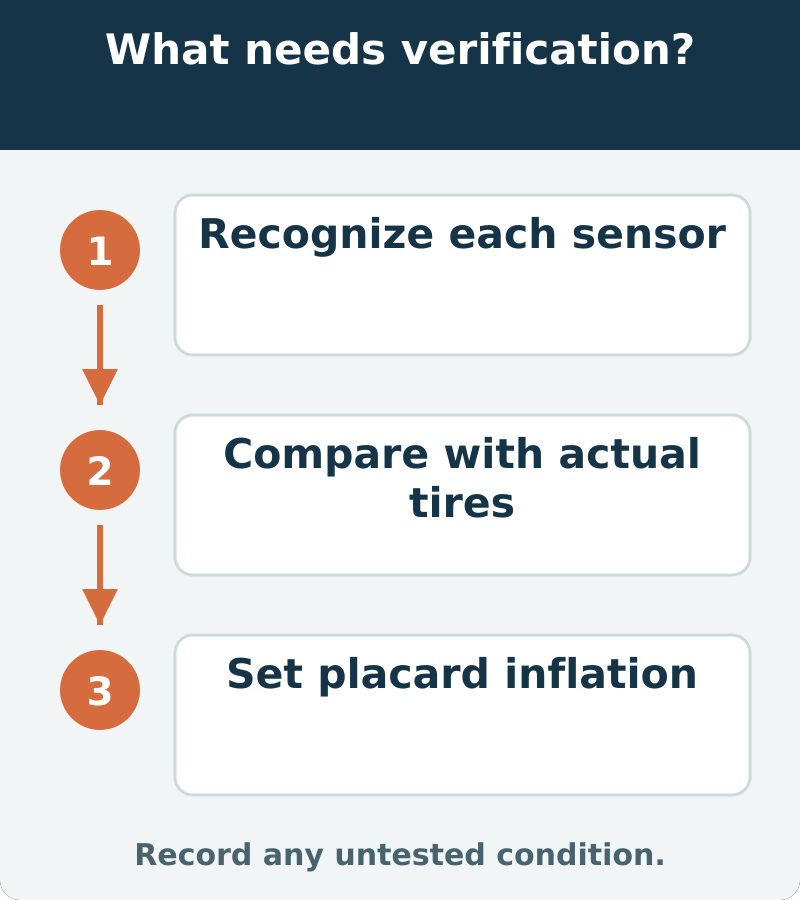
A warning lamp going out does not repair a damaged tire or establish that someone selected the right pressure. Conversely, correctly inflated tires do not prove the monitoring system can warn you of a later loss.
What to ask if the warning returns
Bring the recorded pressures, the warning’s timing and any recent wheel, tire or body work. Ask whether the same sensors stopped being recognized or whether the new event affects a different part of the path.
That comparison helps avoid restarting with the same assumption. Four suspicious values should prompt one careful investigation—not automatically four new sensors.









Comments 0
Questions, fixes, and real-world diagnostic notes from readers.
Be the first to share a diagnostic result or ask a follow-up question.