
2016 Chevy Tahoe Had No-Starts and Misfires: The Aftermarket LED Headlights Were the Trigger

No-Starts, Misfires—From Led Bulbs?
Quick answer: The repeated fuel-system and misfire symptoms were not resolved by another control module. Removing the aftermarket LED bulbs stopped the faults, and reconnecting either one reproduced them; restoring halogen bulbs survived repeated starts, road tests and a later owner follow-up. This article follows one documented vehicle. It explains the evidence chain, not a universal failure rate or a direction to replace the same part on every similar car. Stop whenever the test would involve overheated brakes, high current, moving parts, refrigerant handling or an uncontrolled road condition.
When an added electrical device changes several unrelated circuits, a meter and low-bandwidth scope can compare supply stability, ripple and switching behavior at identified test points; AUTOOL DM303 Digital Multimeter is one practical way to capture those observations. It cannot prove radio-frequency interference, certify an LED conversion, or make probing headlamp and module circuits safe without the correct wiring diagram and measurement setup.
Three fault families made the Tahoe look as though several systems were failing at once. The breakthrough was not another module; it was a reversible change to an accessory that could switch the same symptoms off and back on.
Quick answer: The repeated fuel-system and misfire symptoms were not resolved by another control module. Removing the aftermarket LED bulbs stopped the faults, and reconnecting either one reproduced them; restoring halogen bulbs survived repeated starts, road tests and a later owner follow-up.
In this guide
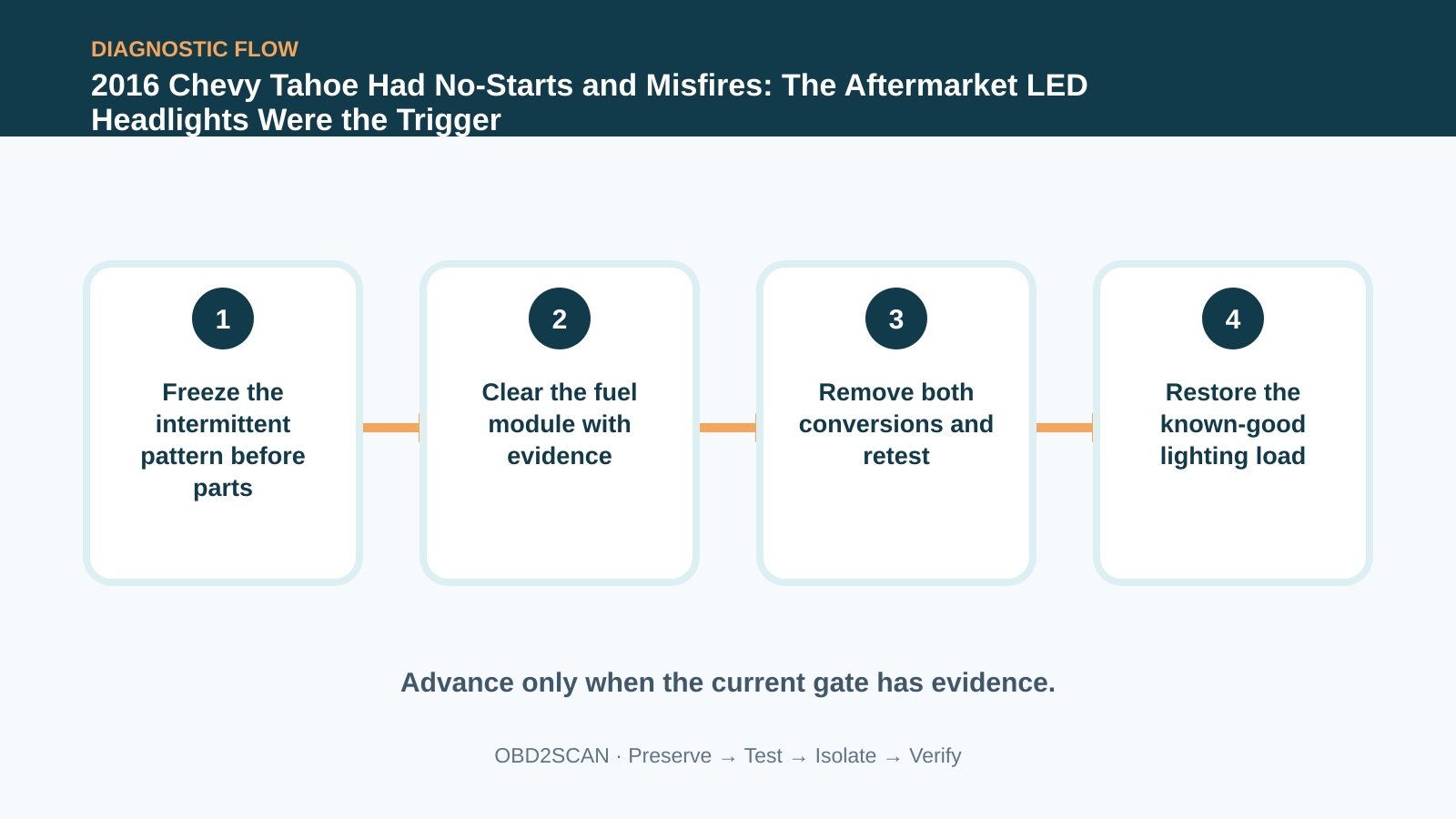
Freeze the intermittent pattern before parts
Begin with a timeline, because this Tahoe had accumulated repairs and symptoms over several visits. Record the intermittent crank/no-start, which cylinder misfired, the exact low-voltage codes and whether the lighting conversion predated them. A long parts history is not one diagnosis; it is a set of events that must be placed in order before the next component is blamed. Preserve the original condition before changing it. The first observation is the control sample against which every later test must be compared.
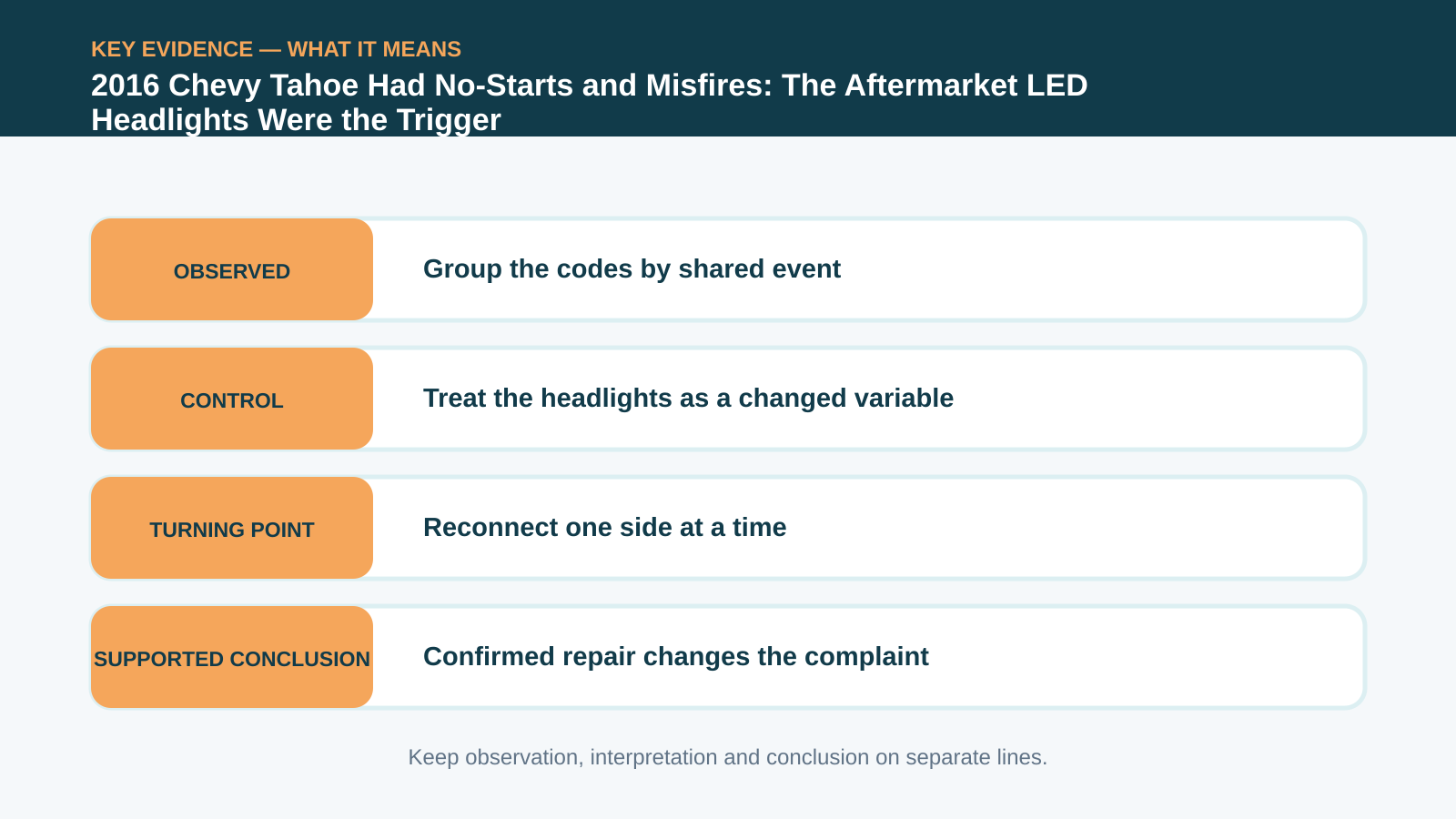
Group the codes by shared event
P1682, P129D and P0300 crossed ignition, fuel-pump control and combustion. Check fuses, module powers and grounds in the failed state, then inspect aftermarket wiring and grounds without assuming the lamps are causal. The documented fuel-pump control module tested normally, which made another replacement a poor next step. Use service information for the exact engine, build date and options. A correct method on the wrong terminal can create a precise but useless result.
Clear the fuel module with evidence
Both headlamps contained aftermarket H11 LED bulbs with small cooling fans. Added electronics can change current draw or introduce switching noise, but appearance alone proves neither. Photograph the connections, preserve polarity and fitment, and do not condemn an accessory until removing it changes the same vehicle-level symptoms. Treat prior work as evidence, not blame. A repair that made no change can narrow the case when its installation and test conditions are verified.
Treat the headlights as a changed variable
With both LED conversions removed and halogen bulbs installed, the complaints and codes stopped. That was a useful A/B result because it changed one category of hardware while returning the lighting circuit toward its intended load. A quiet MIL once is evidence, but intermittent faults need more than one short observation. At this stage, separate what was observed from what is inferred. The observation should remain true even if the current theory is later rejected.
| Observation | What it supports | What it does not prove |
|---|---|---|
| P1682, P129D and P0300 appear together | One event may affect several systems | The fuel module is failed again |
| Fuel-module checks pass | That branch loses priority | Headlights are automatically causal |
| Removing LEDs stops symptoms | The added load is a supported trigger | The interference mechanism is known |
| Either LED reproduces the MIL | Controlled rechallenge strengthens causality | Every LED conversion causes these faults |
Remove both conversions and retest
Reconnect one LED side at a time only if doing so is safe and the original fault can be observed without risking a stall in traffic. In the documented case either side brought the MIL back within about five minutes. Reproduction on both branches made one damaged headlamp housing less likely, especially with no visible moisture or corrosion. This is the decision point in the documented case. Its value comes from changing one bounded condition while leaving the rest of the system intact.
Reconnect one side at a time
The case did not capture conducted noise, radiated interference or a specific voltage disturbance. A meter or scope could compare headlamp supply, ground drop, ripple and relevant controller feeds, but absence of a captured spike would not automatically approve the conversion. State the demonstrated trigger and leave the unmeasured mechanism open. A confirmed component still needs a repair that restores sealing, support, torque, routing or terminal fit—the physical conditions that keep the fault from returning.
Restore the known-good lighting load
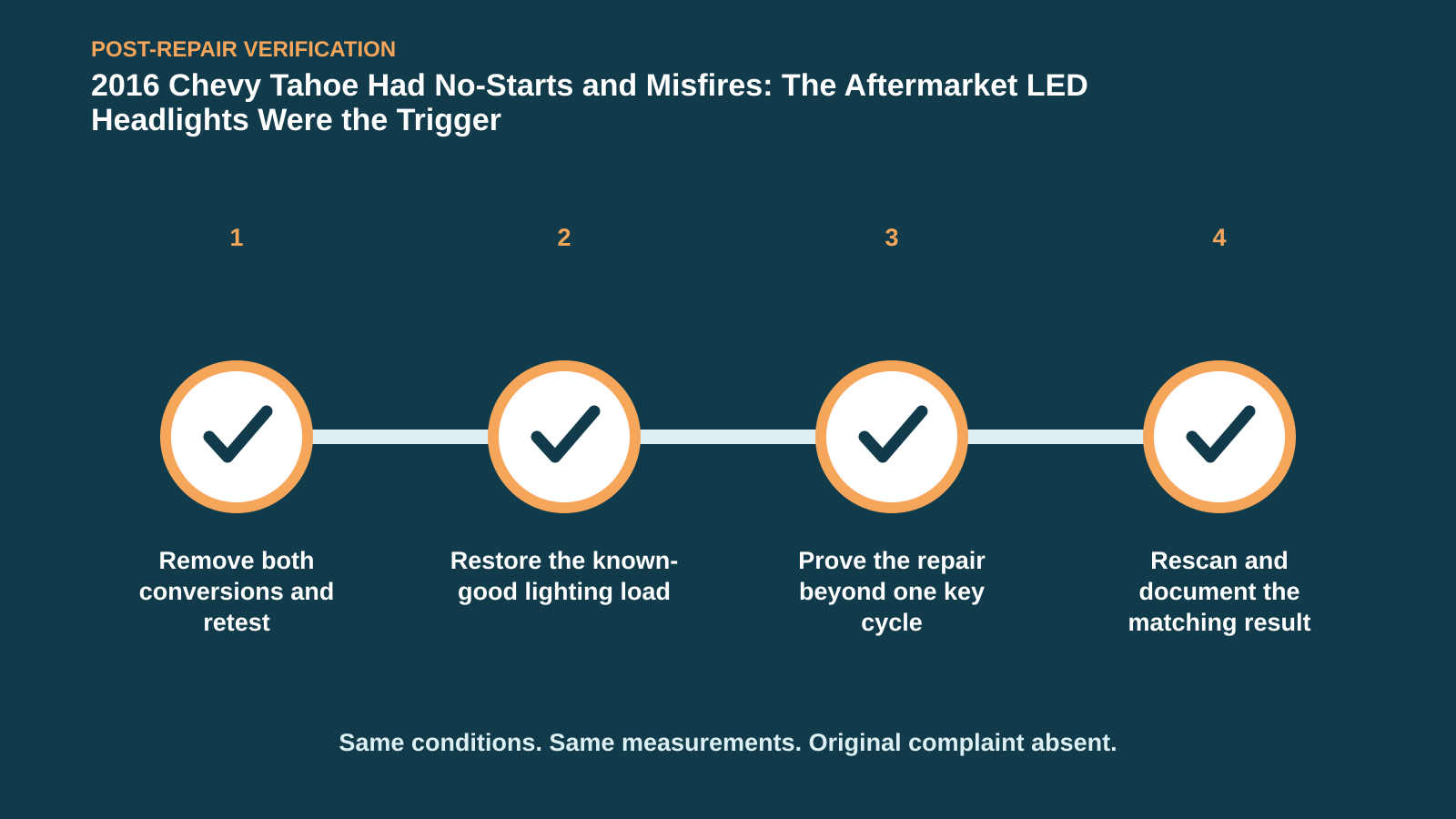
Restore halogen bulbs with correct wattage, seating and connector condition. Inspect for heat damage caused by the previous installation and verify beam aim before road use. The repair target is not merely a dark dashboard; starting, idle, misfire counts, fuel-control codes and lighting operation must all remain normal together. Reassemble protective covers and retainers before declaring success. A diagnostic shortcut must not become the next failure mechanism.
Prove the repair beyond one key cycle
Close the case with repeated ignition cycles, road tests that cover the former failure window and a pending-code rescan. ALLDATA’s case also included a one-month owner follow-up with no recurrence. That longer observation matters because the original complaint was intermittent; one clean five-minute test would have been too weak. Use the customer’s original complaint as the final specification. A cleared code, quiet bay or one good key cycle is not equivalent to reproducing and passing that condition.
If you are bringing a similar symptom to a shop, arrive with the useful conditions rather than a requested part: whether the vehicle was cold or hot, the exact speed or switch position, which warning lamps appeared, what changed after a restart, and a chronological list of earlier repairs. A short video can preserve an intermittent sound or lamp pattern, but record it only while parked or with a passenger handling the camera. Ask the technician to retain the pre-repair scan and measurements, explain the test that separated the failed path from the alternatives, and show how the original complaint was repeated afterward.
For the owner or service adviser, a useful repair explanation has three parts: what was observed, why the decisive test narrowed the fault, and which original condition passed after the repair. It should also say what the test did not prove. That boundary prevents a memorable case from becoming an automatic parts recommendation.
The repeated fuel-system and misfire symptoms were not resolved by another control module. Removing the aftermarket LED bulbs stopped the faults, and reconnecting either one reproduced them; restoring halogen bulbs survived repeated starts, road tests and a later owner follow-up. The reusable lesson is narrower and more valuable: Borrow the mature case’s controlled rechallenge, but separate the demonstrated cause-and-effect from the mechanism the source did not measure.







Comments 0
Questions, fixes, and real-world diagnostic notes from readers.
Be the first to share a diagnostic result or ask a follow-up question.