
2014 Audi A6 Put Engine Oil in the Coolant: The Leak Was Under the Crankcase Vent Valve

Oil In Coolant—Trace Where Fluids Can Cross
Quick answer: No DTC could clear the head gasket, oil cooler or internal seals. The decisive inspection found a torn gasket beneath the crankcase vent valve; replacing it stopped the pressure loss, and staged cooling and lubrication cleanup produced clean fluids after the road test. This article follows one documented vehicle. It explains the evidence chain, not a universal failure rate or a direction to replace the same part on every similar car. Stop whenever the test would involve overheated brakes, high current, moving parts, refrigerant handling or an uncontrolled road condition.
Once the mechanical leak is repaired, a controlled cooling-system flush and exchange machine such as AUTOOL SC611 Cooling System Flush Machine can help remove residual contamination and exchange coolant through an approved service route. It cannot locate the torn gasket, flush the crankcase, prove that oil and coolant no longer communicate, or substitute for Audi fluid specifications and post-cleanup sampling.
Oil in the Audi’s coolant looked like a major internal engine failure. Pressure loss with no external leak justified going deeper, but the contamination path ended at a small torn gasket beneath the crankcase vent assembly.
Quick answer: No DTC could clear the head gasket, oil cooler or internal seals. The decisive inspection found a torn gasket beneath the crankcase vent valve; replacing it stopped the pressure loss, and staged cooling and lubrication cleanup produced clean fluids after the road test.
In this guide
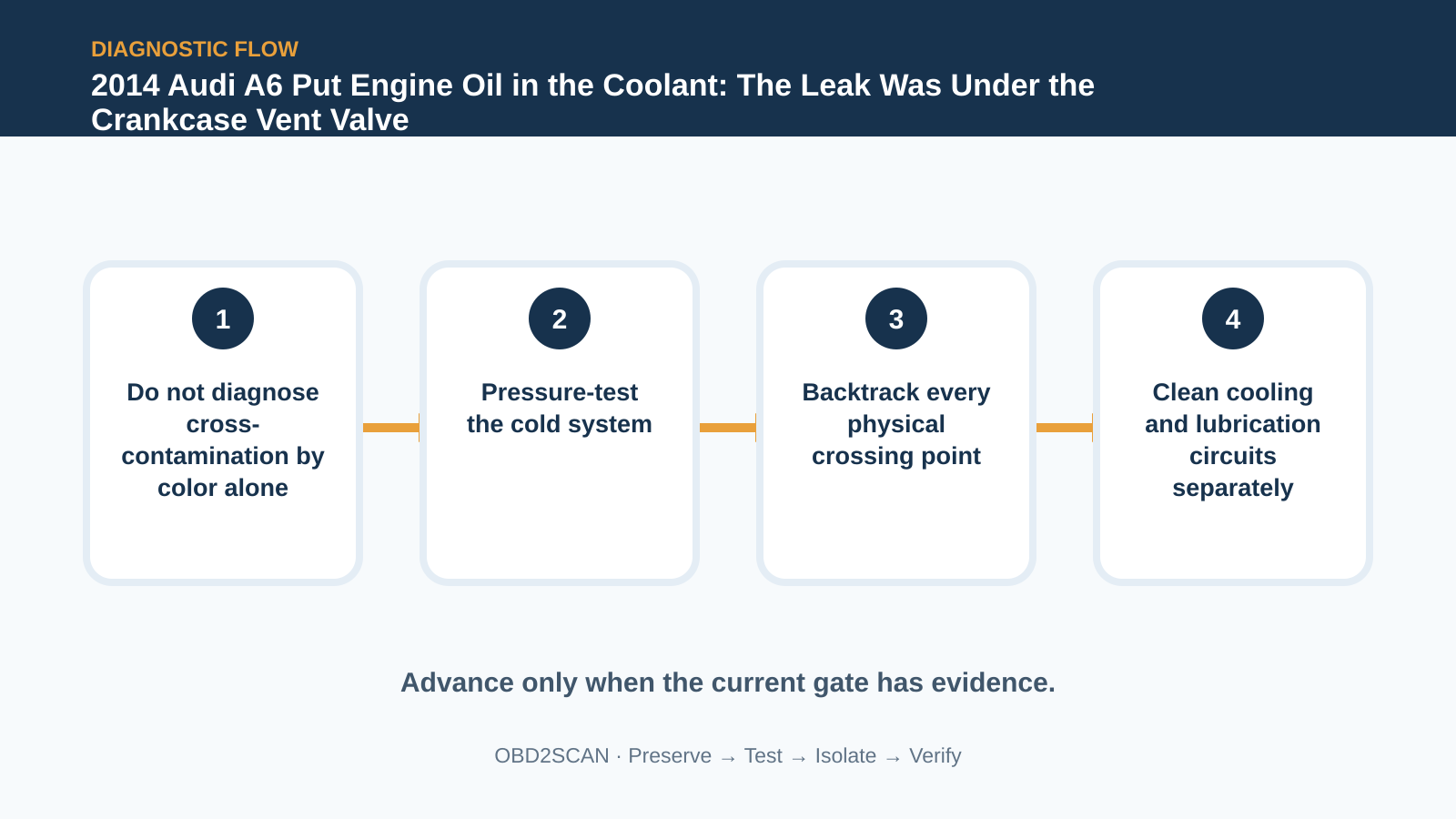
- Do not diagnose cross-contamination by color alone
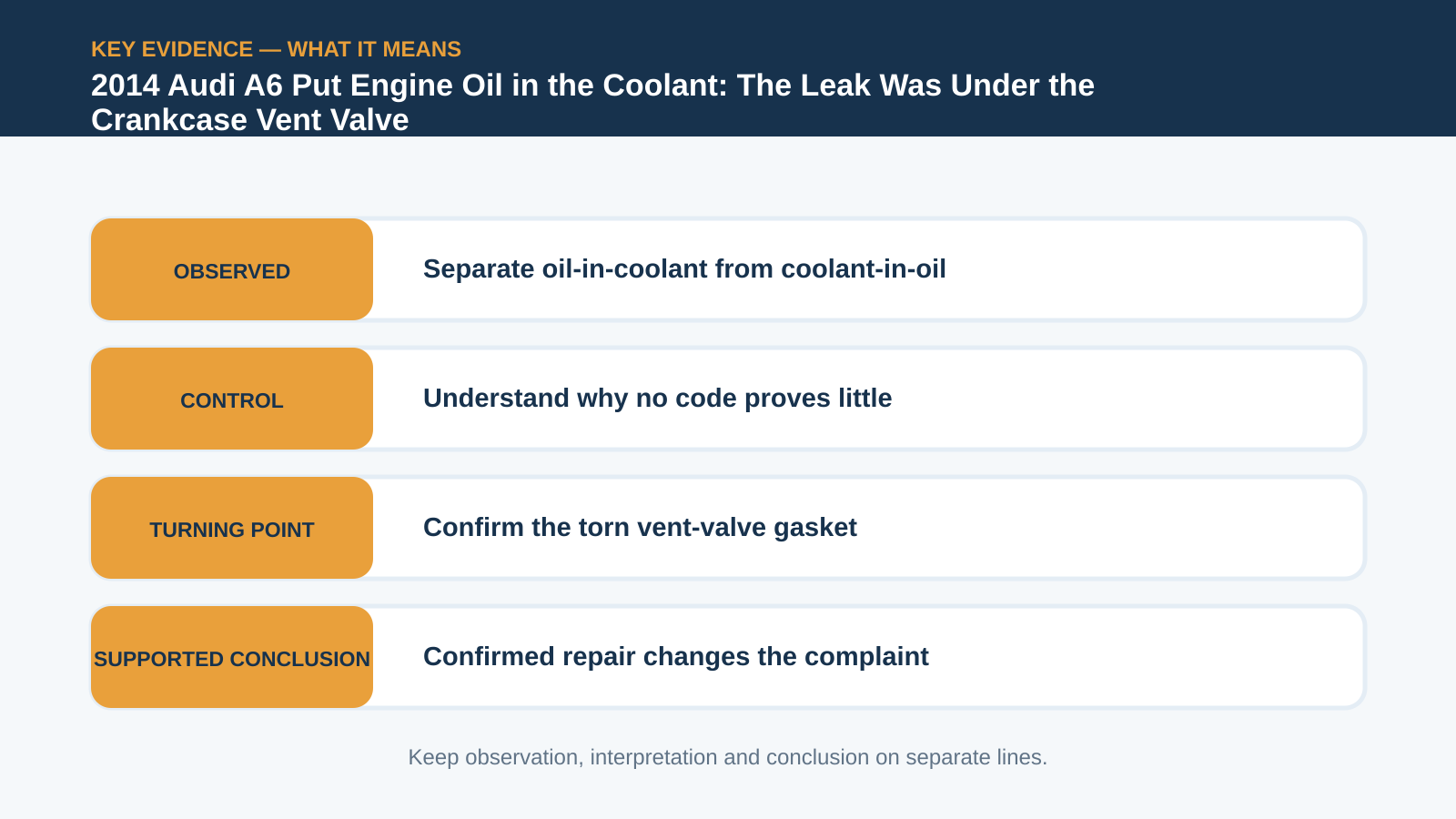
- Separate oil-in-coolant from coolant-in-oil
- Pressure-test the cold system
- Understand why no code proves little
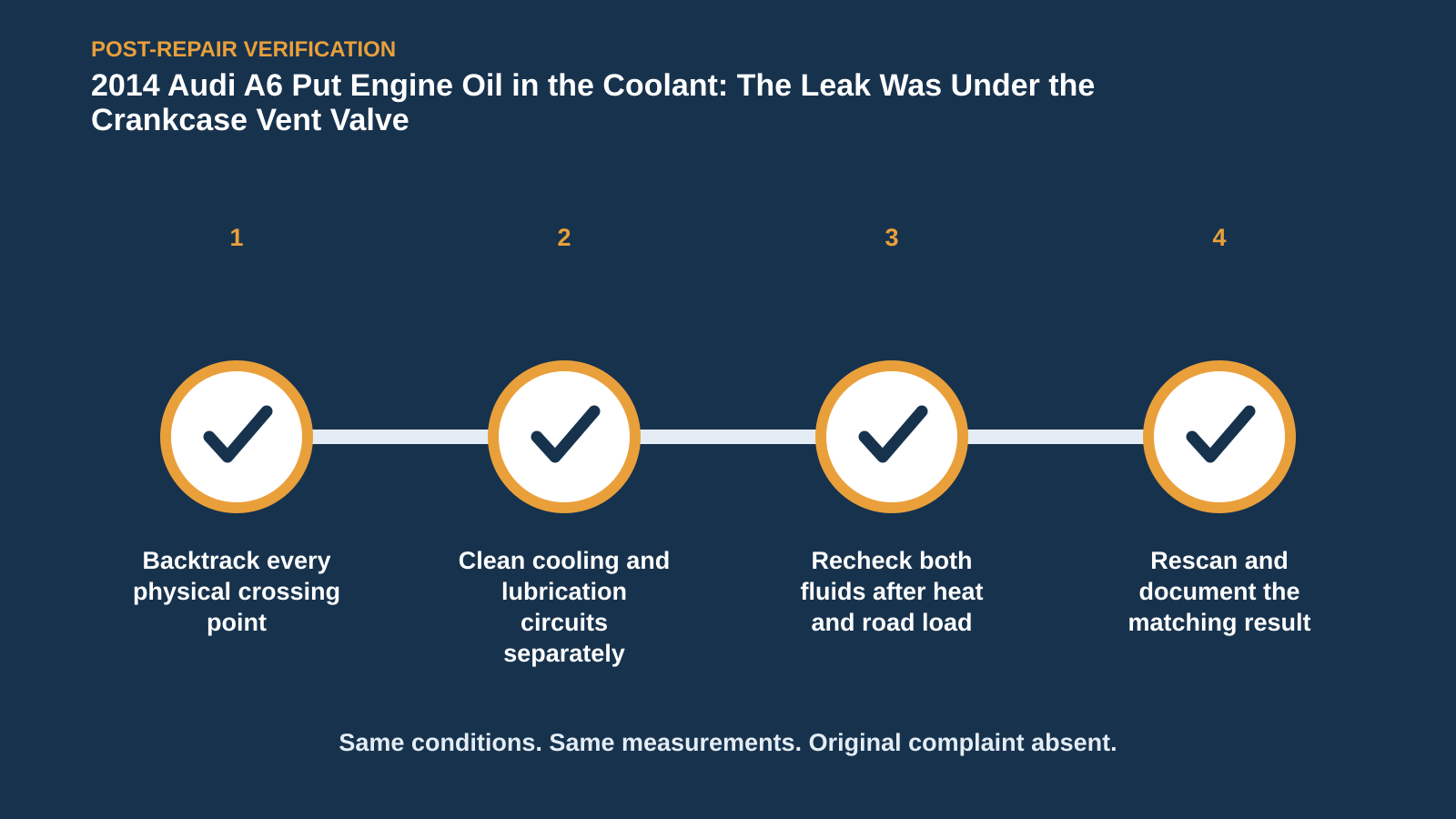
- Backtrack every physical crossing point
- Confirm the torn vent-valve gasket
- Clean cooling and lubrication circuits separately
- Recheck both fluids after heat and road load
Do not diagnose cross-contamination by color alone
Confirm what has crossed where. Oil floating in the expansion tank differs from coolant emulsifying the crankcase, and both fluids may be affected. Collect clean samples when cold, note levels and stop driving if lubrication or coolant quantity is unsafe. Color alone cannot identify the failed interface. Preserve the original condition before changing it. The first observation is the control sample against which every later test must be compared.
Separate oil-in-coolant from coolant-in-oil
No DTCs were stored. A head gasket, oil cooler or static seal can leak fluids without violating an electrical monitor. Do not use a clean scan to rule out mechanical paths; use it only to note that the controller did not record a monitored fault. Use service information for the exact engine, build date and options. A correct method on the wrong terminal can create a precise but useless result.
Pressure-test the cold system
Pressure-test the cold cooling system with the correct cap adapter and limit. The pressure fell quickly in this case. Clamp or isolate a suspected cooler only if the OEM procedure allows it; hoses can be damaged, and an internal path elsewhere can make that branch inconclusive. Treat prior work as evidence, not blame. A repair that made no change can narrow the case when its installation and test conditions are verified.
Understand why no code proves little
List every place pressurized oil and coolant pass near one another on the 3.0T engine. The crankcase ventilation assembly sits over an area where its gasket matters to fluid separation. Service history can help prioritize it, but physical access and inspection must provide the decision. At this stage, separate what was observed from what is inferred. The observation should remain true even if the current theory is later rejected.
| Observation | What it supports | What it does not prove |
|---|---|---|
| Oil appears in coolant | A fluid crossing exists | Head gasket is failed |
| No DTCs | No monitored electrical fault is stored | Mechanical sealing is good |
| Pressure falls; vent gasket is torn | A physical crossing point is supported | Cleanup is complete |
| Fresh samples stay clean after road test | Repair and cleanup held in this case | Every 3.0T contamination case is identical |
Backtrack every physical crossing point
Removing the crankcase vent valve revealed a torn gasket. Inspect the housing and mating surface for distortion, debris and cracks so the new seal is not asked to compensate for damaged parts. Replace fasteners and follow tightening sequence where required. This is the decision point in the documented case. Its value comes from changing one bounded condition while leaving the rest of the system intact.
Confirm the torn vent-valve gasket
A pressure hold after replacement confirmed that the immediate crossing path no longer leaked under the test condition. That is the mechanical-repair check, not the cleanup check. Contaminated coolant and oil can remain in passages and create a false impression that the leak continues. A confirmed component still needs a repair that restores sealing, support, torque, routing or terminal fit—the physical conditions that keep the fault from returning.
Clean cooling and lubrication circuits separately
Flush the cooling circuit and service the lubrication circuit separately with fluids and methods approved for the vehicle. The documented case used staged oil changes after removing coolant contamination. Never use an aggressive chemical or machine connection solely because residue is difficult to remove. Reassemble protective covers and retainers before declaring success. A diagnostic shortcut must not become the next failure mechanism.
Recheck both fluids after heat and road load
Bring the engine through full heat cycles, road-test it, allow it to cool and inspect fresh samples from both systems. Recheck pressure, levels and new residue. Closure requires no renewed crossing and safe fluid condition; a newly dry gasket surface alone is not enough. Use the customer’s original complaint as the final specification. A cleared code, quiet bay or one good key cycle is not equivalent to reproducing and passing that condition.
If you are bringing a similar symptom to a shop, arrive with the useful conditions rather than a requested part: whether the vehicle was cold or hot, the exact speed or switch position, which warning lamps appeared, what changed after a restart, and a chronological list of earlier repairs. A short video can preserve an intermittent sound or lamp pattern, but record it only while parked or with a passenger handling the camera. Ask the technician to retain the pre-repair scan and measurements, explain the test that separated the failed path from the alternatives, and show how the original complaint was repeated afterward.
For the owner or service adviser, a useful repair explanation has three parts: what was observed, why the decisive test narrowed the fault, and which original condition passed after the repair. It should also say what the test did not prove. That boundary prevents a memorable case from becoming an automatic parts recommendation.
No DTC could clear the head gasket, oil cooler or internal seals. The decisive inspection found a torn gasket beneath the crankcase vent valve; replacing it stopped the pressure loss, and staged cooling and lubrication cleanup produced clean fluids after the road test. The reusable lesson is narrower and more valuable: Tell the case as two connected jobs—locating the crossing point and removing what already crossed—so the repair is not declared finished at gasket replacement.









Comments 0
Questions, fixes, and real-world diagnostic notes from readers.
Be the first to share a diagnostic result or ask a follow-up question.