
2011 Ford F-150 Cranked but Would Not Start: Fuse 75 Made Contact Only When It Moved

Pcm Power Returns When The Fuse Moves?
Quick answer: The starter was doing its job, but the PCM was offline because its fuse connection was not carrying power reliably. Cleaning and tightening the terminal contact and replacing the marked fuse restored PCM communication and normal starting. This article follows one documented vehicle. It explains the evidence chain, not a universal failure rate or a direction to replace the same part on every similar car. Stop whenever the test would involve overheated brakes, high current, moving parts, refrigerant handling or an uncontrolled road condition.
Once service information identifies the correct PCM feed, a long-reach automotive circuit tester can compare power at both fuse blades and farther down the path; MRCARTOOL B530 Automotive Circuit Tester fits that narrow check without requiring the harness to be cut. It cannot measure terminal grip by itself, justify powering an unknown circuit, or replace voltage-drop and heat-damage inspection under the actual load.
The F-150’s starter cranked normally while the PCM stayed silent. Then a test probe moved fuse 75 and the controller woke up—a tiny state change that separated an intact fuse element from an unreliable fuse connection.
Quick answer: The starter was doing its job, but the PCM was offline because its fuse connection was not carrying power reliably. Cleaning and tightening the terminal contact and replacing the marked fuse restored PCM communication and normal starting.

In this guide
- Read the warning flood as one missing node
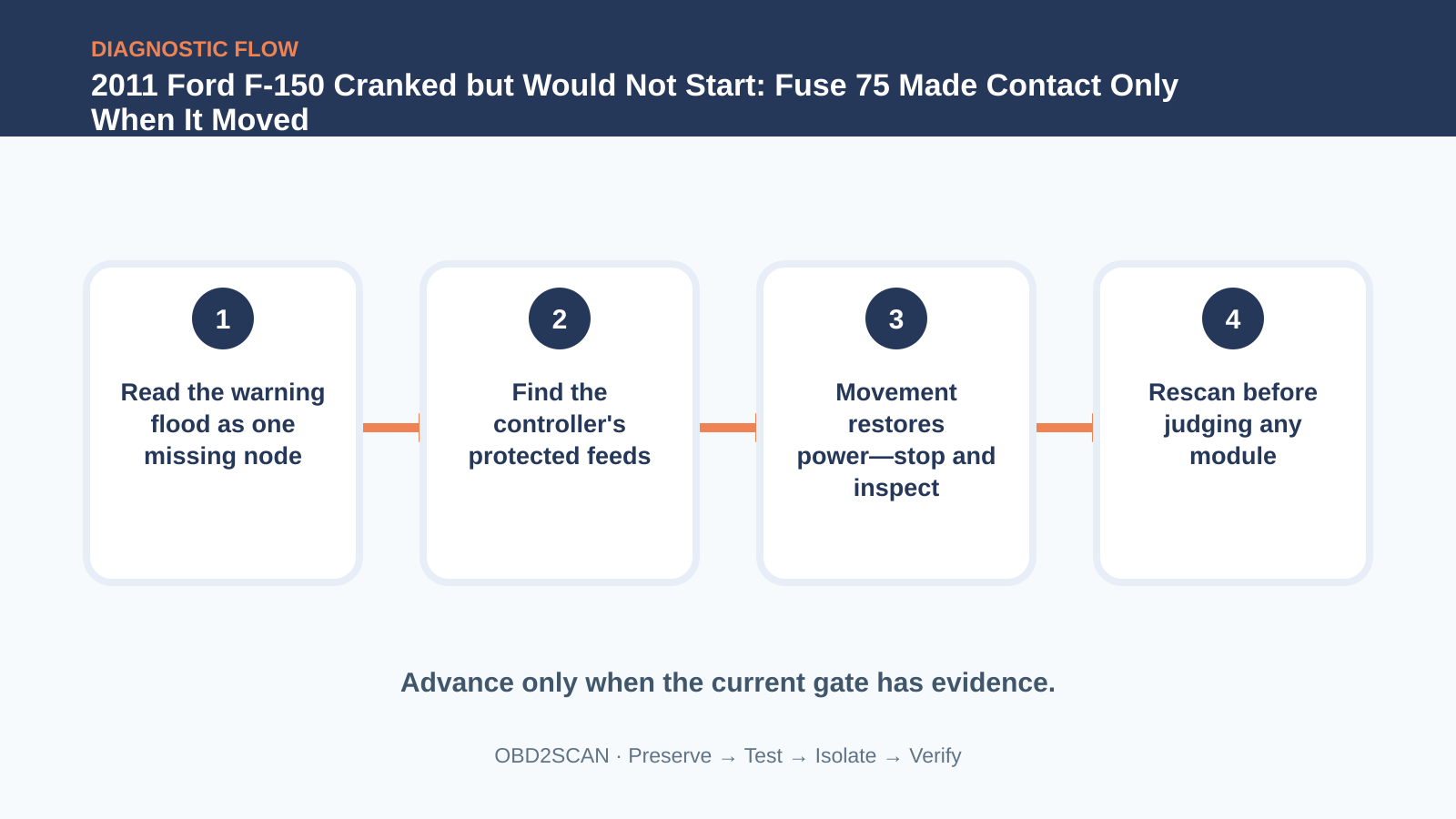
- Confirm the PCM is actually offline
- Find the controller’s protected feeds
- Test both sides without forcing the cavity
- Movement restores power—stop and inspect
- Repair grip, surface and fuse together
- Rescan before judging any module
- Repeat hot and vibration-prone starts
Read the warning flood as one missing node
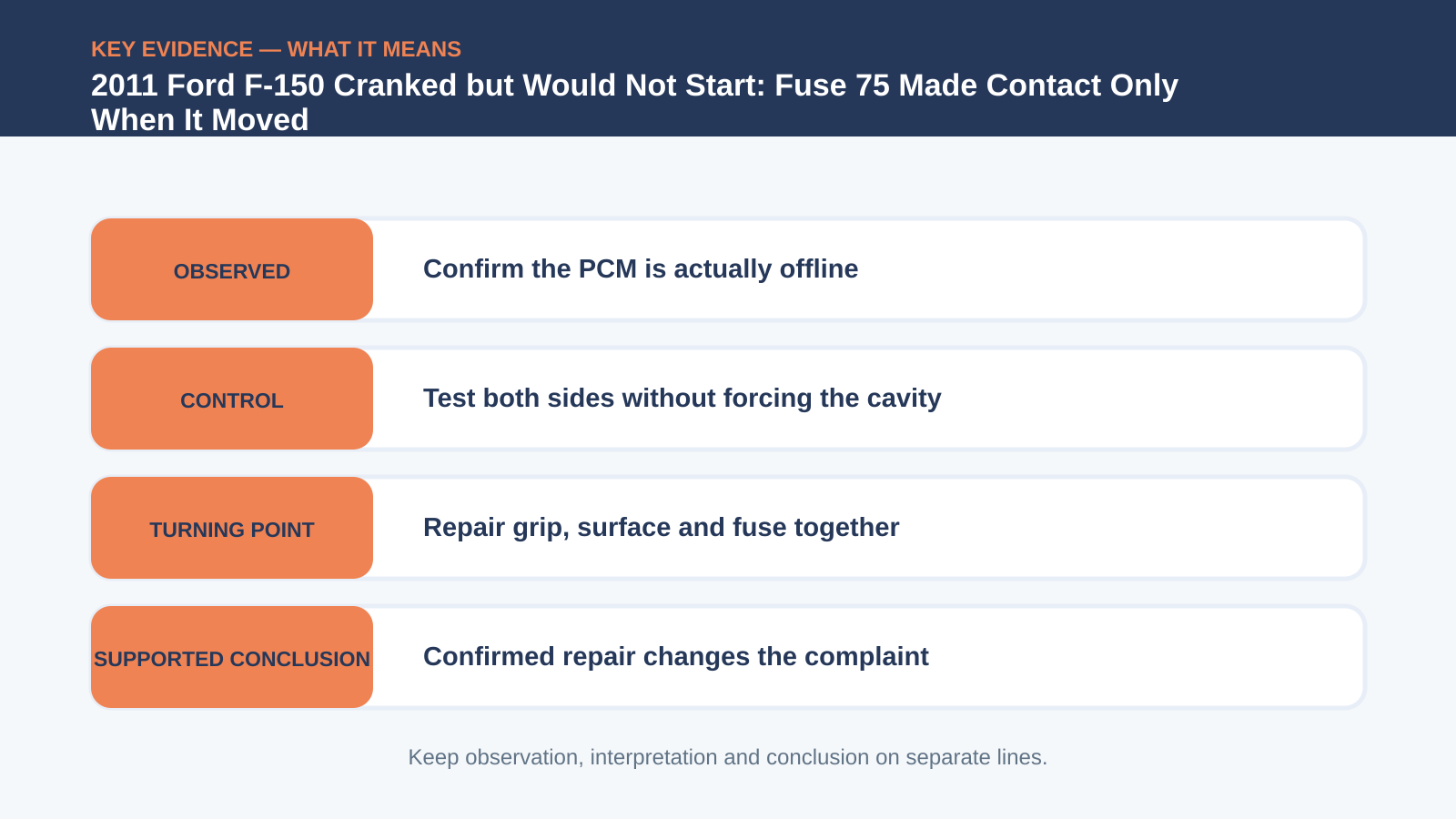
A crank/no-start with a dark MIL and no PCM communication should be treated as a controller prerequisite problem before a fuel or antitheft problem. Record which warning messages appear, which modules still answer and whether the tachometer moves during cranking. Several dramatic warnings can all be consequences of one absent PCM. Preserve the original condition before changing it. The first observation is the control sample against which every later test must be compared.
Confirm the PCM is actually offline
Use the exact F-150 wiring information to identify every PCM feed and ground. A fuse can look intact while its blades fail to carry current through a loose or heat-damaged terminal. Test on both sides at the smallest safe access point and avoid pushing an oversized probe into the cavity. Use service information for the exact engine, build date and options. A correct method on the wrong terminal can create a precise but useless result.
Find the controller’s protected feeds
In this case PCM fuse 75 did not supply the controller consistently. While the technician was checking it, moving the test probe caused power to return. That state change is more informative than a static continuity beep, because it shows the measurement disturbed a poor mechanical connection. Treat prior work as evidence, not blame. A repair that made no change can narrow the case when its installation and test conditions are verified.
Test both sides without forcing the cavity
Stop wiggling once the symptom changes and remove power as required before inspection. Repeated movement can polish, spread or arc the contact and erase evidence. The fuse blades and terminal contacts showed black marks, consistent with a connection that had generated heat or arcing rather than a simply blown fuse element. At this stage, separate what was observed from what is inferred. The observation should remain true even if the current theory is later rejected.
| Observation | What it supports | What it does not prove |
|---|---|---|
| PCM is offline while engine cranks | Controller prerequisites come first | Starter operation proves PCM power |
| Fuse element looks intact | The element is not visibly open | Its terminals carry load reliably |
| Probe movement restores feed | Connection is movement-sensitive | Wiggling is an acceptable repair |
| Contact repair restores starting | Fuse cavity was causal here | Every no-comm F-150 needs fuse 75 |
Movement restores power—stop and inspect
Inspect the surrounding plastic for distortion, compare terminal grip with the approved gauge and check whether the conductor or bus below the cavity is discolored. Cleaning only the visible blade may leave weak spring tension behind. Follow Ford’s service method for the terminal or fuse-box repair instead of bending it blindly. This is the decision point in the documented case. Its value comes from changing one bounded condition while leaving the rest of the system intact.
Repair grip, surface and fuse together
Install the correct-rated replacement fuse after restoring the contact. Never increase amperage to keep a marginal connection alive. With the circuit loaded, compare voltage at battery positive, both fuse sides and the PCM feed so the final drop belongs within the service limit. A confirmed component still needs a repair that restores sealing, support, torque, routing or terminal fit—the physical conditions that keep the fault from returning.
Rescan before judging any module
When communication returns, scan the entire vehicle before clearing the record. Many warning messages should disappear once the PCM is online, but unrelated codes may remain. Confirm normal fuel and ignition control rather than treating network presence alone as permission to release the truck. Reassemble protective covers and retainers before declaring success. A diagnostic shortcut must not become the next failure mechanism.
Repeat hot and vibration-prone starts
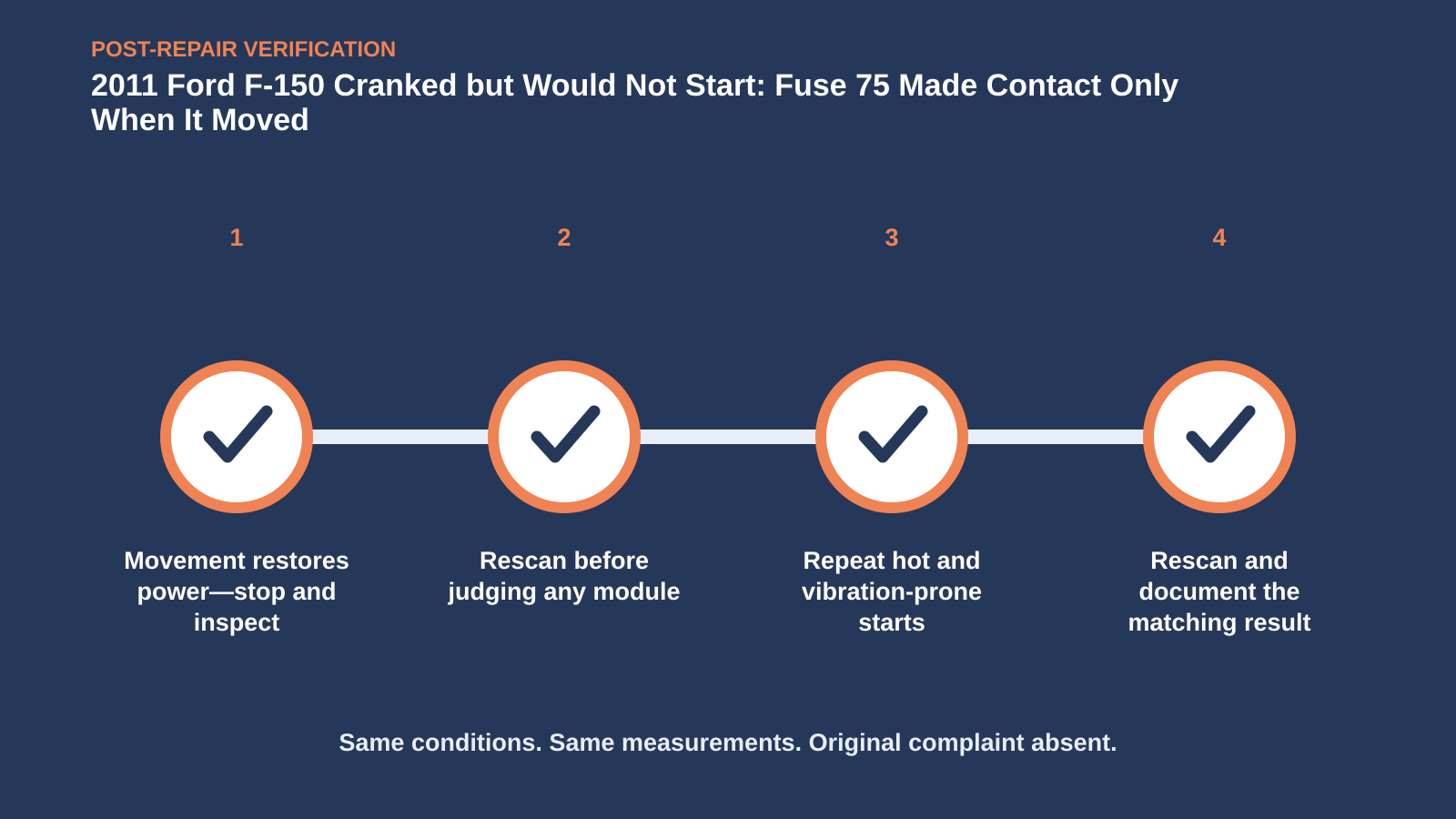
Repeat cold and hot starts, add a controlled vibration check around the repaired fuse box and inspect for renewed temperature rise. The transferrable lesson is simple: an intact fuse answers whether its element is open; it does not answer whether the fuse and its terminal can deliver power under load. Use the customer’s original complaint as the final specification. A cleared code, quiet bay or one good key cycle is not equivalent to reproducing and passing that condition.
If you are bringing a similar symptom to a shop, arrive with the useful conditions rather than a requested part: whether the vehicle was cold or hot, the exact speed or switch position, which warning lamps appeared, what changed after a restart, and a chronological list of earlier repairs. A short video can preserve an intermittent sound or lamp pattern, but record it only while parked or with a passenger handling the camera. Ask the technician to retain the pre-repair scan and measurements, explain the test that separated the failed path from the alternatives, and show how the original complaint was repeated afterward.
For the owner or service adviser, a useful repair explanation has three parts: what was observed, why the decisive test narrowed the fault, and which original condition passed after the repair. It should also say what the test did not prove. That boundary prevents a memorable case from becoming an automatic parts recommendation.
The starter was doing its job, but the PCM was offline because its fuse connection was not carrying power reliably. Cleaning and tightening the terminal contact and replacing the marked fuse restored PCM communication and normal starting. The reusable lesson is narrower and more valuable: Use the probe-induced recovery as the turning point: a good fuse element and a good fuse connection are different test results.










Comments 0
Questions, fixes, and real-world diagnostic notes from readers.
Be the first to share a diagnostic result or ask a follow-up question.