
2021 Toyota RAV4 Stalled With No Codes: The Battery Failed the Test Everyone Skipped

Stalls With No Codes? Test The Battery Under Load
Three shops had already replaced plausible parts, yet the RAV4 still stalled at lights, at idle and sometimes on the road. It restarted and stored no codes, which made every successful restart tempting evidence that the problem was gone. The useful reset was to stop asking which airflow part had been missed and test whether the vehicle’s electrical foundation remained credible under load.
One useful machine class at this stage is a bounded measurement tool, chosen only after the circuit or system question is defined. The AUTOOL BT360 is one route for that supporting task. BT360 can assess a compatible 12-volt starting battery and support cranking and charging checks. It cannot reproduce the stall, load-test every ground, read Toyota data or prove the battery is the only fault.
This article follows one documented vehicle. Its cause is a useful diagnostic pattern, not a failure-rate claim and not permission to replace the same part on a similar symptom. The goal is to show which evidence changed the decision and how the repair was verified.
Quick answer: No code or intake fault explained the stall. The battery failed under load, and replacement with connection service and a new relearn produced a successful road test.
In this guide
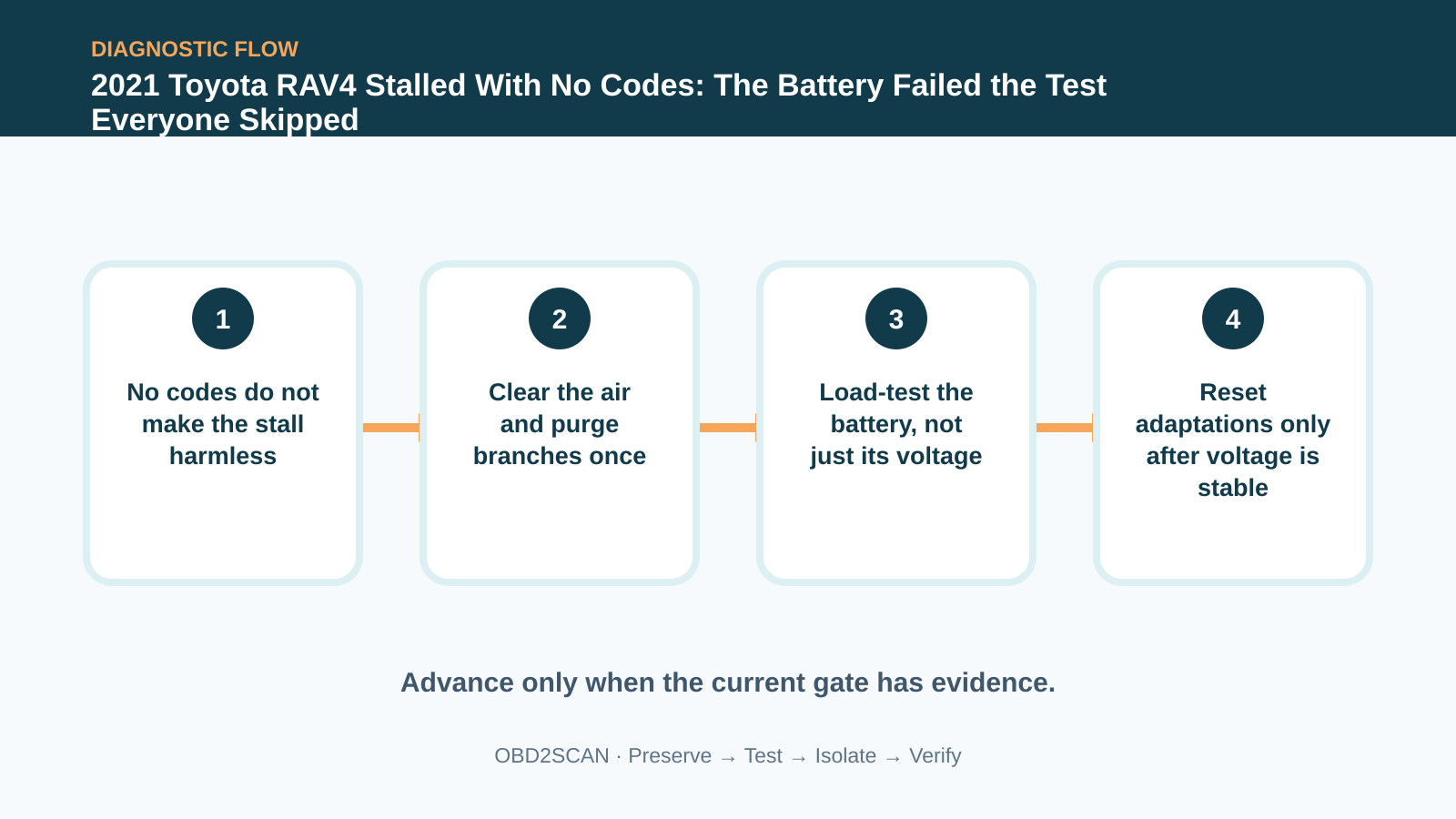
- No codes do not make the stall harmless
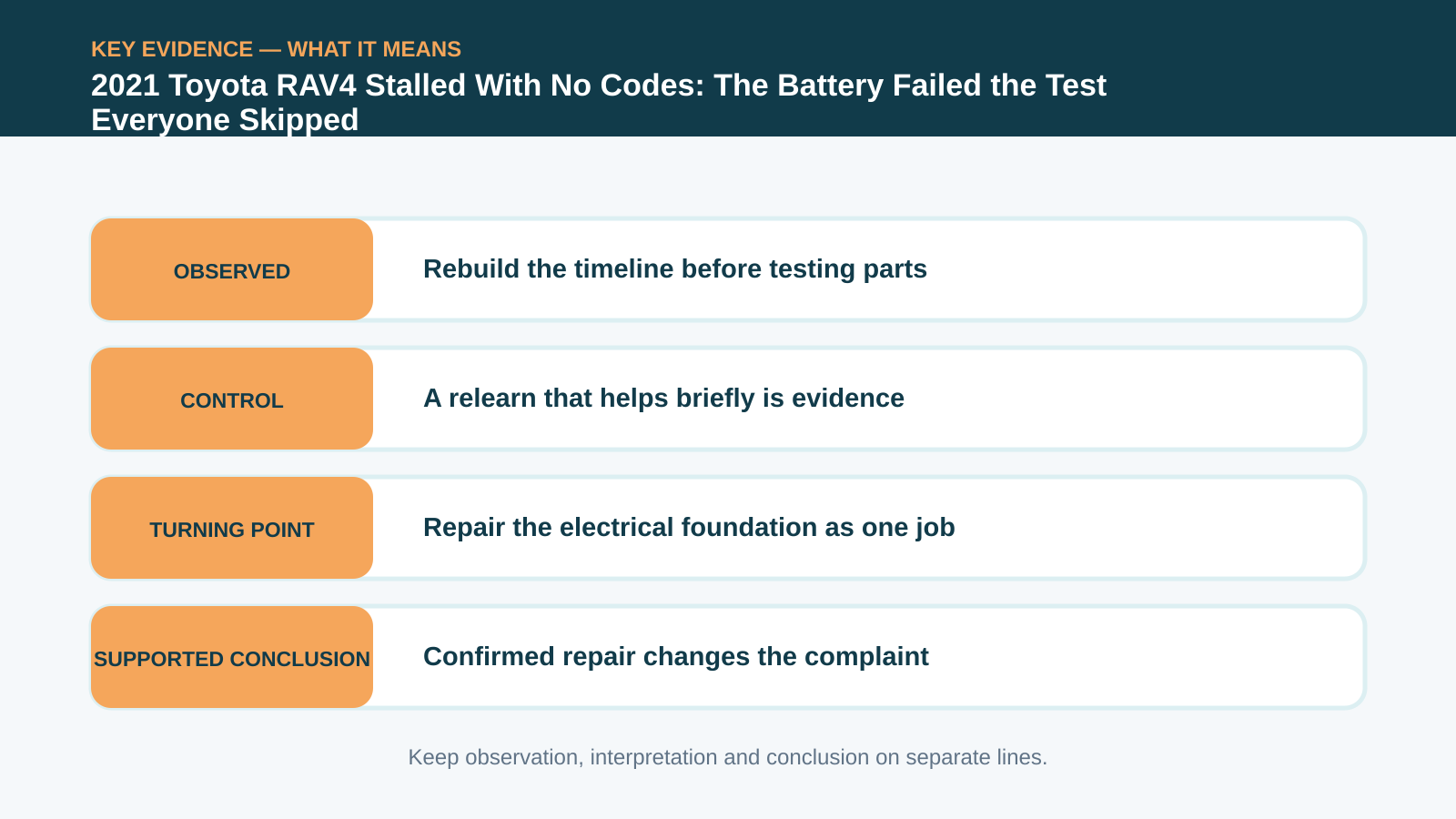
- Rebuild the timeline before testing parts
- Clear the air and purge branches once
- A relearn that helps briefly is evidence
- Load-test the battery, not just its voltage
- Repair the electrical foundation as one job
- Reset adaptations only after voltage is stable
- Repeat the road condition that made it stall
No codes do not make the stall harmless
Treat a stall in traffic as a safety issue. Record whether it occurs stopped, coasting or under load and whether steering or brake assist changes; tow the vehicle when repeat operation is not safe. Keep the vehicle in the failed state long enough to capture evidence, but never extend a test beyond the point where a stall, brake event, refrigerant release or moving component creates risk.
Rebuild the timeline before testing parts
List the MAF sensor, purge valve and plugs already replaced, but retest functions rather than trusting or condemning those parts. Save a full scan, freeze frames and battery history before clearing adaptations. Write down the conditions before disconnecting anything. That record is what lets a later change mean something instead of becoming another uncontrolled attempt.
Clear the air and purge branches once
A controlled intake smoke test found no leak, and purge and MAF behavior were plausible. Those results closed specific branches for that test period; they did not certify the entire engine-management system. Use service information for the exact engine, build and option set. A correct test on the wrong pin or configuration can produce a precise but useless answer.
A relearn that helps briefly is evidence
Reset adaptations and idle relearn stabilized the engine in the bay, but the stall returned on the road. A temporary improvement suggested learned control and supply stability deserved attention rather than another airflow component. This is the turning point in the documented case. It gains weight because earlier branches were tested and because the symptom changed with one controlled condition.
| Observation | What it supports | What it does not prove |
|---|---|---|
| No DTCs | Fault may be outside code thresholds | Vehicle is healthy |
| Smoke/purge/MAF pass | Those branches are less likely | Battery is good |
| Relearn helps briefly | Supply/learned control deserve review | Relearn is the repair |
| Battery fails load test | Battery cannot meet test demand | No other checks are needed |
Load-test the battery, not just its voltage
Open-circuit voltage can look normal on a weak battery. Test the correct battery type at a known state of charge, record conductance or load result, and inspect voltage behavior during cranking and electrical demand. Separate observation from inference: record what moved, opened, failed or remained stable, then state only the component or path that result actually narrows.
Repair the electrical foundation as one job
The confirmed repair combined battery replacement with cleaning terminals and grounds. Treating those contacts as part of the job matters because a new battery connected through resistance can preserve resets and unstable control voltage. The repair must remove the demonstrated mechanism and restore mechanical support, sealing, torque or terminal fit—not merely make the symptom disappear once.
Reset adaptations only after voltage is stable
Only after stable voltage should adaptations be reset and the Toyota idle relearn repeated. Otherwise the controller may learn while supply voltage is moving, and a good procedure produces an ambiguous result. Reassemble to the original protection standard. Clear codes only after preserving the pre-repair record and confirming the relevant controller is online.
Repeat the road condition that made it stall
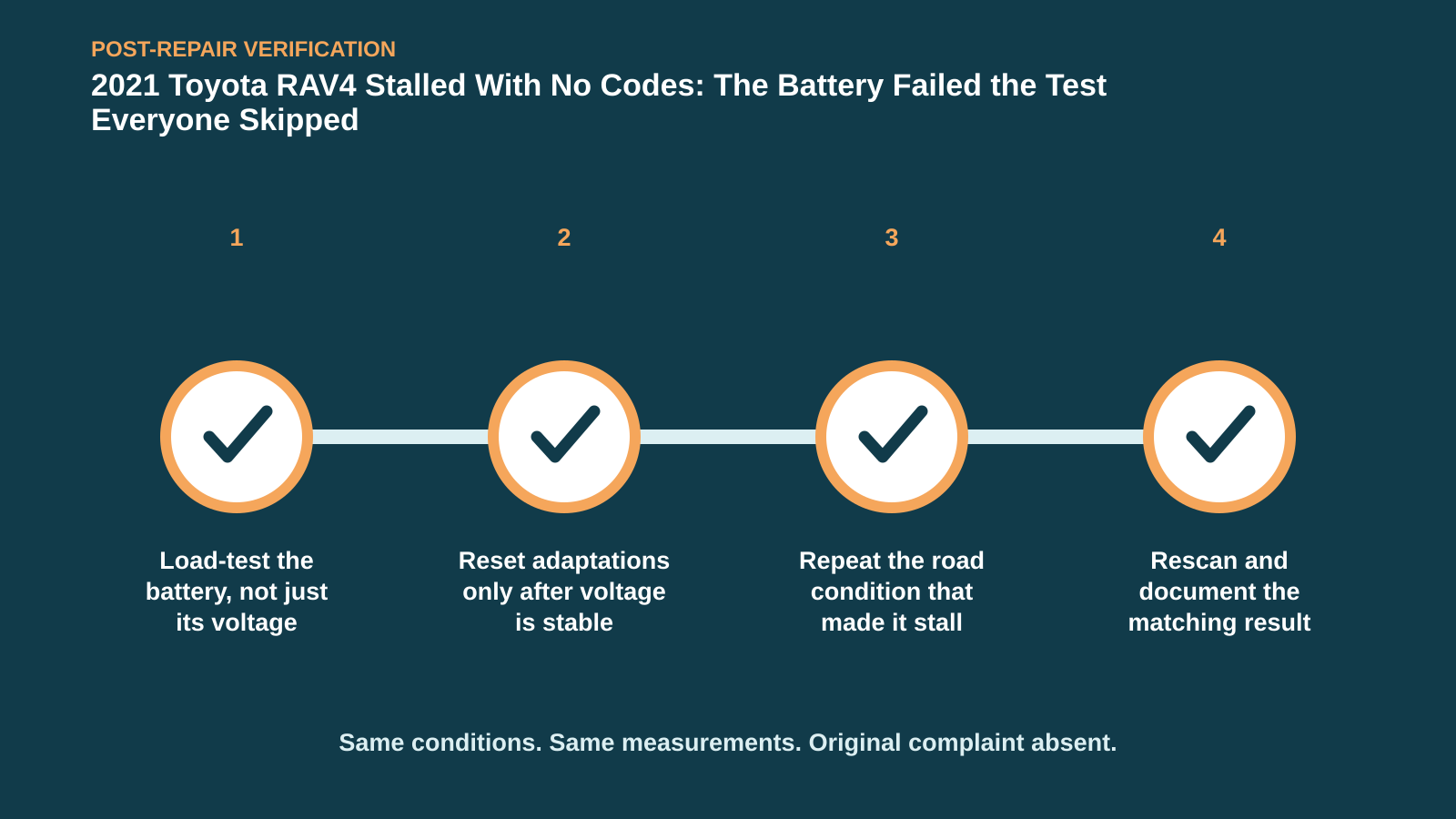
Repeat idle, stops, low-speed transitions and an extended road drive. The source reported a good test drive; readers should also rescan for pending faults and document battery, cranking and charging evidence. Use the customer’s original complaint as the final test specification. Matching conditions and a post-repair scan are stronger closure than a quiet bay or a cleared warning lamp.
For the owner or service adviser, the useful explanation has three parts: what was observed, why the decisive test narrowed the fault, and which original condition was repeated after repair. It should not promise that every similar vehicle needs the same component. This was one evidence chain on one vehicle, and the appropriate next step on another car may change with build data, prior work, safety condition and test results. That honest boundary makes the case easier to trust and more useful at the next diagnostic visit.
No code or intake fault explained the stall. The battery failed under load, and replacement with connection service and a new relearn produced a successful road test. The reusable lesson is narrower and more valuable: Reverse a parts-cannon story by returning to battery condition, connections and verification without shaming prior work.



Comments 0
Questions, fixes, and real-world diagnostic notes from readers.
Be the first to share a diagnostic result or ask a follow-up question.