
2005 Mitsubishi Endeavor Lost All Power With the Key Out: The ETACS ECU Was the Link

No Start, Then No Body Power
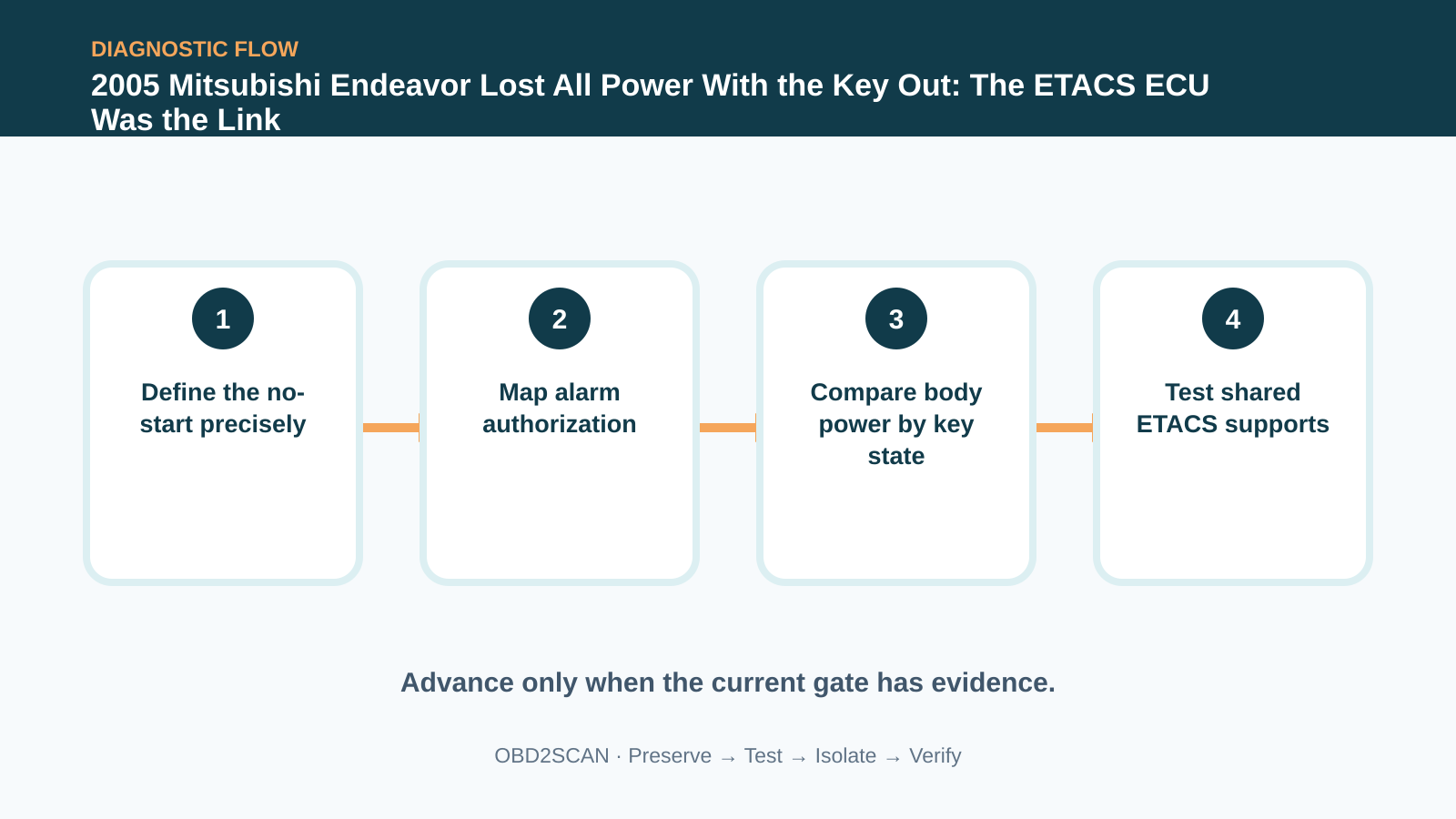
The 2005 Mitsubishi Endeavor did not start. When the alarm path was bypassed during diagnosis, the engine could run—but removing the key then caused all body power to disappear. Dome lamps, hazards and headlights went dark even though the obvious headlamp fuses were intact. Those five observations are enough to teach a useful path, but the published record is too brief to support an invented hour-by-hour test diary.
A breakout box can expose identified OBD-II power, ground and communication pins during a no-start triage. The AUTOOL OBD2 Breakout Box Premium is one option for that non-intrusive access. The breakout box can expose identified OBD-II power, ground and communication pins for safe measurement. It cannot bypass the immobilizer, diagnose ETACS from the symptom list alone or program VINs and keys.
The documented repair was replacement of the ETACS ECU, followed by programming the VIN and keys. Starting, lights and accessories returned. Because the source does not provide connector voltages, network waveforms or a complete elimination sequence, this case is best read as an annotated symptom-and-repair brief—not proof that every Endeavor with lost body power needs an ETACS module.
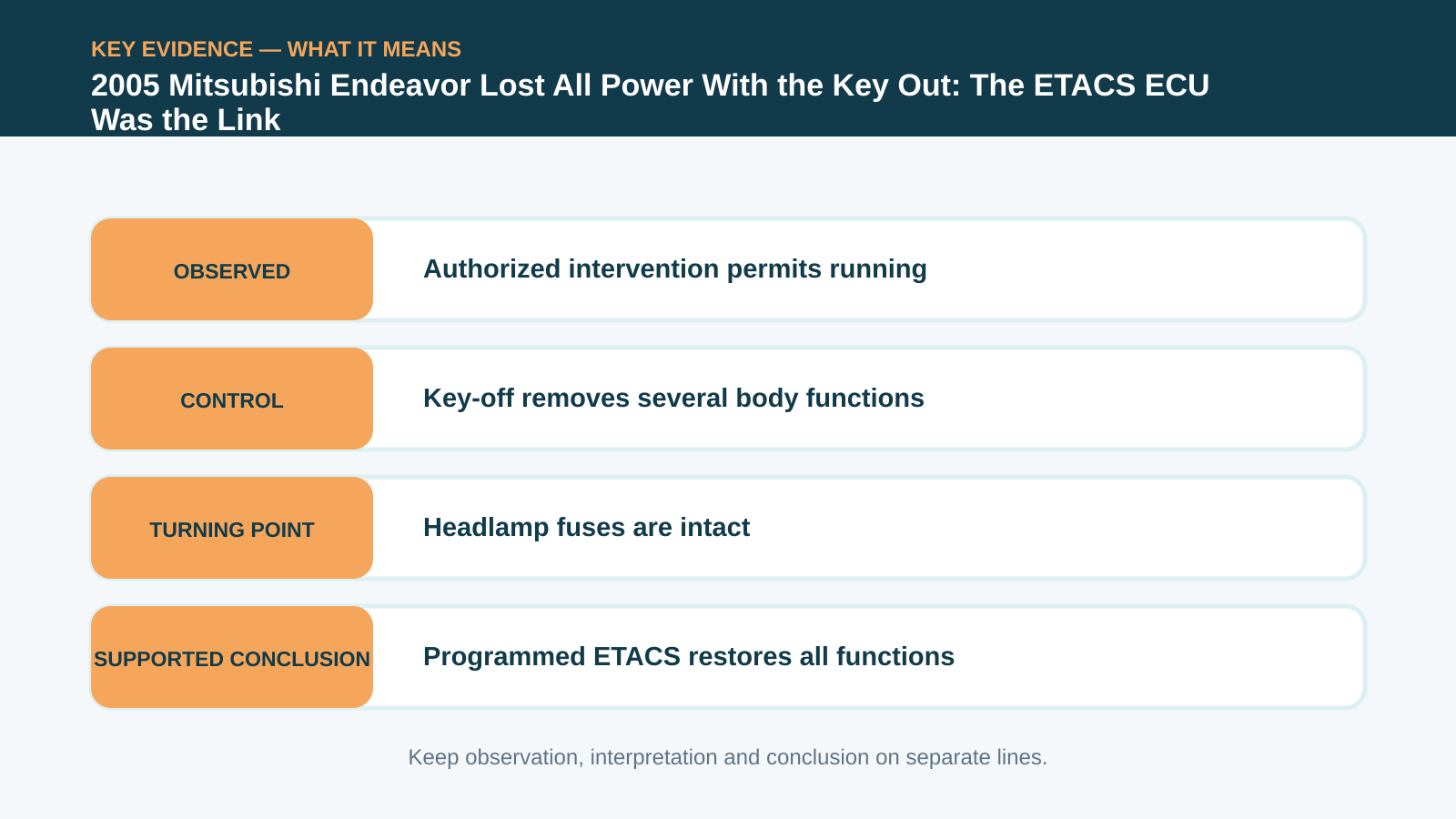
Quick answer: The Endeavor could run after authorized alarm-path intervention but lost multiple body functions with the key out. Programmed ETACS replacement restored all of them.

In this guide
- Observation one: the engine does not start
- Observation two: the alarm path changes the outcome
- Observation three: key-off body power disappears
- Observation four: the obvious headlamp fuses are intact
- What these observations support
- What the sparse record does not prove
- Replacement requires identity and key programming
- Verify every function that shared the failure
Observation one: the engine does not start
Before touching the security system, identify whether “no start” means no crank, crank with no fire or start-and-stall. Record security-lamp behavior and test both authorized keys. Verify battery condition and terminal voltage under an attempted start. Do not publish or use bypass methods outside an authorized diagnostic setting; immobilizer work requires proof of ownership and careful key control. The mature case states that bypassing the alarm path allowed running, but it does not give a safe procedure to reproduce.
Observation two: the alarm path changes the outcome
That change tells us the engine can run when start authorization is satisfied. It does not identify whether the key, antenna, ETACS controller, wiring or another module caused the denial. Scan every reachable controller and save immobilizer and body codes before clearing. Compare key-recognition data, authorization state and start request using Mitsubishi information. A bypass result is a direction toward the security/body-control chain, not a license to replace the most expensive controller in it.
Observation three: key-off body power disappears
The stranger symptom appeared with the key removed: dome lamps, hazard lamps and headlights all lost power. Build a function matrix showing what works in ACC, ON, START and OFF. Functions that fail together may share a body-controller output, retained-power logic, junction block or feed. Verify whether exterior lamps fail at the bulbs, relay control or supply. That key-state pattern is more useful than saying the vehicle has an “electrical problem.”
Observation four: the obvious headlamp fuses are intact
Headlamp fuses were reported good. Confirm that claim with voltage on both sides under load, then inspect the upstream feed and downstream command. A good fuse narrows one link; it does not prove the relay, module, ground or current path. Because several unrelated body loads vanish together, avoid tracing each lamp separately until the shared ETACS/junction architecture is understood. One diagram can prevent three parallel parts-swapping exercises.
What these observations support
Taken together, the symptoms support focused ETACS power, ground, input and output testing. They do not reveal the missing measurement values, so do not supply fictional numbers. A complete diagnosis would load-check all controller feeds and grounds, verify ignition-switch states, inspect network integrity and confirm the module receives valid key information. If a feed is missing, repair the circuit; if the module’s inputs are correct but its body-power and authorization functions fail together, replacement becomes credible.
| Documented observation | What it supports | What it does not prove alone |
|---|---|---|
| Engine will run after authorized alarm-path intervention | Basic engine operation is possible | Exact immobilizer component failed |
| Key removal kills several body functions | Key-state/body-control dependency exists | Battery is healthy or ETACS is certainly bad |
| Headlamp fuses are intact | Obvious fused link is not open | Power reaches the lamps under load |
| ETACS replacement/programming restores all functions | ETACS assembly was responsible in this vehicle | Same repair applies to every Endeavor |
What the sparse record does not prove
ETACS is part of the vehicle’s identity and security environment, not a plug-in relay. Match part number and configuration, maintain stable battery support and use authorized Mitsubishi-capable programming. Transfer or program the VIN and keys as required. Document every key accepted and return old modules through the proper security process. An interrupted or incorrect programming session can leave the vehicle immobilized even when the physical module is good.
Replacement requires identity and key programming
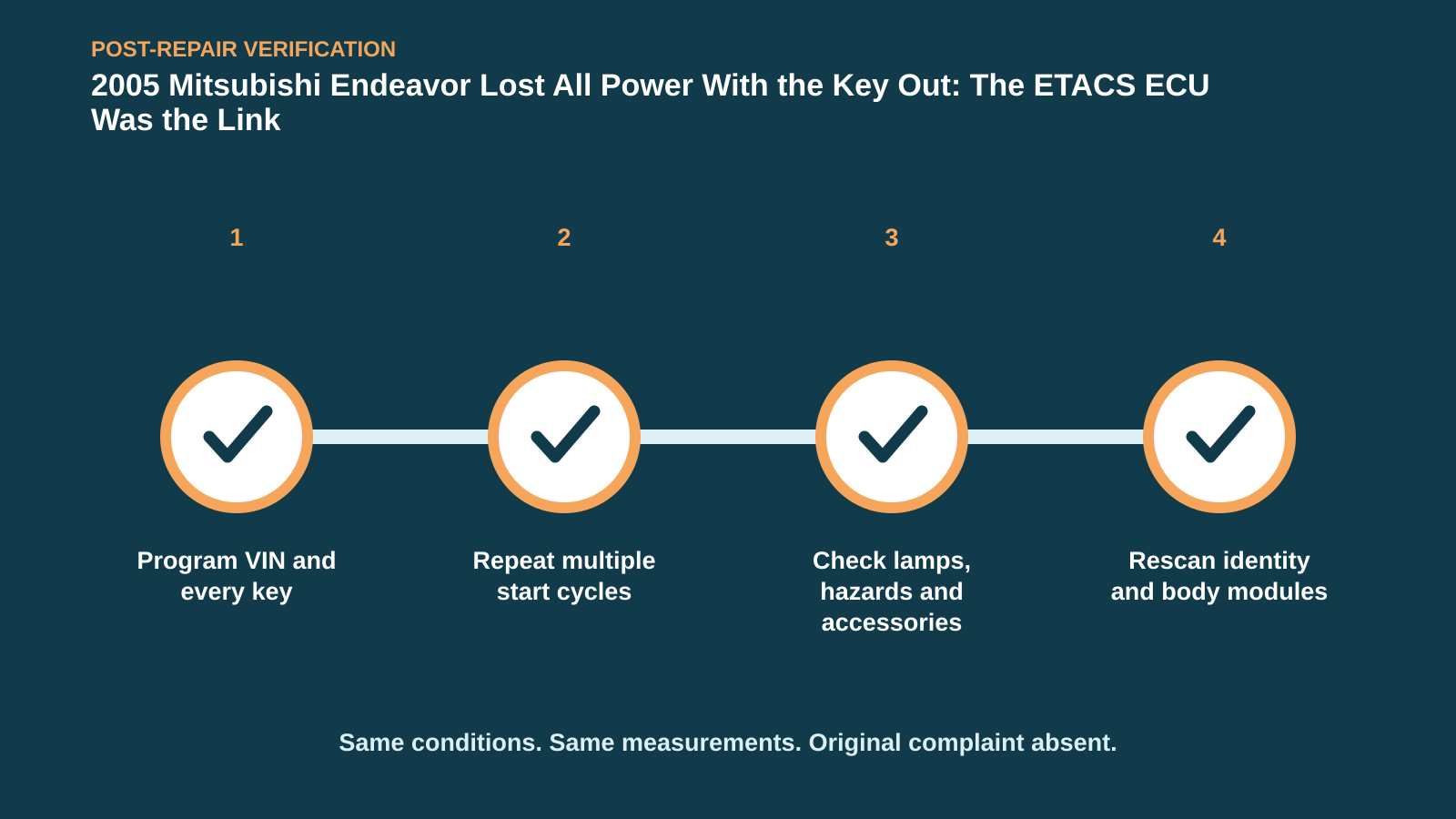
The documented repair restored starting, lighting and accessories. Verify no-crank/start authorization, several key cycles and every key. Then check dome lamps, hazards, headlights and retained-power behavior with the key in each position. Rescan all modules and confirm no active identity, communication or voltage faults. A successful engine start alone would leave half of this original complaint untested.
Verify every function that shared the failure
Because the source is concise, its strongest transferable lesson is restraint. Use the observed key-state function matrix and the successful programmed repair, but do not turn missing detail into a universal flowchart. Another Endeavor with the same headline may have a weak battery, damaged ignition feed, aftermarket alarm or harness fault. The job begins with those same five observations and earns the module only after its own inputs and supports pass.
A short case can still be useful when its limits stay visible. Here the repair result identifies ETACS on one vehicle; the reader’s protection comes from keeping every undocumented voltage and bypass step out of the story.









Comments 0
Questions, fixes, and real-world diagnostic notes from readers.
Be the first to share a diagnostic result or ask a follow-up question.