
Scania R480 Idled Rough and Smoked: A Known-Good Truck Exposed the Crank Signal

Rough Scania? Compare A Known-Good Crank Trace
A Scania R480 arrived with poor idle, misfire, smoke, diesel knock and fault codes. Those complaints can pull a workshop toward injectors or engine mechanics. The shortcut to clarity was not a parts catalog. It was another healthy R480 in the same fleet, tested under the same conditions.
An automotive meter/scope can provide a bounded first view of an identified crank sensor circuit. The AUTOOL DM303 is one truck-capable example for accessible supply or waveform checks before a specialist matched capture. DM303 can support an accessible crank-sensor supply or waveform check on trucks when the Scania diagram, signal type and safe connection are known; it cannot provide an authoritative known-good trace, inspect the entire ring gear or turn one signal difference into an injector diagnosis.
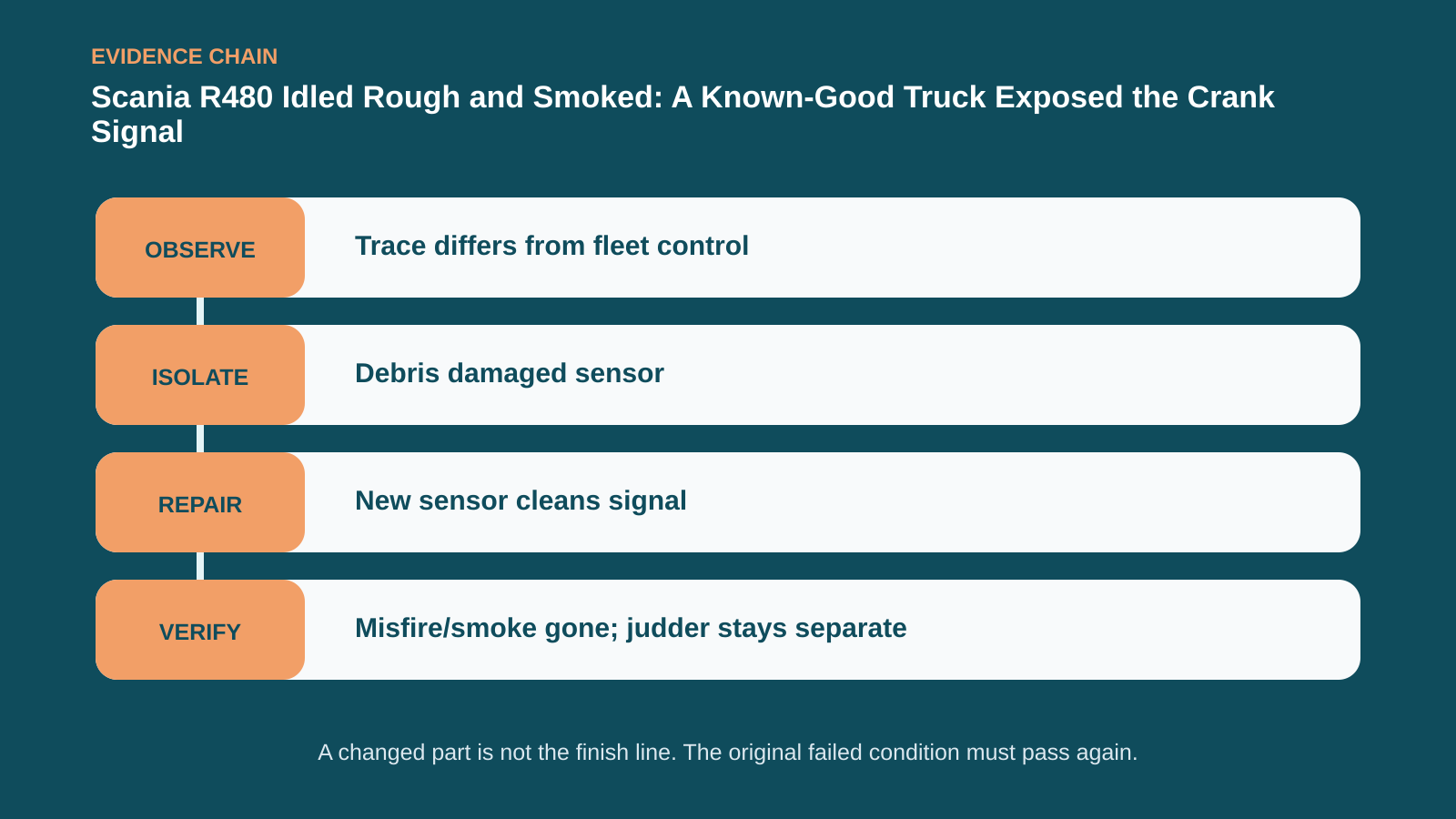
The suspect truck’s crank waveform differed sharply from the known-good vehicle. Inspection found ring-gear damage and debris that had harmed the sensor. Replacement restored a clean trace and removed smoke, misfire and knock. A smaller judder remained and was left as a separate complaint rather than being folded into a false total victory.
Quick answer: A matched known-good R480 exposed a distorted crank trace. Ring-gear debris had damaged the sensor; replacement removed smoke, misfire and knock.
In this guide
- Name smoke, misfire and judder separately
- Record the suspect crank signal under the complaint
- Borrow a known-good truck under matched conditions
- Compare shape before chasing amplitude
- Inspect the sensor and ring gear as a pair
- Replace the damaged sensor and remove debris
- Retest the complaints the signal could explain
- Keep the remaining judder on its own job
Name smoke, misfire and judder separately
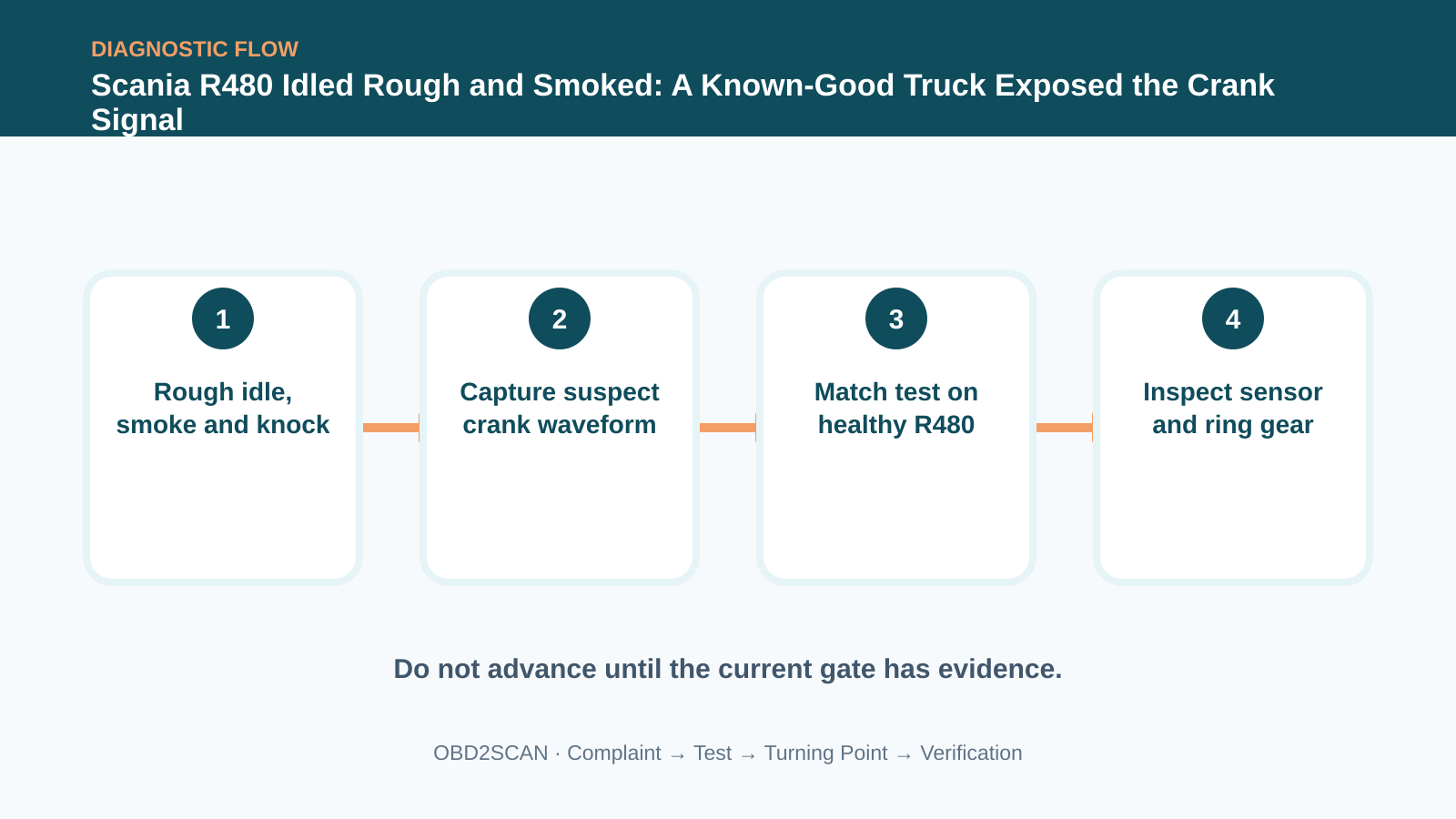
Start by giving each symptom its own row. Does smoke occur at idle or load? Is the knock tied to combustion, engine speed or vehicle speed? Does the judder happen at the same time? Save all codes, status and relevant operating data. Check oil, coolant, intake and obvious fuel leaks before running a heavy diesel. Stop if the knock becomes severe, smoke prevents safe testing or the engine shows low oil pressure. Grouping every sensation under ‘runs rough’ makes it too easy for one repair to claim credit for an unrelated condition.
Record the suspect crank signal under the complaint
Capture the suspect crank signal during the exact poor-idle event. Confirm sensor type, supply if applicable, ground and connector condition. Use safe test points and keep leads clear of the ring gear and belts. Note time base, coupling, probe, engine speed and temperature. A distorted trace can come from the sensor, target, gap, wiring, power or test setup. The first waveform is a question: does the controller receive a stable account of crank position? It is not yet a purchase order.
Borrow a known-good truck under matched conditions
A healthy sister truck can remove uncertainty that generic reference images cannot. Match engine family, sensor type, rpm, temperature, probe direction and instrument settings. Document any configuration differences. Then compare tooth pattern, amplitude, edge stability and repeating disturbances. The useful contrast is not ‘this one looks prettier.’ It is a repeatable feature present only on the failed vehicle. In fleet diagnosis, a known-good unit also helps reveal whether an unusual pattern is normal for that exact application.
Compare shape before chasing amplitude
Look first at shape and timing. An amplitude difference may follow air gap or probe setup, while a missing, doubled or distorted event at the same crank position points toward the sensor-target relationship. Align several revolutions and check whether the irregularity repeats. Correlate the event with misfire or smoke data if possible. Avoid converting one bad-looking tooth into an injector claim. Crank information can disturb timing calculations across cylinders, so a shared position error can imitate several combustion problems.
| Comparison | Suspect R480 | Known-good R480 |
|---|---|---|
| Test condition | Poor idle at matched rpm | Stable idle at matched rpm |
| Crank trace | Distorted/irregular | Repeatable reference shape |
| Physical inspection | Sensor damaged; debris present | No equivalent damage |
| After sensor repair | Smoke, knock and misfire gone | Baseline remains stable |
Inspect the sensor and ring gear as a pair
With signal evidence pointing to the pickup, inspect both sensor and target. Debris on a magnetic face can change the gap and damage the tip. Ring-gear defects can create a fresh sensor failure if only the pickup is replaced. Rotate and inspect as much of the target as the approved procedure permits; do not enter a pinch point or turn the engine from an unsafe location. In this case debris and ring-gear damage explained why the electrical trace differed from the control truck.
Replace the damaged sensor and remove debris
Fit the correct sensor, remove accessible debris and address target damage to the repair scope agreed with the customer. Set any specified gap and route the harness away from heat and movement. Preserve the removed sensor and photographs. Then capture the new signal before assuming the engine behavior will follow. A clean trace is direct proof that the sensing problem changed. It still needs symptom verification because an engine can have a valid crank signal and a separate injector, mount or driveline fault.
Retest the complaints the signal could explain
Verify poor idle, smoke and diesel knock under the original conditions. Clear and rescan only after saving the pre-repair codes. The documented repair removed those complaints, an outcome consistent with the corrected crank information. Repeat after warm-up and a controlled loaded run. Compare the post-repair trace with the known-good vehicle using identical settings. If smoke or misfire returns, reopen the evidence rather than assuming the replacement sensor is immune from ring-gear consequences.
Keep the remaining judder on its own job
A slight judder remained. That sentence improves the case because it protects the owner from overpromising. Describe its speed, load and location separately, and open a new diagnostic line for driveline, tire, mount or remaining engine-order evidence. Do not use disappearance of smoke to claim every vibration is repaired. The work order should state exactly which symptoms passed verification and which did not. Honest partial closure is more useful than a polished story that sends the truck back with an unnamed concern.
The sister truck supplied a trustworthy reference, but the repair still had to connect waveform, physical damage and changed symptoms. The remaining judder stayed visible because good diagnosis closes only what it has proved.




Comments 0
Questions, fixes, and real-world diagnostic notes from readers.
Be the first to share a diagnostic result or ask a follow-up question.