
Range Rover Sport Lost Brake Assist in Traffic: The Booster Passed One Test and Failed the Next

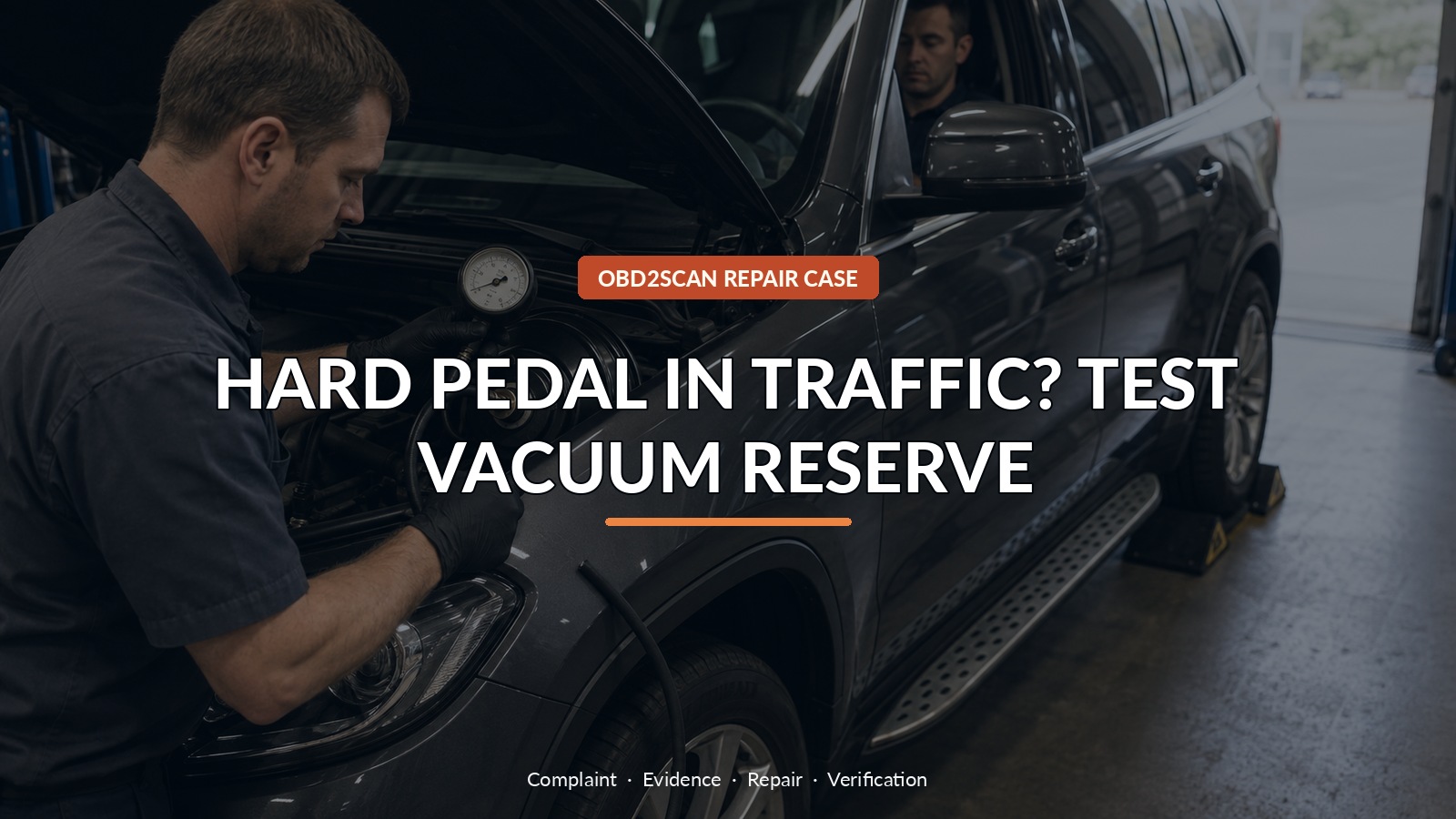
Hard Pedal In Traffic? Test Vacuum Reserve
The Range Rover Sport L320 was creeping in traffic when repeated brake applications turned the pedal hard and allowed the vehicle to move farther than the driver intended. Engine braking and the parking brake helped bring it under control. Later, the familiar test—hold the pedal, start the engine, feel it sink—appeared to pass. Both observations were real. The vacuum pump could create assistance briefly, but the booster could not store enough of it for repeated use.
The relevant instrument is a vacuum gauge used at service-information-approved connection points. A tool such as the AUTOOL PT502 covers a stated negative-pressure range and lists brake-booster checks among its applications. PT502 measures negative pressure from -101 to 0 kPa and lists brake-booster checks among its applications; it cannot make a hard-pedal vehicle safe to drive, test hydraulic braking, select Land Rover connection points, distinguish every leak location, or substitute for before/after reserve testing.
Because this is a braking complaint, the case starts with the no-drive decision and ends with reserve testing—not with a product or a single reassuring pedal movement. The decisive evidence came from time, decay and isolation.
Quick answer: The booster passed one familiar start-up check but lost vacuum reserve. Build time, shutdown decay and clamp isolation proved an internal booster leak.
In this guide
- A hard pedal and creeping vehicle ends the road test
- Check recall completion without assuming the recall is the cause
- Run both basic booster checks
- Measure vacuum build time and reserve
- Clamp isolation separates pump capacity from booster leakage
- Use a vacuum gauge only within its negative-pressure range
- Replace the leaking booster assembly
- Repeat build, hold and multiple-pedal tests before release
A hard pedal and creeping vehicle ends the road test
A hard pedal is different from a pedal that sinks through hydraulic pressure. It suggests the driver may still have foundation braking but has lost the assistance that makes normal pedal force effective. That is not a fault to repeatedly demonstrate in traffic. Once the symptom was confirmed, the vehicle was recovered for stationary testing and the basic hydraulic system, fluid level and warning state were checked. An owner who experiences the same change should increase following distance only long enough to stop safely, then arrange recovery rather than testing whether the next junction feels better.
Check recall completion without assuming the recall is the cause
The vehicle fell within a history that made brake-booster recalls relevant, and the campaign work had already been completed. That fact did two jobs: it prevented a duplicated recall assumption and kept the current fault open. A completed campaign is not proof that every component in the same system remains healthy years later. The VIN should be checked through the manufacturer or relevant authority, but recall status must not replace present-day measurements.
Run both basic booster checks
Two simple checks asked different questions. With the engine off, several pedal applications depleted stored vacuum; holding pressure while starting then let the pedal move as assistance arrived. That appeared normal. The second test built vacuum, stopped the engine and watched whether assist remained. The pedal lost its reserve too quickly. The first test showed that the pump could momentarily overcome leakage. The second showed that the system could not retain what the pump supplied.
Measure vacuum build time and reserve
A pressure-over-time capture made the weakness visible. Building strong vacuum took more than 30 seconds, and after only two pedal applications the reserve had deteriorated to roughly -177 mbar. Exact acceptable values and procedures must come from the correct Land Rover information, but comparison under the same sequence was already decisive: the system was slow to build and weak at holding enough assistance for the stop-and-go condition the driver described.
Clamp isolation separates pump capacity from booster leakage
The line was isolated carefully between the vacuum source and the booster circuit. When the servo side was clamped at an appropriate hose point, the pump achieved close to -1 bar, demonstrating useful source capacity. Reintroducing the booster brought the poor build and decay back. Clamp testing is not an invitation to crush rigid lines, damage one-way valves or drive with a brake-vacuum hose isolated. Its value here was stationary separation: capable pump on one side, loss of stored vacuum on the other.
| Test | Before repair | After booster replacement |
|---|---|---|
| Time to build vacuum | More than 30 seconds | About 16 seconds |
| Reserve after repeated pedal use | Around -177 mbar after two applications | Four assisted applications available |
| Pump with booster side isolated | Close to -1 bar | Source capacity remained adequate |
| Hold after shutdown | Decayed too quickly | Around -700 mbar retained in the comparison |
Use a vacuum gauge only within its negative-pressure range
Negative pressure can be expressed in mbar, kPa, inHg or relative bar, so units must travel with every number. The measuring range must also include the expected vacuum without over-ranging, and hoses or tees must be rated and leak-free. A gauge connection that introduces its own leak can make a healthy booster look poor. The AUTOOL instrument mentioned earlier can show vacuum in its supported range, but the diagnosis still depends on correct plumbing, Land Rover specifications and the repeated-pedal sequence.
Replace the leaking booster assembly
The leaking brake-booster assembly was replaced and all disturbed vacuum connections were inspected. Booster work affects a safety-critical interface between pedal, master cylinder and bulkhead; correct fasteners, seals, pushrod arrangement and bleeding requirements belong to the service procedure. The old unit’s internal leak was the conclusion of the isolation tests, not a reason to skip inspection of the non-return valve, hoses or pump.
Repeat build, hold and multiple-pedal tests before release
After replacement, peak vacuum arrived in about 16 seconds rather than more than 30. The running value reached around -750 mbar, shutdown hold remained near -700 mbar, and four assisted pedal applications were available instead of the earlier rapid loss. A controlled braking check then confirmed normal pedal effort. Those before-and-after numbers matter because the original start-up test had already shown that one apparently normal pedal movement could conceal poor reserve.
The phrase to remember is vacuum reserve. A booster can make the pedal dip once at startup and still fail the repeated applications that city traffic demands. If your pedal suddenly becomes hard, prioritize stopping and recovery. For diagnosis, ask the shop to verify build time, shutdown decay and repeated-pedal reserve so one familiar pass does not overrule the exact condition that frightened the driver.



Comments 0
Questions, fixes, and real-world diagnostic notes from readers.
Be the first to share a diagnostic result or ask a follow-up question.