
GM EV No Heat With P1C01? Cabin Comfort Is Not the Only Warning

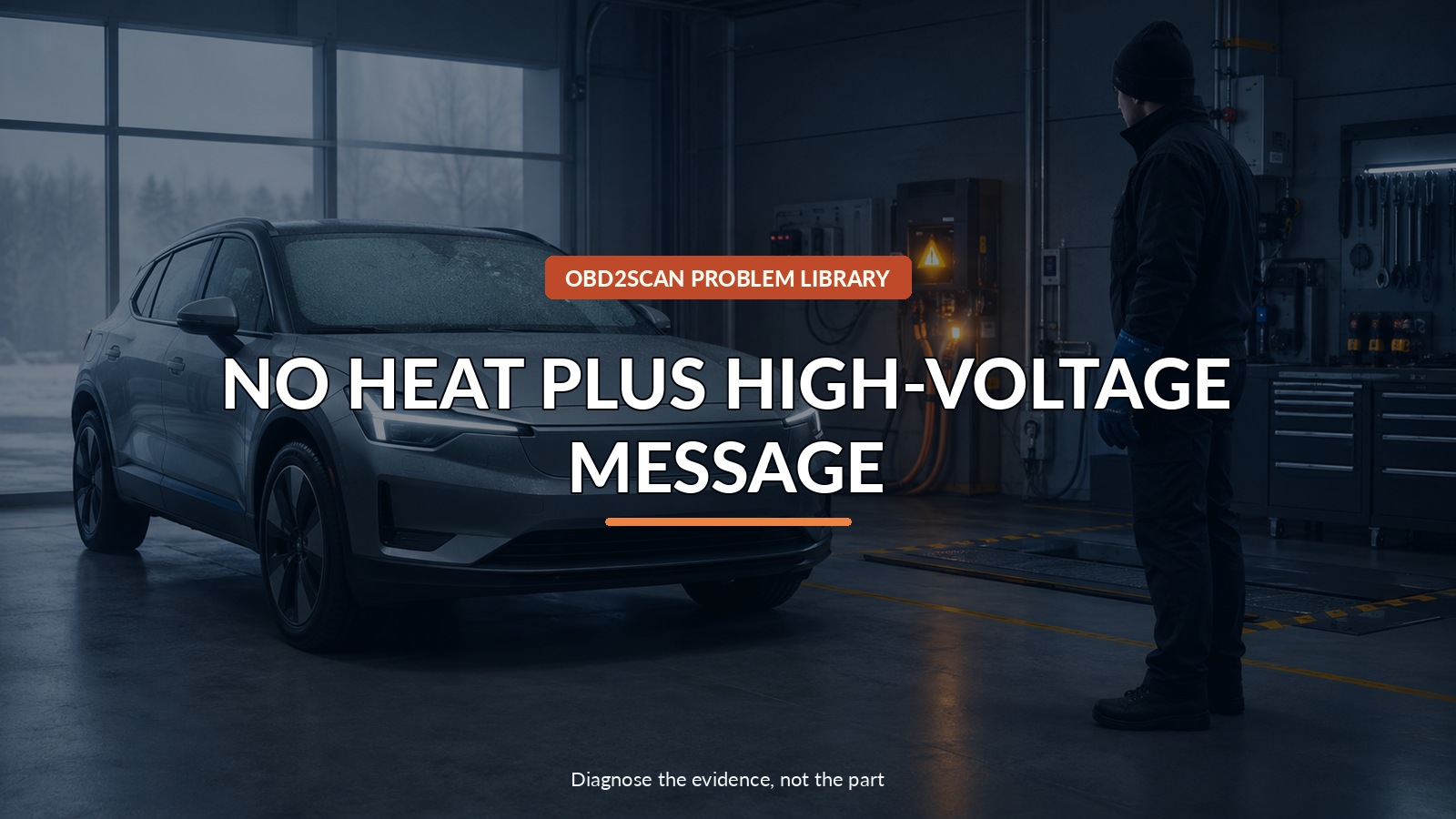
No Heat Plus High-Voltage Message
No heat is usually described as a comfort problem. In a 2025 Cadillac OPTIQ, Chevrolet Blazer EV, or Chevrolet Equinox EV, no heat combined with a Service High Voltage message and P1C01 belongs in a different category. Prioritize a clear windshield and safe stopping place, preserve the warning, and arrange evaluation by a certified EV repair facility. GM’s bulletin says to update the vehicle’s modules and not replace parts first.
If a later, separate HVAC branch genuinely requires refrigerant measurements, a trained technician may use compatible digital manifold equipment such as the AUTOOL LM70 to record pressure and temperature. It cannot make a high-voltage warning safe, restore defrost, read P1C01, update modules, or justify opening the refrigerant circuit. The software gate comes before ordinary HVAC instrumentation here.
Until visibility and the high-voltage warning are resolved, this is not a “how warm can I make the cabin?” experiment. It is a decision about seeing the road, stopping safely, and delivering useful data to a certified facility.
Quick answer: No heat plus a Service High Voltage message is a visibility and safety problem; save P1C01 and use GM’s certified vehicle-wide programming path before parts.
In this guide
- Decide whether you can keep the windshield clear
- Treat the high-voltage message as more than an HVAC lamp
- Save P1C01 before cycling the vehicle repeatedly
- Confirm the exact 2025 GM EV scope
- Do not order a heater, compressor, or battery yet
- Let certified vehicle-wide programming come first
- Measure refrigerant only if a later branch calls for it
- Verify heat, defrost, warning state, and every module
Decide whether you can keep the windshield clear
The first question is not “How cold is the cabin?” It is “Can the driver see?” If the windshield fogs or ices and defrost cannot clear it, move off the road as soon as conditions allow. Do not continue into rain, snow, or freezing temperatures while wiping a narrow viewing slot by hand.
Note ambient temperature, vehicle state of charge, whether the fan blows, whether airflow direction changes, and whether any warmth appears at all. Photograph the messages only while parked. If the vehicle also limits propulsion, will not enter Ready, smells hot, shows smoke, or displays a stop-now instruction, follow the owner’s manual and emergency guidance rather than experimenting with restarts.
Treat the high-voltage message as more than an HVAC lamp
An EV’s thermal-management system can serve the cabin, battery, power electronics, and charging functions through shared pumps, valves, sensors, software, and refrigerant components. A failure that the driver experiences as cold air may therefore coexist with a system warning whose importance reaches beyond comfort.
Use this triage:
| Condition | Driver response |
|---|---|
| No heat, windshield remains clear, no other warnings | Limit travel and arrange prompt diagnosis |
| No heat plus Service High Voltage message | Preserve P1C01 and use a certified EV repair route |
| Defrost cannot maintain visibility | Stop driving when safe |
| Smoke, unusual heat/odor, charging fault, or propulsion limitation | Follow emergency/owner-manual instructions and arrange recovery |
Do not touch orange cables, high-voltage connectors, battery enclosures, or electric A/C components. A warning that disappears after a restart still deserves documentation.
Save P1C01 before cycling the vehicle repeatedly
GM’s bulletin requires verification that P1C01 is set. Save a full scan or ask the shop to print the pre-repair report, including current, history, and communication codes. Record whether the condition began after charging, remote start, a software update, collision work, 12V battery service, or a long cold soak.
Repeatedly switching the vehicle off and on may change module states and hide the sequence that matters. Avoid clearing codes with a generic reader. Even if it can erase an emissions record, it may not capture manufacturer-specific high-voltage data or the module-wide context needed for vehicle-wide programming.
Confirm the exact 2025 GM EV scope
Bulletin 25-NA-067 covers 2025 Cadillac OPTIQ, Chevrolet Blazer EV, and Chevrolet Equinox EV vehicles in listed regions. It describes a Service High Voltage warning, P1C01, and a software-anomaly cause. Model year and name must match; a similar message on another Ultium vehicle does not automatically receive this repair.
Check the VIN for current campaigns and software status. A TSB is not itself proof of a recall or guaranteed coverage. The bulletin also limits completion to certified facilities meeting the training, tool, and equipment requirements for the brand and model. That qualification is part of the repair, not optional fine print.
Do not order a heater, compressor, or battery yet
GM explicitly says “DO NOT replace any parts” when verifying this bulletin condition. That matters because no heat could otherwise send diagnosis toward a heater, valve, pump, compressor, sensor, refrigerant charge, battery component, or control module. Parts replacement before the software state is corrected can add cost without changing the underlying logic.
This does not mean every physical component is guaranteed healthy. It means the official first branch is software. If P1C01 is absent, another code dominates, visible damage exists, or the condition remains after the update, the technician returns to the current service procedure and gathers new evidence.
Let certified vehicle-wide programming come first
The correction uses SPS2 Vehicle Wide Programming to update and confirm all modules, with the battery energy control module specifically included in the service procedure. Vehicle-wide programming is more involved than updating one infotainment app or disconnecting the 12V battery.
The facility must control 12V support, diagnostic connectivity, vehicle wake/sleep state, software eligibility, and postprogramming checks. Opening doors, charging, or operating accessories at the wrong time can disturb a session. Ask for the before-and-after software report and whether every required module completed, rather than accepting “we reset the heater” as a sufficient description.
Measure refrigerant only if a later branch calls for it
If heat remains unavailable after successful programming and the warning/code path is resolved, normal HVAC diagnosis may resume. First determine whether the missing heat comes from refrigerant movement, coolant flow, airflow/blend control, an electrical heater, a sensor input, or another module. Vent temperature alone cannot separate those paths.
Refrigerant work on an EV needs the correct refrigerant, oil, dedicated or contamination-controlled equipment, and high-voltage awareness. Pressure readings must be paired with ambient and line temperatures plus commanded operating state. Do not add refrigerant based on “low side looks low,” and do not energize the compressor with improvised leads. The instrument measures a state; it does not select the repair.
Verify heat, defrost, warning state, and every module
After programming, check that the vehicle enters Ready normally, the Service High Voltage message stays absent, P1C01 does not return, and no programming-related codes remain. Test heat and defrost from a cold starting condition, not just in a warm service bay. Confirm airflow direction and windshield clearing as well as outlet temperature.
Review all-module status and charging behavior. If no heat persists without P1C01, treat it as a fresh HVAC complaint. If the warning returns, stop repeating resets and preserve the new event. The owner should leave knowing which software campaign was applied, what changed during a true cold test, and what safety threshold requires an immediate return.




Comments 0
Questions, fixes, and real-world diagnostic notes from readers.
Be the first to share a diagnostic result or ask a follow-up question.