
2015–2016 Honda Fit Misfire Code Cluster: Check Injector Warranty Scope

Honda Fit: Misfire Code Cluster
A 2015–2016 Honda Fit with several misfire, fuel-trim, imbalance, or catalyst codes may fit Honda’s fuel-injector warranty-extension path—but only after the VIN and diagnostic result agree. Save the whole code cluster and freeze data before swapping coils, cleaning injectors, or clearing the MIL.
If removal is eventually justified, a multi-channel injector bench can compare compatible injectors under the same controlled conditions. The AUTOOL CT500 injector cleaner and tester can support flow and spray-pattern comparison of removed compatible injectors. It cannot establish Honda warranty eligibility, reproduce combustion pressure, replace compression or leak-down testing, or decide that cleaning is the approved remedy.
Read this problem as a matrix rather than a single-code lookup. The VIN is one axis; the code combination, fuel trims, cylinder behavior, and competing ignition or mechanical evidence are the others. A match opens an inspection route, not an automatic parts order.
Quick answer: Keep the Honda Fit codes as a cluster, verify VIN eligibility, and rule out ignition, air, and mechanical faults before judging injector flow.

In this guide
- Keep the codes as a cluster
- Run the VIN gate before buying parts
- Sort ignition, air, fuel, and mechanical branches
- Use trims and misfire counts as direction
- Bench-test only after removal is justified
- Protect the catalyst while diagnosing
- Build the warranty-ready handoff
- Verify balance, trims, and code return
Keep the codes as a cluster
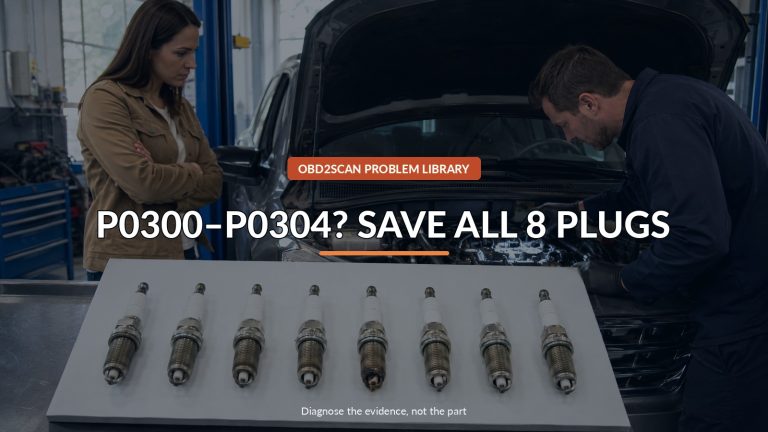
Honda bulletin 22-002 names P0300, P0301, P0302, P0303, P0304, P0171, P0172, P219A, and P0420, including P0420 with another listed code. Record which are current, pending, permanent, or history. Capture RPM, load, coolant temperature, fuel trims, vehicle speed, and fuel level from freeze data.
A flashing MIL means active misfire may overheat the catalyst. Reduce load, stop driving as soon as safely possible, and arrange diagnosis. Do not repeatedly road-test a flashing-lamp vehicle to collect more data.
The cluster matters because reduced injector flow can create cylinder misfire and air/fuel imbalance, while catalyst monitoring may react downstream. It still does not exclude a damaged plug, weak coil, air leak, fuel-quality problem, valve issue, or loss of compression.
Run the VIN gate before buying parts
The bulletin covers 2015–2016 Fit vehicles, but Honda directs technicians to check VIN status for eligibility. Confirm the VIN with a Honda dealer or official owner lookup and ask which current bulletin applies. Model year alone does not prove that an injector is covered or failed.
Keep the vehicle’s in-service date, mileage, ownership records, and previous misfire invoices. Coverage rules can change, and the current dealer record controls. Avoid authorizing cleaning or replacing parts before the eligibility check if preserving a potential claim matters.
Sort ignition, air, fuel, and mechanical branches
Build four columns and put each test result in only one place:
| Branch | Useful evidence | Common false shortcut |
|---|---|---|
| Ignition | Plug condition, coil output/transfer result, boot tracking | “P0302 means coil 2” |
| Air | Smoke-tested intake path, MAP behavior, purge state, trims | “Lean code means injector” |
| Fuel | Pressure/quality, trims, balance, injector comparison | “Cleaner fixed idle, so cause proven” |
| Mechanical | Compression, leak-down, valve action, timing evidence | “Good spark means engine healthy” |
Check oil level, coolant level, fuel quality, basic wiring, and intake integrity. If a component is moved between cylinders, label its original and new location and change only one variable. Otherwise the experiment loses its reference.
Use trims and misfire counts as direction
Look at short- and long-term trims under controlled idle and raised-load conditions. A problem that is most visible at idle can point differently from one that grows with load. Cylinder misfire counters show distribution and timing; they do not identify the physical cause.
P219A describes an air/fuel imbalance pattern, while P0171 or P0172 describes mixture correction direction. Compare both banks only where the engine design provides them, and use Honda service limits. Do not import a generic trim percentage as a universal fail line.
If the engine has an obvious mechanical noise, low compression, or coolant/oil contamination, stop the injector branch until that condition is understood.
Bench-test only after removal is justified
An on-vehicle balance or contribution test can build a removal case when Honda’s procedure permits it. Once injectors are removed, preserve cylinder identity, seals, orientation, and contamination control. Use the bench fluid and pressure specified by the equipment—not gasoline in an indoor workspace.
Compare leakage, spray shape, and delivered volume across identical cycles. Repeat an outlier to establish that it follows the injector rather than the fixture position. Cleaning that improves a bench pattern is useful service evidence, but Honda’s bulletin may call for replacement under its warranty process. Do not substitute an aftermarket procedure for an authorized remedy.
Protect the catalyst while diagnosing
Raw fuel from a dead-misfire cylinder or repeated start attempts can damage the catalyst. A lean cylinder can also raise combustion temperature. Limit run time, avoid high load, and stop if the MIL flashes, the exhaust glows, or fuel odor becomes strong.
P0420 in this cluster does not automatically mean the catalyst needs replacement. Repair and verify the upstream misfire or imbalance first, then allow the monitor to run under Honda conditions. Conversely, do not promise that the catalyst survived merely because P0420 clears.
Build the warranty-ready handoff
Give the dealer the VIN, mileage, code status and freeze data, when the MIL flashes or stays steady, cold/hot behavior, fuel source, recent work, trims at named conditions, misfire counts, cylinder-labeled plug and coil findings, pressure/balance evidence, and any compression results. Include receipts for earlier related repairs.
Ask the dealer to verify bulletin 22-002 eligibility and the current diagnostic version. A clear matrix saves time and protects the distinction between “listed code,” “diagnosed injector failure,” and “covered repair.”
Verify balance, trims, and code return
After the approved repair, use the same operating conditions that exposed the problem. Confirm smooth cold and hot starts, even contribution, stable trims, no current or pending misfire/imbalance codes, and successful monitor completion. Recheck for leaks after any fuel-system opening.
The repair is not verified merely because the MIL was cleared. The original cylinder pattern must be gone, the mixture evidence must normalize, and the catalyst monitor must be evaluated after the engine fault no longer interferes.






Comments 0
Questions, fixes, and real-world diagnostic notes from readers.
Be the first to share a diagnostic result or ask a follow-up question.