
Toyota Tundra or Highlander P162B87/P15AD87? Test the Battery Before Blaming the Grille

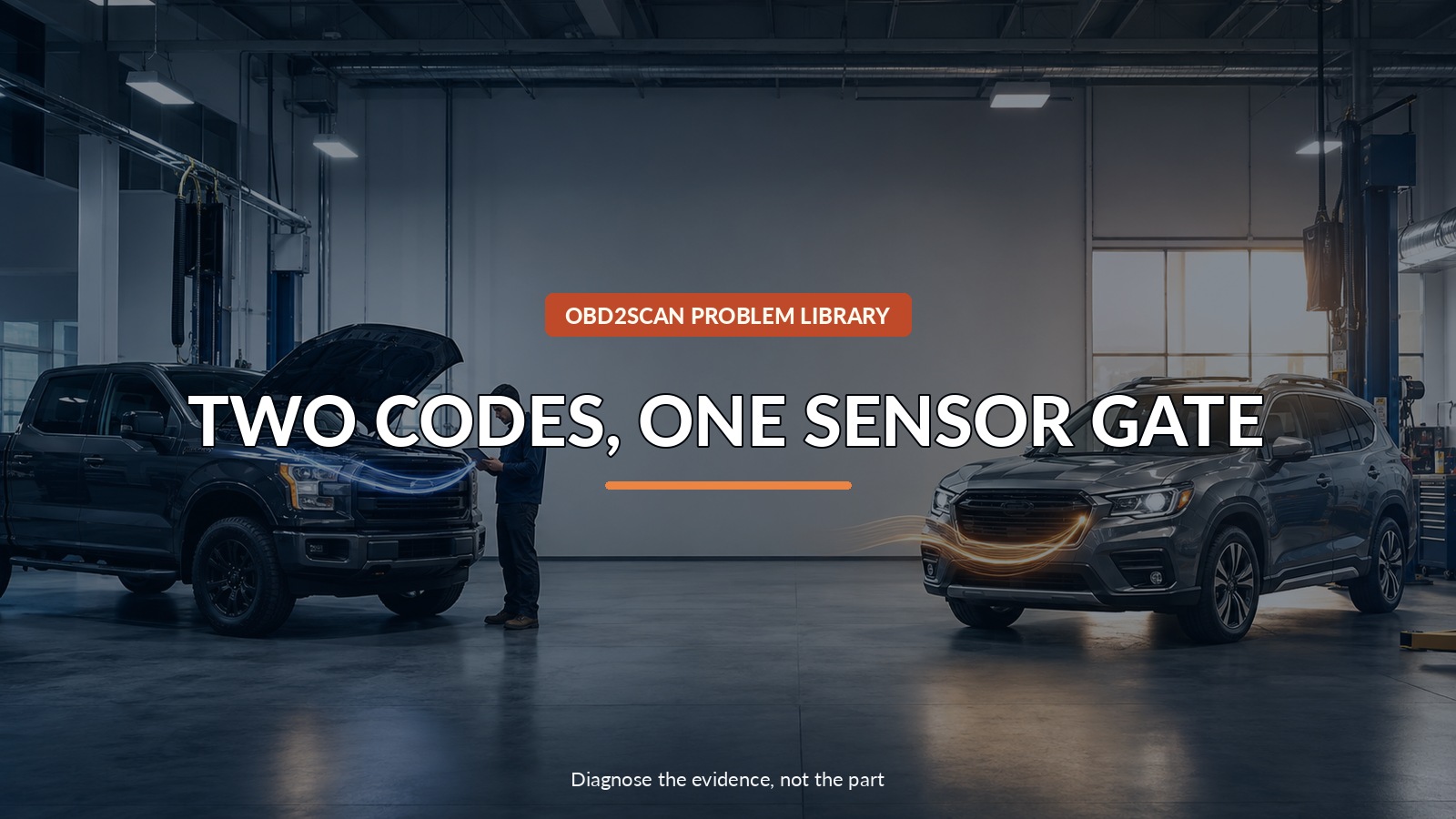
Two Codes, One Sensor Gate
P162B87 and P15AD87 look as though they belong to different repairs. One says the battery monitor message is missing; the other names the active grille shutter. On the Toyota vehicles covered by T-SB-0050-24 Rev2, however, either code can open the same battery-state-sensor branch. Save the report, make sure the 12V supply is trustworthy, and verify the VIN/model-year fence before anyone orders a grille assembly.
A battery-system analyzer is useful here only for the first question: was the diagnostic session built on a stable 12V foundation? The AUTOOL BT960 battery tester can record compatible 12V battery condition, cranking, charging, and selected current behavior. It cannot verify a missing CAN message, identify a failed battery state sensor, clear codes through GTS+, or make an out-of-range VIN eligible.
The most useful record fits on one page: exact code, 12V condition, vehicle eligibility, component branch, and post-repair result.
Quick answer: Save both codes, stabilize the 12V supply, and confirm the Highlander/Tundra production fence before following Toyota’s battery-state-sensor branch.
In this guide
- Save the two code names before clearing anything
- Make the 12V baseline trustworthy
- Open the Toyota production fence
- Treat the grille code as a message clue
- Let code presence control the sensor branch
- Keep physical grille faults in their own lane
- Hand the shop a one-page evidence card
- Verify with GTS+ and a clean restart
Save the two code names before clearing anything
Record whether the MIL is on now and whether each code is current, pending, or history. Save the complete scan—not just P162B87 or P15AD87—plus freeze-frame data, 12V voltage at arrival, recent battery work, jump-start history, collision or grille work, and any low-voltage event.
Do not clear codes merely to see whether the light returns. Clearing removes timing and operating context and can reset monitors. If the truck or SUV has a charging warning, hot cable, swollen battery, damaged wiring, or unstable electrical behavior, stop and have the supply system made safe before continuing.
Make the 12V baseline trustworthy
Identify the battery chemistry and rating from its label. Inspect terminals, the negative-terminal sensor area, grounds, and recent accessory connections without unplugging anything prematurely. Charge with the correct profile if the battery is discharged, allow the required rest, and test again under Toyota guidance.
A poor connection or collapsing battery can create communication noise, but a good battery does not prove the battery state sensor is good. Likewise, a failed battery test does not erase the Toyota bulletin. Correct the supply problem, preserve both before/after results, and rescan under stable voltage.
| Evidence card | Record | What it does not prove |
|---|---|---|
| Code | Full text, status, freeze frame | Which physical part failed |
| 12V baseline | Chemistry, rating, charge, test result | CAN-message integrity |
| Vehicle fence | Model year, VIN, production position | Warranty approval |
| Verification | GTS+ clear and rescan | That an unrelated grille fault is absent |
Open the Toyota production fence
The bulletin applies to all 2023 Highlander vehicles and all 2022–2023 Tundra vehicles. It also covers certain 2024 Tundras built before the production-change VINs listed by plant and drivetrain in the bulletin. A model-year label alone is therefore not enough for a 2024 truck.
Confirm the full VIN, model, drivetrain, production information, engine, prior sensor work, and latest TIS revision. This is a technical service bulletin, not a statement that every listed vehicle is affected and not a promise of warranty coverage. Check recall or campaign status separately by VIN.
Treat the grille code as a message clue
P15AD87 contains the words “Active Grille Air Shutter,” but its full description in this bulletin ends with “Missing.” That matters. A missing message can be caused by a communication participant or supply issue rather than a jammed shutter blade.
Before condemning the grille, ask what the vehicle actually does. Is there impact damage? Do the shutters bind? Are there other communication codes? Is the sensor connector disturbed? A physical shutter problem follows its own repair-manual path. Do not replace a visible assembly simply because its name appears in a message code.
Let code presence control the sensor branch
Toyota’s decision is unusually direct: does the scoped vehicle have P162B87 and/or P15AD87 with the MIL condition? If yes, the bulletin directs removal and installation of the updated battery state sensor assembly under the model-specific repair manual. If no, the bulletin says it does not apply and normal diagnosis continues.
That yes/no gate should remain intact. Similar network codes, a dead battery without these codes, or a grille symptom without the missing-message fault do not inherit the replacement. The negative-terminal area also deserves careful handling; current sensors, terminal connections, and retained power procedures are not generic battery-clamp work.
Keep physical grille faults in their own lane
If a scoped vehicle has collision damage, debris, frozen shutters, broken linkage, actuator noise, or a code whose failure type is mechanical rather than missing-message, document it separately. One car can have both a sensor communication issue and a damaged grille system.
After stabilizing supply and following the Toyota branch, inspect whether the physical complaint remains. This prevents the sensor bulletin from becoming a universal explanation for every P15AD-related concern.
Hand the shop a one-page evidence card
Give the technician the saved full scan, battery label and test record, VIN/build data, recent battery or front-end work, and a short symptom timeline. Ask for three answers on the repair order:
- Was the vehicle inside the applicable production range?
- Was P162B87 and/or P15AD87 present under stable 12V conditions?
- Was the updated sensor installed and the result confirmed with current GTS+?
Those questions are more useful than requesting a grille, battery, or sensor by name.
Verify with GTS+ and a clean restart
Toyota specifies GTS+ to clear stored codes and confirm the condition no longer exists. After the approved sensor work, confirm terminal security, correct harness routing, no new codes, normal starting/charging behavior, and a clean restart. If the MIL or either code returns, preserve the new report rather than repeatedly clearing it.
A successful repair is not just a dark lamp in the parking lot. It is stable 12V supply, correct sensor installation, no returning missing-message code after the relevant checks, and normal grille behavior where applicable.


Comments 0
Questions, fixes, and real-world diagnostic notes from readers.
Be the first to share a diagnostic result or ask a follow-up question.