
Mercedes C-Class Codes Explained: W204, W205, and W206

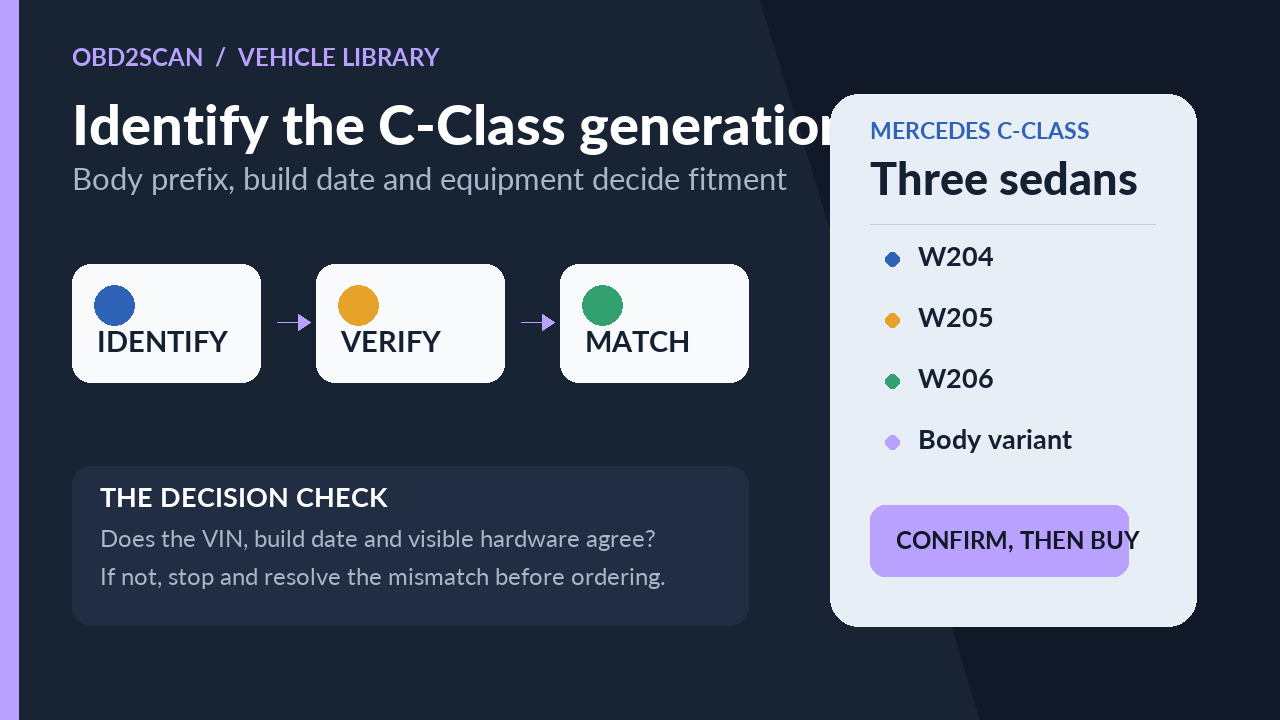
W204, W205, and W206 are internal series codes for three successive Mercedes-Benz C-Class sedan generations. For a U.S. sedan, they generally align with 2008–2014, 2015–2021, and 2022 onward model years. A coupe, wagon, cabriolet, long-wheelbase car, or imported vehicle can carry a different prefix even when sellers call it the same generation, so identify body style and VIN before parts.
Fast answer
- W204, W205, and W206 refer specifically to sedan series—not every C-Class body sold in the same era.
- C204/C205 are coupe codes; A205 is a cabriolet; S204/S205 are wagons; V205 is long wheelbase.
- U.S. sedan model-year ranges are a useful shortcut, not a substitute for the VIN and build month.
- Engine, 4MATIC, AMG, lighting, brakes, and facelift status all require separate confirmation.
In this guide
1. Use the generation map as an orientation tool
| Sedan code | Useful U.S. model-year shortcut | What to verify next |
|---|---|---|
| W204 | Generally 2008–2014 C-Class sedan | Pre-facelift or facelift, engine, RWD/4MATIC, standard/AMG |
| W205 | Generally 2015–2021 C-Class sedan | Production phase, engine family, lighting, driver assistance, brakes |
| W206 | Generally 2022-on C-Class sedan | Engine/electrification, market equipment, software and option package |
Mercedes’ own model history uses 204, 205, and 206 as series families. Launch dates in that history are global production dates, while U.S. sales use model years. That is why a worldwide page may say series 205 began in 2014 while a U.S. owner knows the car as a 2015 model.
When the car sits near a changeover, use the full VIN and certification-label build date. Do not settle the question from the registration year or a listing headline.
2. W is the sedan; other prefixes identify other bodies
On series 204, Mercedes identifies the W204 sedan, S204 wagon, and C204 coupe. Series 205 expands the family: W205 sedan, S205 wagon, V205 long-wheelbase sedan, C205 coupe, and A205 cabriolet. Those prefixes are not decoration. Body shell, glass, doors, seats, trim, suspension calibration, restraint equipment, wiring, and exhaust routing can change.
This matters most with the C204 coupe. It arrived during the 204 era but its “C” prefix means coupe, not C-Class. A seller who calls it “W204 coupe” is using informal family shorthand. Search by C204 when body-specific parts are involved.
W206 is the sedan identity in the newer family. Related body and market variants again require their own code. If a parts site asks only for “C-Class 2022,” keep narrowing until it represents the actual body.
3. A facelift can look like a new generation without being one
W204 and W205 both received substantial updates during their production runs. Lamps, bumpers, grilles, steering wheels, infotainment, engines, driver-assistance equipment, and control modules can change while the underlying series code remains the same. Aftermarket sellers often use “pre-facelift” and “facelift”; the factory parts catalog will usually be more precise with a VIN or production break.
A bumper or headlamp retrofit can also make an earlier car look later. Treat exterior appearance as a clue and the VIN/build data as the identity. Then inspect part numbers and connectors on the modified area.
AMG is not one filter
An AMG appearance package, a full Mercedes-AMG model, and a standard car wearing AMG-style body parts can require different brakes, suspension, cooling, body and electronic components. Confirm the actual model and option codes.
4. These C-Class purchases need more than W204/W205/W206
- Engine service: badge, model year, engine designation, emissions market, and production date. The companion M274/M264/M254 guide helps separate common four-cylinder families.
- Front axles and suspension: rear-wheel drive versus 4MATIC, standard versus sport/AMG, axle load, and adaptive equipment.
- Brakes: rotor diameter, caliper, performance package, parking-brake design, and VIN option data.
- Lighting: sedan/coupe/cabriolet body, pre- or post-update lamp, market, left/right side, LED control modules, and coding.
- Belts and accessories: exact engine and accessory drive. Use a model-specific procedure such as the W204/W212 belt guide only after confirming the engine/application.
- Electronics: part-number index, option package, software and teach-in/coding—not merely connector shape.
5. Build a description a supplier can actually use
Write the car as: market + series/body code + model year + build month + exact model + engine + drivetrain + relevant option. For example, “U.S. W205 sedan, 2019 model year, September 2018 build, C300, 4MATIC, LED headlamps.” That is far more useful than “2019 C-Class.”
Confirm that description in the NHTSA VIN decoder, the door label, and a current Mercedes-Benz catalog. If any result conflicts—especially on an import, rebuilt vehicle, or body conversion—pause the order and read the original part number. The correct series code opens the catalog; it does not finish the selection.
Official sources used for this guide
- The C-Class: History of a Success Story — Mercedes-Benz Heritage
- The New C-Class, W206 — Mercedes-Benz Media
- 2019 C-Class Brochure — Mercedes-Benz USA
- NHTSA VIN Decoder — National Highway Traffic Safety Administration
What a successful identification looks like
You can state the market, VIN-confirmed model and body, production date, engine, drivetrain, and the equipment relevant to the job. The catalog result and the hardware on the vehicle agree, and the supplier can confirm a current part number for that exact record.


Comments 0
Questions, fixes, and real-world diagnostic notes from readers.
Be the first to share a diagnostic result or ask a follow-up question.