
P0171 or P0174 Lean Code? Use the Pattern Before Replacing Parts

P0171 (Bank 1) or P0174 (Bank 2) means the controller has added fuel and still judged that bank too lean under the conditions that matured the code. It does not identify a vacuum hose, mass-airflow sensor, oxygen sensor, or fuel pump. Save both banks' fuel trims, freeze-frame, related codes, and the idle-versus-load pattern before clearing anything; those comparisons choose the next test.
What to do first
- If the malfunction lamp flashes, the engine shakes severely, power falls sharply, raw fuel is present, or the catalyst becomes extremely hot, stop driving and arrange inspection.
- Record whether P0171, P0174, or both are current, pending, or history, plus freeze-frame and short- and long-term trims for both banks.
- Do not clean a MAF, spray flammable products around a running engine, or replace an oxygen sensor from the code name.
- Compare the symptom at warm idle and under a safe, repeatable light-load condition using exact-vehicle data and limits.
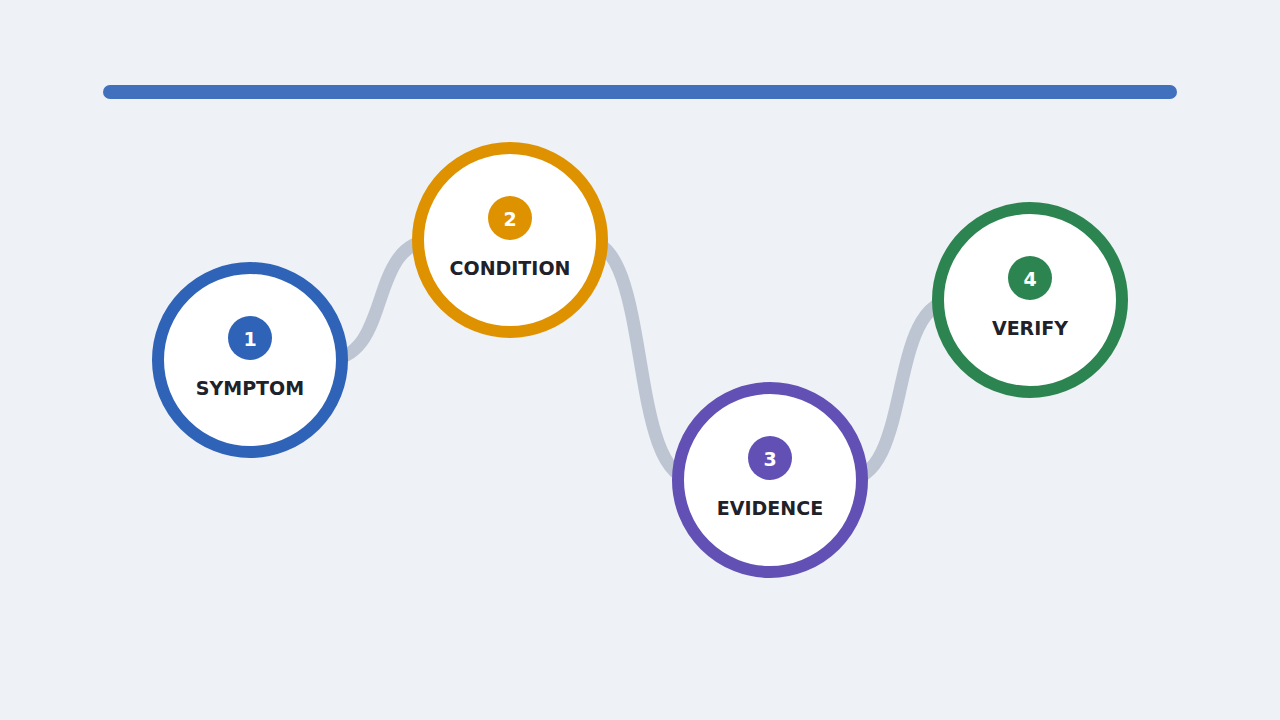
In this guide
1. What the symptom means—and does not prove
The controller infers mixture from multiple inputs and exhaust feedback, then applies short- and long-term correction. A positive correction pattern says the calculated mixture needs more fuel; it does not say why. The bank relationship and the condition in which correction grows are more informative than one isolated percentage.
It does not independently prove
- that unmetered intake air is the only possible cause;
- that the front oxygen or air/fuel sensor is reporting correctly;
- that fuel pressure and delivered volume meet the vehicle specification;
- that an exhaust leak is not drawing oxygen toward the sensor;
- that incomplete combustion, valve leakage, or a misfire is absent;
- that a bulletin for one engine applies to another vehicle;
2. Save the evidence and make only low-risk checks
- all powertrain codes and their status, not just the lean code;
- freeze-frame RPM, load, coolant temperature, airflow, trims, loop status, speed, and voltage;
- both-bank trims at the same warm idle and light-load conditions;
- recent intake, PCV, brake-booster, exhaust, sensor, battery, or software work;
- fuel level/source, hard-start, whistle, brake-pedal, misfire, and oil-cap behavior;
Preserve this record before resets, repeated starts, part swaps, or fluid additions change the condition. Related background: OBD-II evidence workflow rough-idle workflow.
3. Use the pattern to choose the next test
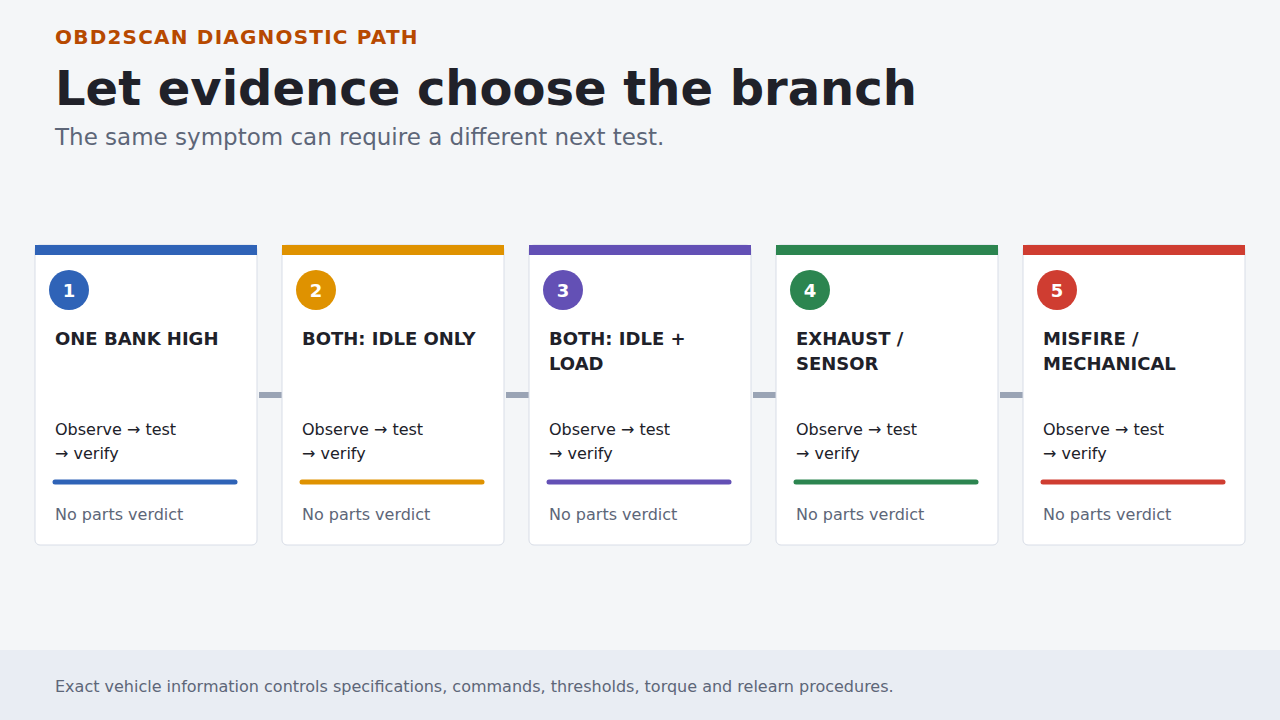
1. One bank is high; the other is near its normal pattern
What the pattern changes: A bank-specific intake gasket, injector delivery issue, exhaust leak, sensor circuit, or mechanical problem moves ahead of a common MAF or fuel-supply theory.
Next proof: Inspect and test the affected bank using the engine layout. Do not assume Bank 1 is the left or right side.
2. Both banks are higher at idle and improve with airflow
What the pattern changes: This pattern raises the value of a professional intake/PCV/booster leak test because a fixed leak is proportionally larger at idle. If both banks are leanest at idle and improve with airflow, the MRCARTOOL T105 automotive smoke machine can make an intake or vacuum leak path easier to locate before the MAF sensor, injectors, or fuel pump are blamed.
Next proof: Use the prescribed smoke or low-pressure method on a cool engine. Spraying combustible cleaner is not an acceptable leak test.
3. Both banks remain high at idle and load
What the pattern changes: Fuel supply, contaminated or under-reporting airflow measurement, commanded purge flow, or a larger shared air path becomes more plausible.
Next proof: Compare commanded and actual fuel pressure, delivered volume where applicable, MAF plausibility, and purge control to vehicle specifications.
4. An exhaust leak or sensor bias is present
What the pattern changes: Air entering upstream of the feedback sensor can create a false lean report even when delivered fuel is not actually low.
Next proof: Prove exhaust integrity and sensor power, ground, heater, response, and plausibility before replacing the sensor.
5. Misfire or mechanical evidence accompanies the code
What the pattern changes: Unburned oxygen from poor combustion can be interpreted as lean. Compression, valve clearance, timing, and injector contribution may be the real branch.
Next proof: Resolve the combustion fault first, then re-evaluate fuel control under the original condition.
Safety boundary
Exact service information controls specifications and invasive procedures. Fuel/refrigerant systems, hot or rotating parts, brake hydraulics, lifted vehicles, high-current circuits, pressure testing, forced commands, and road reproduction belong with trained personnel and the correct equipment.
4. Give the shop a reproducible handoff
- VIN, engine and bank layout;
- all DTC statuses and freeze-frame;
- same-condition trims for both banks;
- smoke/leak, exhaust, pressure and sensor results;
- recent work and fuel history;
Ask for the failed test and the before/after result—not only the name of the installed part. A model-specific bulletin is useful only after VIN, engine, software, code set, and symptom applicability match.
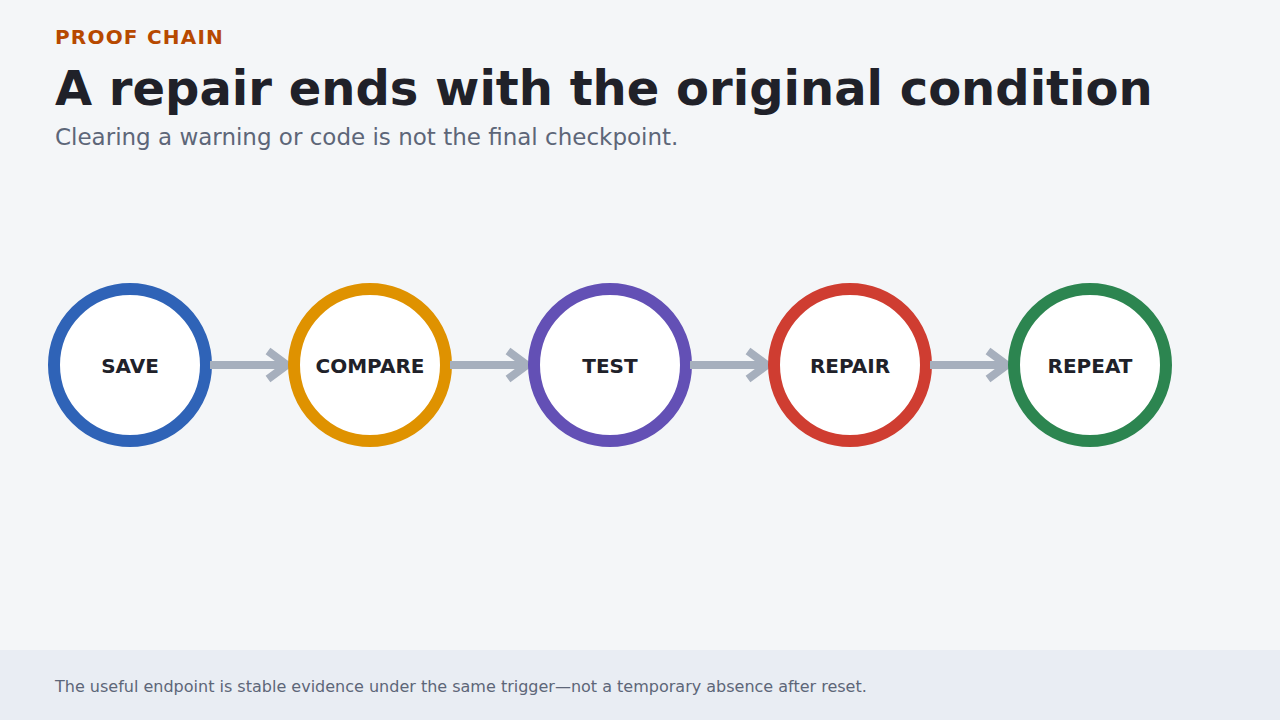
5. Verify the repair under the original condition
Recreate the original warm-idle and load conditions after repair. Both banks should follow the vehicle's expected fuel-control pattern, the original symptom should be absent, no related current or pending code should return, and the affected monitor must complete. A lower trim immediately after clearing adaptive memory is not, by itself, proof of repair.
Official and primary technical references
- Subaru TechTIPS: DTC P0171 diagnostics — Subaru of America / NHTSA
- GM bulletin 20-NA-065 — General Motors / NHTSA
- Nissan campaign bulletin NTB98-018g — Nissan / NHTSA
The useful outcome
You should finish with the original condition precisely recorded, the unsafe possibilities controlled, one failed path proven, and a repeat test showing the symptom or warning is genuinely resolved.





Comments 0
Questions, fixes, and real-world diagnostic notes from readers.
Be the first to share a diagnostic result or ask a follow-up question.