
2021 GM Full-Size SUV Front Air Suspension Sags Below 0°F? Measure the Cold Leak

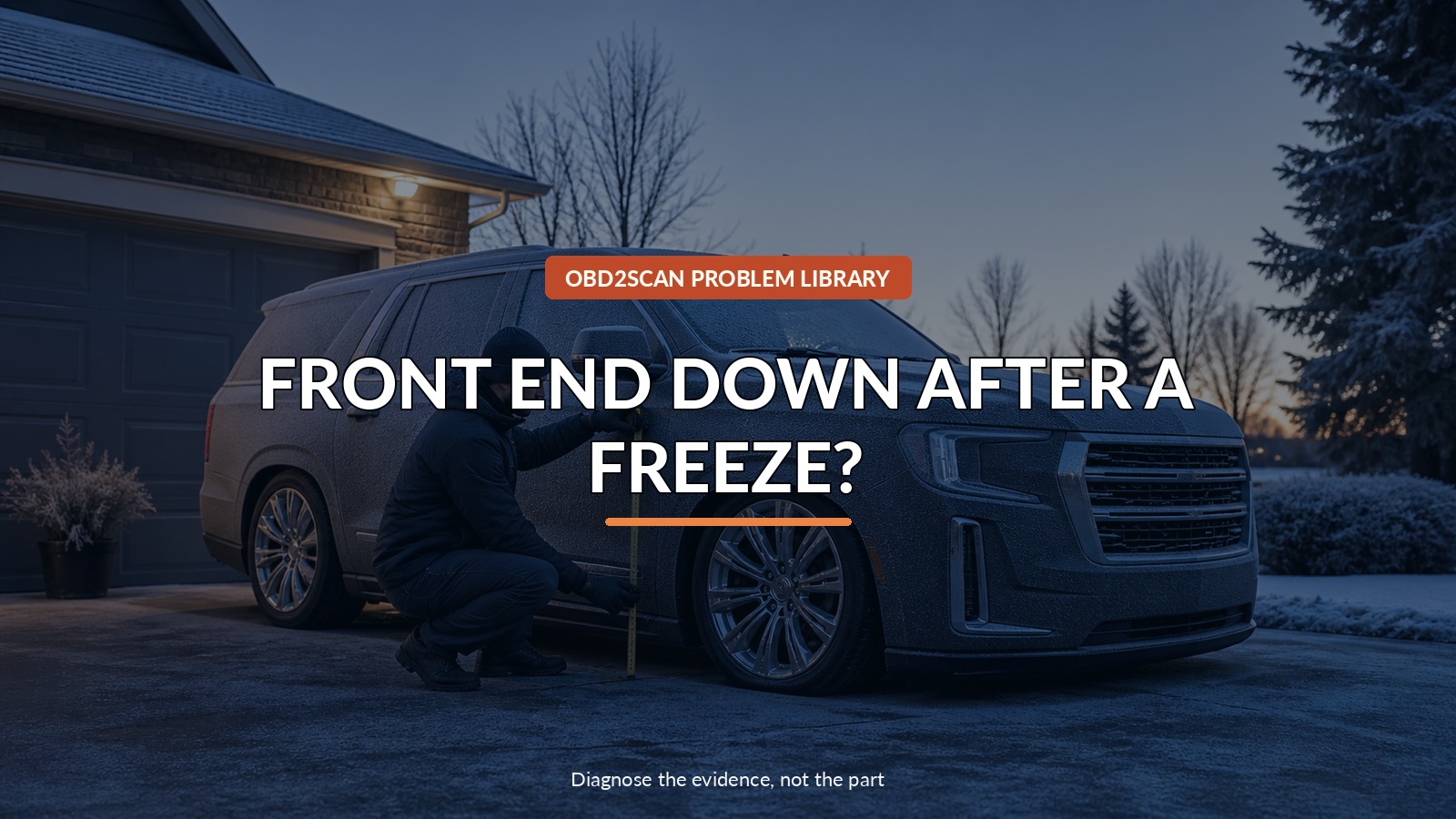
Front End Down After A Freeze?
A 2021 Escalade, Suburban, Tahoe, or Yukon that looks normal in the afternoon but drops at the front after a deep freeze is carrying perishable evidence. Do not unlock, start, or command the suspension before photographing it. GM’s cold-soak bulletin makes temperature and time part of the fault, not incidental weather notes.
Once the system is made safe under the correct service procedure, a two-channel air-suspension pressure tester can compare compatible left and right circuits. The AUTOOL PT680 air-suspension pressure tester is one route for that comparison with correctly matched fittings. It cannot command GM service mode, guarantee connector compatibility, prove an upper-crimp leak by itself, or make a vehicle with deflated air springs safe to drive.
Think like a winter field engineer: height, pressure, temperature, and elapsed time belong on the same page. A warm-shop test performed after the SUV has lifted itself may erase the most useful part of the case. Stop and arrange professional transport if either front air spring is visibly deflated.
Quick answer: Do not drive on deflated air springs; record all four heights before wake-up, verify F47 and sub-zero scope, then compare cold pressure decay.
In this guide
- Do not wake or drive the evidence away
- Confirm F47 and the temperature fence
- Build a four-corner height ledger
- Separate stored pressure from commanded height
- Compare the two front circuits cold
- Move from line connections to the upper crimp
- Keep compressor conclusions downstream
- Repeat the same overnight soak
Do not wake or drive the evidence away
GM PIT5888A warns against driving a vehicle with the front air springs deflated. The safe response is to leave the vehicle where it is, keep people clear of suspension pinch points, and arrange professional handling. Never work under an air-suspended vehicle supported only by the suspension.
Before operating a handle or remote, photograph the whole vehicle from level ground and each wheel opening. Record outside temperature, lowest overnight temperature, wind exposure, hours parked, whether the SUV was locked, and whether one or both front corners are low. Note any Service Air Leveling System message and preserve DTCs such as C118B or C118C.
Confirm F47 and the temperature fence
The bulletin applies to specified 2021 Cadillac Escalade, Chevrolet Suburban and Tahoe, and GMC Yukon vehicles equipped with RPO F47 in North America. Verify the VIN, RPO list, suspension hardware, and current GM service information.
Its characteristic event occurs after an overnight soak below 0°F (-15°C). A rear corner low at 50°F, a vehicle modified with nonstandard links, or a system that drops immediately after shutdown belongs on another diagnostic path. The cold threshold is not proof of the named leak, but it is the gate that makes the published sequence relevant.
Build a four-corner height ledger
Choose one repeatable body reference at each wheel opening and one fixed point on the floor. Measure before wake-up, immediately after the approved wake or fill event, and after a defined interval.
| Moment | Left front | Right front | Left rear | Right rear | Temperature |
|---|---|---|---|---|---|
| Parked at night | Record | Record | Record | Record | Record |
| Before first wake-up | Record | Record | Record | Record | Record |
| After approved inflation | Record | Record | Record | Record | Record |
| End of cold observation | Record | Record | Record | Record | Record |
Use millimeters or fractions consistently. A photo with the tape in place helps a shop reproduce the method. Do not compare a wheel-arch measurement on a sloped driveway with one on a level bay.
Separate stored pressure from commanded height
Ride height is the visible result of pressure, vehicle load, valve state, leveling commands, and temperature. A low corner does not automatically mean the spring itself leaks; the line, fitting, valve block, or commanded behavior may be involved.
A capable scan tool and GM procedure are needed to read codes, command service functions, and keep the system in an appropriate state. Pressure data adds a different fact: whether a physically isolated or controlled circuit retains air. Keep those evidence types separate so a height correction is not mistaken for leak repair.
Compare the two front circuits cold
The best comparison begins while the condition is still cold. Follow the current GM depressurization, support, connection, and inflation steps. Confirm adapter engagement before adding air and respect every pressure limit.
Record left and right initial pressure, temperature, time, and decay over the same interval. Soap solution approved for the material can help reveal bubbles at accessible connections, but very cold leaks may be slow and an external liquid can freeze or mislead. Never use an open flame or unregulated shop air.
An unequal decay directs attention to one branch. Similar decay on both fronts may point toward a common connection, valve path, test setup, or temperature effect. Repeatability matters more than one number.
Move from line connections to the upper crimp
GM’s bulletin directs technicians to inspect the front air-line connections first and then the upper crimp area of the front air springs when the preliminary leak check does not find the loss. That sequence avoids condemning an expensive assembly for a connection problem.
Keep the vehicle safely supported and the system handled only by trained personnel. Look for a repeatable pressure loss or bubble formation at the named location. A damp or dirty crimp is not proof; it must correspond to the cold failure.
Keep compressor conclusions downstream
A compressor that runs frequently may be replacing leaked air rather than causing the original loss. Before judging it, document the leak status, commanded state, fill time, supply voltage, relay behavior, thermal protection, and any compressor-specific codes.
Repeatedly cycling the system to “see if it comes back” can overheat the compressor and mask the overnight loss. Repair or exclude the downstream leak first unless the service information directs otherwise.
Repeat the same overnight soak
Verification needs the same cold exposure, parking surface, loading, measurement points, and pre-wake timing. Compare all four heights and, where applicable, the same pressure interval. Confirm that the system reaches and retains commanded height without abnormal compressor operation or returning codes.
A warm bay that stays level for an hour does not close a below-zero case. The repair is proven when the SUV remains safe and level through the original overnight condition.









Comments 0
Questions, fixes, and real-world diagnostic notes from readers.
Be the first to share a diagnostic result or ask a follow-up question.