
2026 Genesis G70 Coolant Leak? Check the 3-Way Hose Campaign First

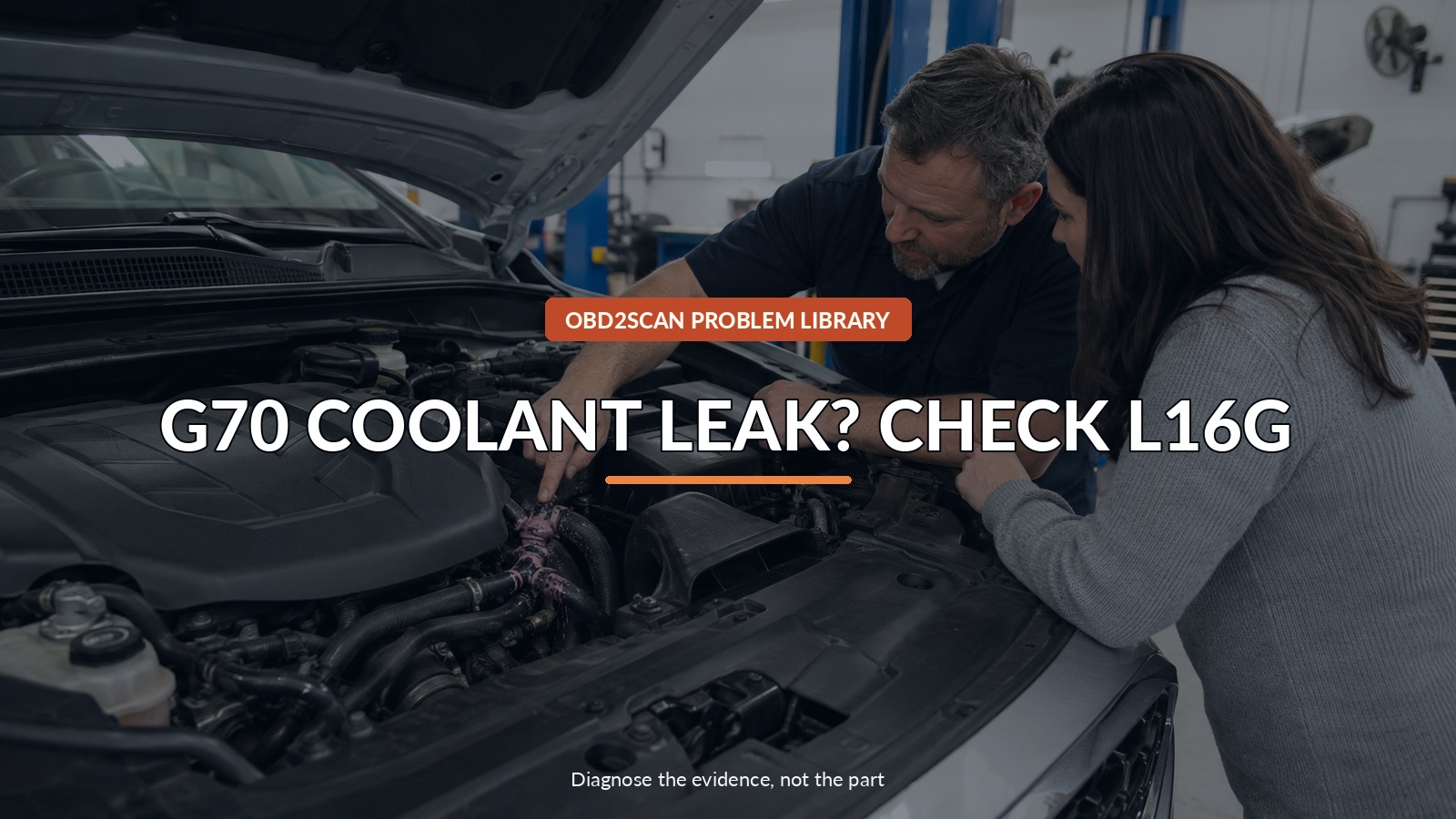
G70 Coolant Leak? Check L16G
If the temperature rises, steam appears or the coolant warning turns red, stop safely and do not open the system hot. On a cooled 2026 G70 3.3T, record where the residue begins and ask a Genesis retailer to check VIN eligibility for campaign L16G. The campaign replaces the three-way hose and fitting even when no active leak is visible; if leakage is found during its inspection, the repair also includes the specified coolant air-bleeding procedure.
Once the engine is completely cold and the campaign branch is known, the useful equipment is a cooling-system pressure tester or vacuum filler—not another bottle of coolant. An AUTOOL SC301 can support those bounded jobs on a compatible reservoir connection. SC301 can support pressure checking and vacuum filling on a compatible, fully cooled system after the correct adapter, pressure limit and bleeding procedure are known; it cannot verify campaign eligibility, make hot coolant safe, prove a hidden hose defect from vacuum alone or replace Genesis’s exact repair and validation steps.
The puddle is only the end of the trail. For this G70, the helpful questions are where the dried residue begins, whether the VIN is included, and whether the campaign inspection finds enough leakage to require the added bleeding procedure.
Quick answer: Stop for heat or rapid loss, trace the highest cold residue and let L16G VIN status plus the leak/no-leak branch decide hose replacement and bleeding.
In this guide
- Decide whether to stop or only document
- Photograph where the residue starts
- Confirm the exact engine and production window
- Check campaign L16G by VIN
- Understand why both branches replace the hose
- Bleed only when the campaign procedure requires it
- Pressure-test without exceeding the system limit
- Recheck cold level and the repaired junction
Decide whether to stop or only document
A few dry pink crystals with a stable cold level are different from a temperature warning, steam or a rapidly growing puddle. If the gauge climbs, the warning turns red, the heater suddenly goes cold or steam appears, pull over, switch the engine off and arrange a tow. Never loosen the reservoir cap while hot. If the level is merely near its low mark when fully cold, photograph it before adding anything and use only the coolant and mixing method in the owner’s information. Do not repeatedly top up a leak that has not been located.
Photograph where the residue starts
Coolant runs downward and is carried rearward by airflow, so the lowest wet spot may mislead. With the engine cold, photograph the ground, splash shield and engine bay before cleaning. Look for the highest fresh wet edge and the first band of dried pink residue around the three-way junction. Note the odor, date, ambient temperature and distance since the last service. A dealer can compare those images with the campaign location. A wet undertray alone does not prove the three-way hose; a water-pump, radiator or unrelated connection needs its own path.
Confirm the exact engine and production window
Campaign L16G is not written for every leaking G70. It covers certain 2026 G70 (IK) vehicles fitted with the Lambda II 3.3-liter T-GDI engine and built from February 12 through May 13, 2026. Confirm the engine and production information from the VIN rather than appearance or registration date. A 2.5T, a different model year or a car outside that window still deserves a cooling-system inspection, but this bulletin cannot be used as a shortcut to its repair. Record any earlier hose, fitting or collision work as well.
Check campaign L16G by VIN
Ask the Genesis retailer to check the VIN in WebDCS and the current campaign record before scheduling parts. The bulletin is a limited-coverage field action, not a promise that every owner complaint has the same coverage. Warranty start date and mileage matter. The public NHTSA recall lookup is useful for safety recalls, but a technical campaign may be tracked differently in the manufacturer’s system. Request a written repair-order note showing whether L16G is open, already completed or not applicable; that single line prevents a generic coolant visit from being confused with a defined campaign repair.
| What you find | What it means next |
|---|---|
| Red warning, steam or rapid loss | Stop, cool and tow; do not open the reservoir |
| VIN eligible for L16G | Follow the campaign even if the junction looks dry |
| Campaign inspection finds leakage | Replace hose/fitting and perform the specified bleeding branch |
| VIN not eligible or leak starts elsewhere | Continue normal cooling-system diagnosis |
Understand why both branches replace the hose
Both campaign branches replace the three-way hose assembly and fitting. The observed leak changes what happens around that replacement: when leakage is present, the bulletin adds the coolant air-bleeding operation; when no leakage is present, it calls for the hose replacement without that added operation. That distinction is why the initial condition should be documented before the area is washed. It is also why a pressure test is not a substitute for the campaign. The VIN-directed preventive branch can apply even when a cooled inspection finds no active drip.
Bleed only when the campaign procedure requires it
If the campaign inspection confirms leakage, the technician follows the current procedure for coolant handling and air removal. Air pockets can make the level change after the first heat cycle, reduce heater performance or create misleading temperature behavior. This is not solved by filling to the top of the reservoir. The specified coolant, correct fill level, commanded circulation or bleed functions, and a complete cool-down all matter. If no leak was present and the bulletin does not call for the added operation, do not invent one; follow the current procedure exactly.
Pressure-test without exceeding the system limit
For a leak outside campaign handling, apply only the pressure specified for the exact cooled system and adapter. Watch the three-way junction and surrounding hoses rather than pumping until something leaks. A slow pressure decline can come from the adapter, trapped temperature change or an actual opening; pair the gauge trend with visible evidence. Release pressure through the tool before disconnecting. Vacuum filling can help after an opened system, but an inability to hold vacuum does not identify the failed part and a successful vacuum hold does not prove every hot-running condition is resolved.
Recheck cold level and the repaired junction
After repair, clean the old residue so new evidence will be visible. Confirm the cold level, warm the vehicle only through the approved verification, check cabin heat and inspect the junction as temperature and pressure change. Allow a full cool-down and check the level again rather than declaring success while the coolant is expanded. Give the owner a simple record: VIN eligibility, whether active leakage was found, hose and fitting replacement, whether bleeding was required, coolant used, and the final cold level. That record is far more useful than ‘coolant topped off.’
The useful answer is not simply ‘replace a hose.’ First protect the engine and anyone near hot coolant. Then preserve the highest leak evidence, prove the exact 2026 G70 3.3T scope and let WebDCS decide whether L16G controls the visit. The campaign replaces the hose and fitting; the presence of leakage decides whether the added bleed operation belongs. Rechecking the cold level after a heat cycle closes the loop for the person who needs the car back, not just the repair order.






Comments 0
Questions, fixes, and real-world diagnostic notes from readers.
Be the first to share a diagnostic result or ask a follow-up question.