
Harley Touring Feels Abrupt on the Rear Brake? Separate Linked-Brake Calibration From a Fault

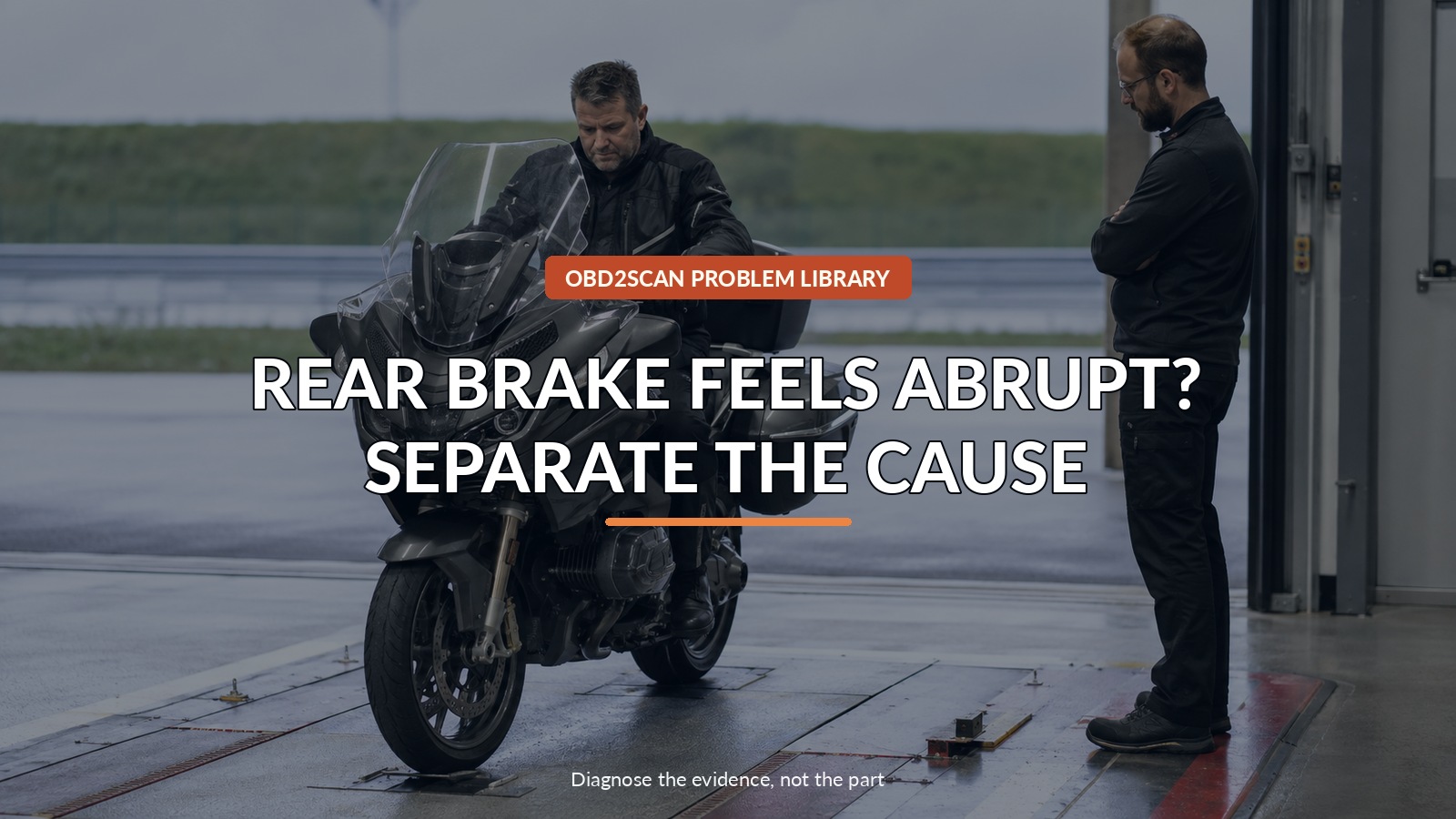
Rear Brake Feels Abrupt? Separate The Cause
If stopping distance, lever/pedal feel, warning lamps or fluid condition changed, stop riding and arrange inspection. If the only complaint is smoothness when the rear pedal alone is applied above about 20 mph, Harley’s M1691 describes an EHCU calibration update for the listed Touring/CVO models. Model, software revision and current safety campaigns must be checked before flashing.
Before factory reprogramming, a Harley-capable scan can preserve supported ABS/EHCU codes and live context for the handoff. The FXTUL M4-HD is one route when exact motorcycle and connector coverage are verified. FXTUL M4-HD can preserve supported Harley fault codes and live data before the motorcycle is handed off, once connector and model coverage are confirmed; it cannot reflash the EHCU, replace Digital Technician II/Techlink 3, validate hydraulic integrity, perform a safe brake road test or decide that a recall is complete.
Rider feel is legitimate evidence, but braking feel must be sorted by safety before software. A calibration can change how linked force is apportioned; it cannot repair air, fluid loss, worn friction material or a damaged hydraulic component. Describe the motorcycle in two speed zones and two input types: below/above the linking threshold, rear pedal alone versus combined controls. That four-box rider report is more useful than the word ‘grabby.’
Quick answer: Stop for true brake faults, compare rear-pedal feel below and above linked-braking speed, then check the exact model and EHCU revision.
In this guide
- Stop riding for any true brake warning
- Describe pedal-only feel above and below 20 mph
- Understand what dynamic linking changes
- Confirm the exact Touring or CVO model
- Read the installed EHCU revision
- Prepare battery support and Harley tools
- Do not open the hydraulic system for a software-only repair
- Verify warning state and braking on a controlled ride
Stop riding for any true brake warning
Do not ride if the ABS or brake warning stays on, the pedal sinks, the lever feels spongy, fluid is low or leaking, the motorcycle pulls, a wheel drags or stopping distance changes. Arrange transport and a complete brake inspection. M1691 addresses a smoothness concern during a particular linked-braking operation, not every brake complaint. Check the VIN for open recalls and safety programs before applying a technical bulletin. A software update should never be used to postpone inspection of a physical warning sign.
Describe pedal-only feel above and below 20 mph
On a closed, safe test area with a qualified rider, describe the feel below and above approximately 20 mph. Note whether it occurs only when the rear pedal is pressed, whether the front lever changes it, how hard the pedal is applied and whether the road is smooth and straight. Do not deliberately provoke abrupt braking in traffic. Record load, passenger, tire condition and recent brake or wheel work. A repeatable transition near the dynamic-linking threshold supports a control-distribution question; a symptom at every speed keeps hydraulic and friction branches prominent.
Understand what dynamic linking changes
Harley’s dynamically linked braking can command some front braking when the rider uses only the rear pedal above the operating threshold. The bulletin says its software update optimizes front/rear proportioning for the scoped smoothness complaint. This does not mean the rider loses independent control in every situation, and it does not prove a particular sensation is normal. The key is timing: identify whether the abruptness begins when linking becomes active and disappears below the threshold, without overlooking ABS intervention caused by surface or tire grip.
| Rider evidence | More consistent with | Required response |
|---|---|---|
| Abruptness only rear-pedal/above linking speed | Scoped calibration may fit | Confirm model and EHCU revision |
| Spongy/sinking control or fluid leak | Hydraulic fault | Stop riding and inspect |
| Warning lamp/current ABS code | Active system fault | Diagnose before software-only route |
| ‘A’ revision already installed | Bulletin flash already represented | Investigate other causes |
Confirm the exact Touring or CVO model
M1691 lists specific 2023–2025 Touring and CVO models, including selected CVO Street Glide/Road Glide variants, the standard Street Glide and Road Glide, and later Street Glide Ultra or Road Glide RR as listed. Confirm the full model code and year; similar fairings do not establish applicability. Check the current bulletin revision and VIN campaign screen. Accessories, nonstandard wheels, suspension changes and brake-component modifications should be recorded because they may change feel or require separate inspection.
Read the installed EHCU revision
Connect Digital Technician II with the current software and read the Electronic Hydraulic Control Unit revision. Harley says motorcycles already carrying the ‘A’ revision described by M1691 do not need the same reflash. Preserve all codes before clearing, and investigate current pump, valve, wheel-speed or communication faults through the electrical diagnostic manual. An aftermarket pre-scan can support the record, but the revision and flash decision belong to Harley’s factory system and current service information.
Prepare battery support and Harley tools
The bulletin specifies a fully charged battery, battery tender, Digital Technician II at the required release or later, Techlink 3 and an external 12-volt supply for the communication hardware. Follow the current setup exactly and secure all leads away from hot exhaust, moving wheels and steering. Do not use an unknown maintainer that changes modes during programming. Stable voltage protects the session; it does not make an unsafe brake system eligible for software-only service. Resolve low-voltage and communication problems first.
Do not open the hydraulic system for a software-only repair
For the scoped update, Harley states that no ABS hydraulic service follows simply because the EHCU was reflashed—the hydraulic system was not opened. That saves unnecessary bleeding, but it is not a blanket instruction to skip fluid or hydraulic work when inspection found a separate problem. Record the prior and new revision, any recovery actions and post-flash codes. If programming fails, keep the motorcycle stationary and follow Harley recovery; do not attempt a road test with an incomplete EHCU session.
Verify warning state and braking on a controlled ride
Verification begins with a static warning-lamp and control check, then a low-speed brake test in a closed area. A trained rider can compare rear-pedal-only behavior below and above the linked threshold, followed by normal combined braking, increasing speed and effort gradually. Confirm straight tracking, normal lever/pedal feel and no leaks or returning codes. The aim is smoother proportioning without reduced stopping confidence. If the original sensation remains—or a new one appears—stop and reopen brake inspection rather than declaring the software successful because the flash completed.
A rider should not have to choose between being told ‘they all do that’ and receiving a parts-heavy brake repair. Start with the stop-riding boundaries, describe feel in the four operating boxes, confirm the exact model and EHCU revision, and use Harley’s programming route only when the pattern fits. Then prove the result on a controlled ride. Calibration can refine linked braking; safety evidence decides whether calibration is enough.



Comments 0
Questions, fixes, and real-world diagnostic notes from readers.
Be the first to share a diagnostic result or ask a follow-up question.