
Wrangler or Gladiator Leaks at the B-Pillar? Recreate the Downhill Park

Recreate The Downhill Leak
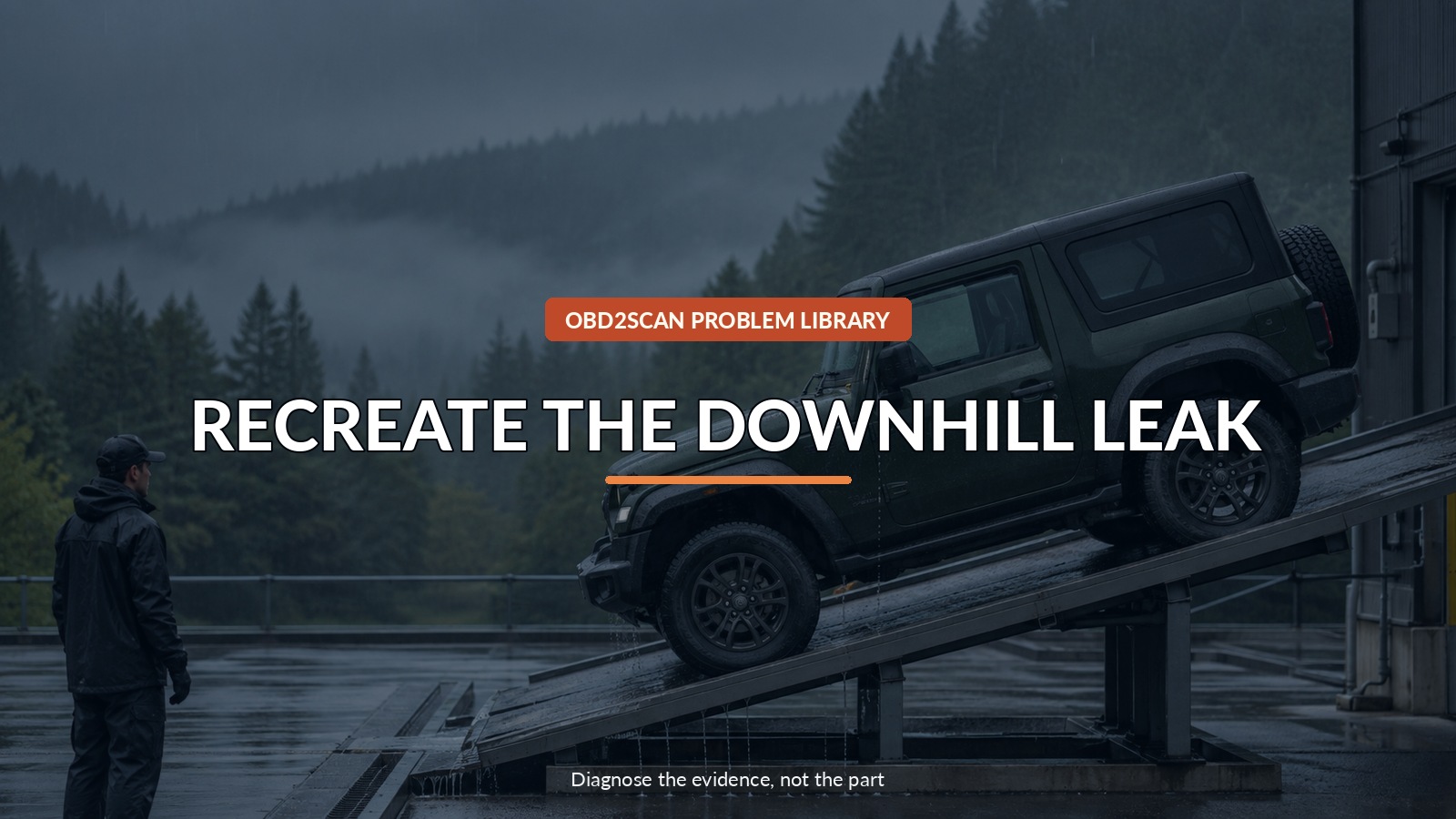
A Wrangler or Gladiator that leaks at the top of the B-pillar only while parked nose-down is giving you a test condition, not an anecdote. Stellantis TSB 23-060-24 recreates that condition by safely raising the rear about 12 inches, soaking the entire roof, and watching both B-pillars. If the leak does not appear there, the bulletin’s foam-pad repair does not apply.
Where trim and seal geometry hide the first drip, an articulating camera can help preserve the path. The MRCARTOOL N180 articulating borescope is one inspection option after safe access. It cannot support the vehicle, create the required slope, prove a roof source from a downstream trail, replace a whole-roof water test, or specify the foam repair.
Treat the driveway angle as part of the symptom. A level-bay hose test can miss the condition entirely.
Quick answer: Record the parking angle, confirm the three-piece hardtop, then recreate the nose-down condition with the bulletin’s 12-inch rear rise and watch both B-pillars.
In this guide
- Write down the parking angle before drying anything
- Confirm the hardtop and build fence
- Rule out unrelated water paths first
- Recreate the 12-inch rear rise safely
- Soak the whole roof and watch both pillars
- Use the first drip path, not the wettest carpet
- Install foam only after reproduction
- Verify the cabin dry on the same slope
Write down the parking angle before drying anything
Ask the driver where the front of the Jeep pointed, how steep the grade felt, how long rain or washing lasted, which side became wet first, and whether the Freedom Panels had recently been removed. Photograph the drip at the top of the B-pillar, door trim, carpet boundary, headliner edge and hardtop joints before wiping them.
Also record whether the water enters only with a door open. Water that drips from a wet roof when a door is opened is a different observation from water entering a closed cabin. Note wind direction, roof accessories, racks, light bars, seal treatments, collision repair and pressure-washer use.
Confirm the hardtop and build fence
The bulletin covers 2021–2025 Wrangler JL and Gladiator JT vehicles built on or after January 1, 2021. They must have the black three-piece hardtop, sales code HT1, or body-color three-piece hardtop, sales code HT3.
A soft top, an earlier build, another roof system, or water entering at a different pillar does not inherit this repair. Confirm the VIN, sales code, build date, panel identity, previous seal work and current Service Library. The TSB is technical information, not automatic warranty or recall authorization.
Rule out unrelated water paths first
Stellantis tells technicians to use the general water-leak diagnosis and testing procedure before this repair so other leaks are not missed. Inspect panel installation, weatherstrip seating, header and door seals, roof fasteners, drains, glass, body seams and aftermarket penetrations as current service information directs.
Do not add sealant or foam to every damp joint. Water can travel inside channels and emerge far from its entry. Dry tissue flags at separate locations, a controlled low-to-high water sequence, and photographs of the first arrival are more reliable than following the largest wet patch backward by guesswork.
Recreate the 12-inch rear rise safely
The bulletin raises the rear approximately 30.4 cm, or 12 inches. This is professional lifting work: use rated equipment, the correct support points, level ground, wheel restraints and a setup that remains stable while water is applied. Do not improvise with loose blocks, a curb, or an unsupported jack.
Measure and record the rise so the post-repair test can repeat it. The goal is not an arbitrary dramatic slope; it is to reproduce how water pools and travels at the rear outer corners of the Freedom Panels.
Soak the whole roof and watch both pillars
With the rear safely raised, apply water to the entire roof as specified. Place one observer inside where safe, or use cameras/tissue flags at both B-pillars. Record which side shows the first bead, elapsed soak time, water rate, panel status and whether another leak appears elsewhere.
| Result on the controlled slope | Bulletin direction |
|---|---|
| Water enters at a B-pillar | Continue to the foam-pad repair branch |
| No B-pillar water | TSB 23-060-24 does not apply |
| Water appears elsewhere | Diagnose that path separately |
| Both B-pillars leak | Preserve both and follow the bilateral repair direction |
Use the first drip path, not the wettest carpet
Water running down a pillar may soak the carpet several inches away. Trace upward to the first fresh point while the test is active. Establish orientation before inserting a camera, keep the lens away from delicate seal surfaces, and capture a slow video rather than a collection of disorienting close-ups.
A hidden drip path shows where water traveled. It does not, by itself, prove which outside seal admitted it. Correlate the internal arrival with the controlled roof application and the bulletin’s defined B-pillar location.
Install foam only after reproduction
If the B-pillar leak is reproduced, the bulletin directs technicians to lower the vehicle, remove both Freedom Panels onto a padded surface, make sure they are dry, and install the specified rear foam pads at the outer corners of both panels. Both sides matter even if only one side visibly leaked during the test.
Panel handling, surface preparation, pad placement and adhesion should follow the current procedure. Do not stack random foam, overtighten latches or add general-purpose sealant; changing compression and drainage can move the leak rather than stop it.
Verify the cabin dry on the same slope
Dry the carpet, trim and hidden padding before retesting. Reinstall the panels correctly, reproduce the same 12-inch rear rise, soak the whole roof for the same duration and rate, and inspect both B-pillars plus any previously noted alternate path.
The release standard is a dry cabin on the reproduced slope, correctly seated panels, undamaged seals and no retained water in padding. A dry result on level ground is not equivalent to the condition that brought the Jeep in.







Comments 0
Questions, fixes, and real-world diagnostic notes from readers.
Be the first to share a diagnostic result or ask a follow-up question.