2022 Ford F59 Loses Power After a Bump: Inspect the Harness Near the Pulley

Quick answer: An impact-triggered fault makes routing and clearance useful inspection targets. It does not mean the sensor named by a code is the damaged component.
A delivery truck that loses power after a bump offers a physical clue, not an invitation to repeat the bump. Inspection may need to reach behind stationary pulleys or shields. An articulating camera such as the AUTOOL SVB308 can document visible routing. Work requires cool, disabled equipment; photographs alone cannot establish a specified clearance or an electrical failure.
In this guide
Keep the bump in the complaint description
Preserve the sequence in the driver’s report: the road event, the immediate change in power, the warning display and what happened after the truck stopped. A maintenance note that says only “reduced power” loses the part that may direct attention to movement and contact.
Do not turn the report into an unsupported impact-damage claim. The bump may expose an existing vulnerability rather than create every defect at that moment. Give the workshop observations and let the inspection establish the condition. Deliberate road shocks are not a safe test method, especially when engine warnings or driver-assistance functions are affected.
An oil-pressure code still deserves caution
A code associated with oil pressure must not be dismissed simply because another electrical explanation seems attractive. The workshop needs to assess the warning and determine whether continued operation is safe. This article does not supply an alternate pressure threshold or permission to ignore the instrument display.
The short repair account identifies damaged wiring, but does not publish a captured electrical event that proves every step of the mechanism. Keep that limit in mind when reading a diagnosis online. A plausible shared-circuit explanation is not the same as a measured one, and no wire color or reference-voltage route should be guessed from this story.
Inspect the space a harness can move into
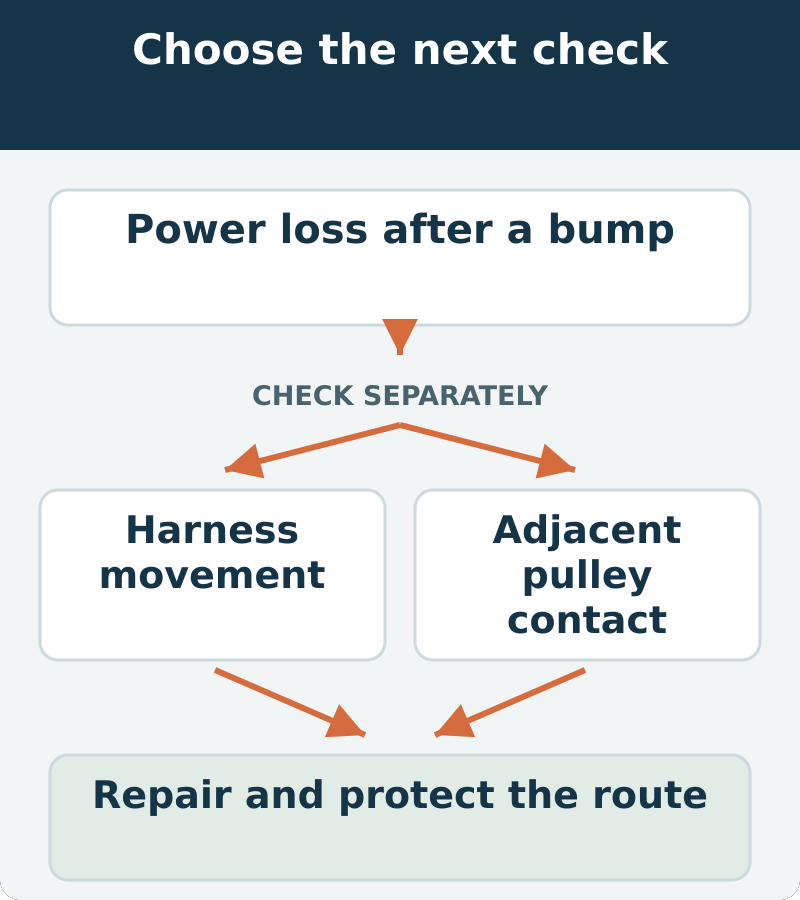
A routing inspection concerns more than the harness’s resting position. A repairer must consider the permitted movement of nearby equipment and whether supports keep wiring away from rotating or sharp parts. The correct clearances and restraints come from vehicle information and the actual installation.
Useful inspection questions include:
- Is there visible wear where the harness approaches adjacent hardware?
- Are the intended retainers and protection present?
- Does the surrounding equipment show related damage?
These are planning questions for a safe inspection. Never reach near a running pulley, tug a live harness or work beneath inadequately supported equipment to answer them.
In the published ALLDATA case, a bump preceded power loss and several disabled assistance features. P0522 and P06A7 were stored. The technician found fan-clutch wiring frayed against the water-pump pulley. Wiring repair and belt replacement were followed by normal operation. The account does not publish a captured reference-voltage event.
Why repairing copper is only part of the job
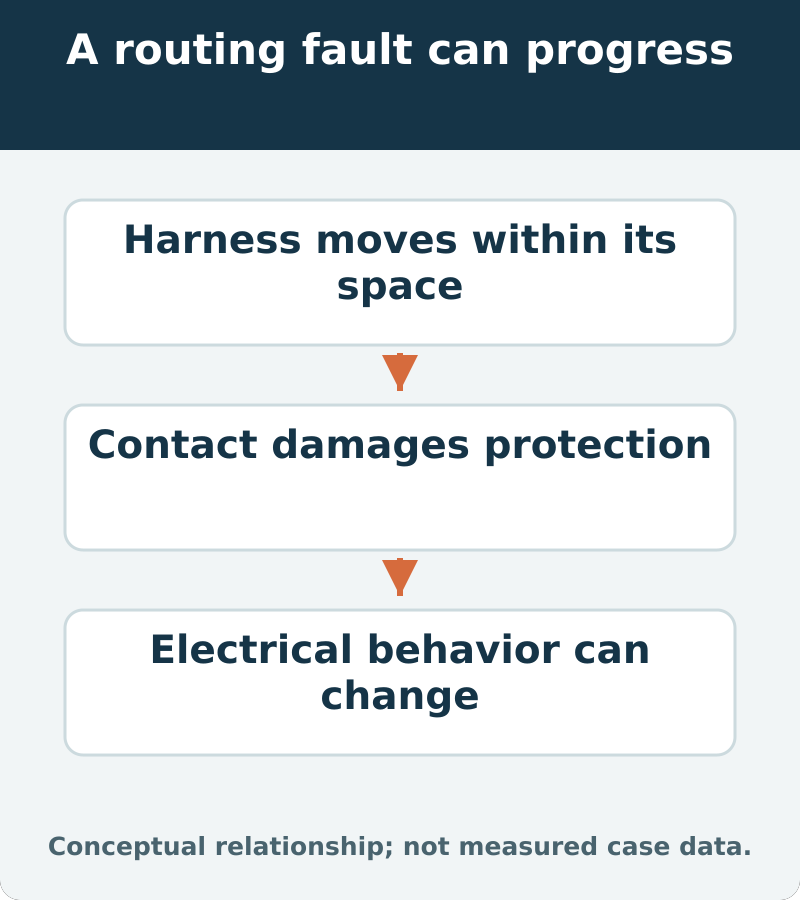
Restoring electrical continuity addresses the damaged conductor. Restoring routing and protection addresses why that conductor was vulnerable. A lasting repair needs the appropriate answer to both questions, not simply tape over the visible mark.
Ask what repair method was used and how the finished harness is supported. Do not prescribe a different wire size, arbitrary extra length or a tie-wrap position from an illustration. The diagram shows the difference between circuit restoration and physical protection; it is not a fabrication drawing. The original account’s successful outcome is helpful, but your truck still needs a repair suited to its own damage.
Include nearby belts and supports in the inspection
Where wiring and a rotating component have contacted one another, the inspection scope should consider both sides of the contact. Ask whether nearby belts, retainers, shields and the relevant pulley area were assessed. This does not mean every adjacent part must be replaced; it means the damage assessment should not end at the first visible conductor.
For a commercial vehicle, record any body-builder or previous repair work that could affect access or routing. Do not assume it caused the fault. Accurate configuration information helps the technician use the correct diagram and inspect the actual installation rather than an imagined standard layout.
Document the protected route before release
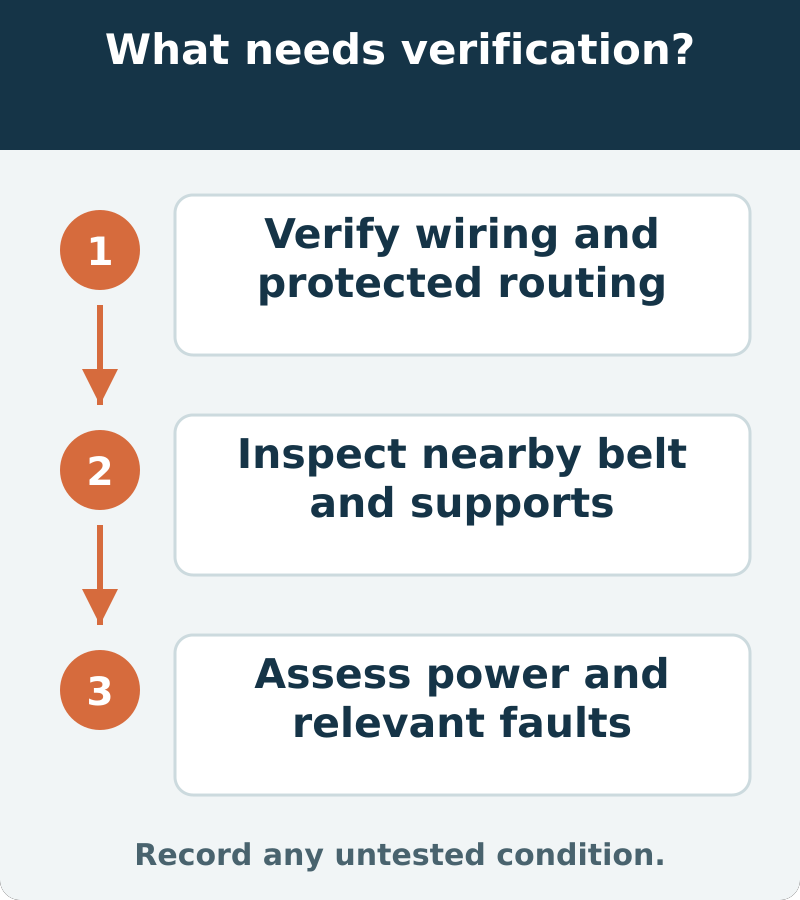
Before fleet release, request the repaired-circuit checks, the assessment of the warning condition and confirmation that the protected route was inspected. Photographs are useful when they show the mounting context, not merely a close-up of fresh insulation.
Keep the original trigger in the job history even if the truck now operates normally. If a later complaint occurs, it gives the next investigation a concrete comparison. The aim is not to prove that every bump-related problem is wiring damage. It is to preserve an unusually useful physical clue, repair the confirmed defect and remove the contact opportunity that could otherwise make the job recur.




Comments 0
Questions, fixes, and real-world diagnostic notes from readers.
Be the first to share a diagnostic result or ask a follow-up question.