
2017 Ram 1500 Lost Throttle Response Intermittently: The Coolant Bypass Valve Was Spiking a Shared Reference

Four Codes, One Shared 5-Volt Disturbance
Quick answer: The accelerator pedal was not the useful first replacement. A coolant bypass valve sharing the reference environment was coupling its 12-volt fault into the five-volt circuit; disconnecting it ended the symptom, and replacement closed all four codes. This article follows one documented vehicle. It explains the evidence chain, not a universal failure rate or a direction to replace the same part on every similar car. Stop whenever the test would involve overheated brakes, high current, moving parts, refrigerant handling or an uncontrolled road condition.
A graphing automotive multimeter can compare the shared five-volt reference and the valve’s 12-volt circuit during the event; AUTOOL DM301 Automotive Multimeter is suitable for that bounded voltage and waveform observation. It cannot authorize disconnecting every sensor at random, prove an internal valve short without circuit isolation, or protect a controller from incorrect power injection.
P0653 made the Ram’s shared five-volt network look like the obvious center of the failure. The decisive clue was that disconnecting one twelve-volt coolant valve stabilized the reference and returned throttle response.
Quick answer: The accelerator pedal was not the useful first replacement. A coolant bypass valve sharing the reference environment was coupling its 12-volt fault into the five-volt circuit; disconnecting it ended the symptom, and replacement closed all four codes.
In this guide
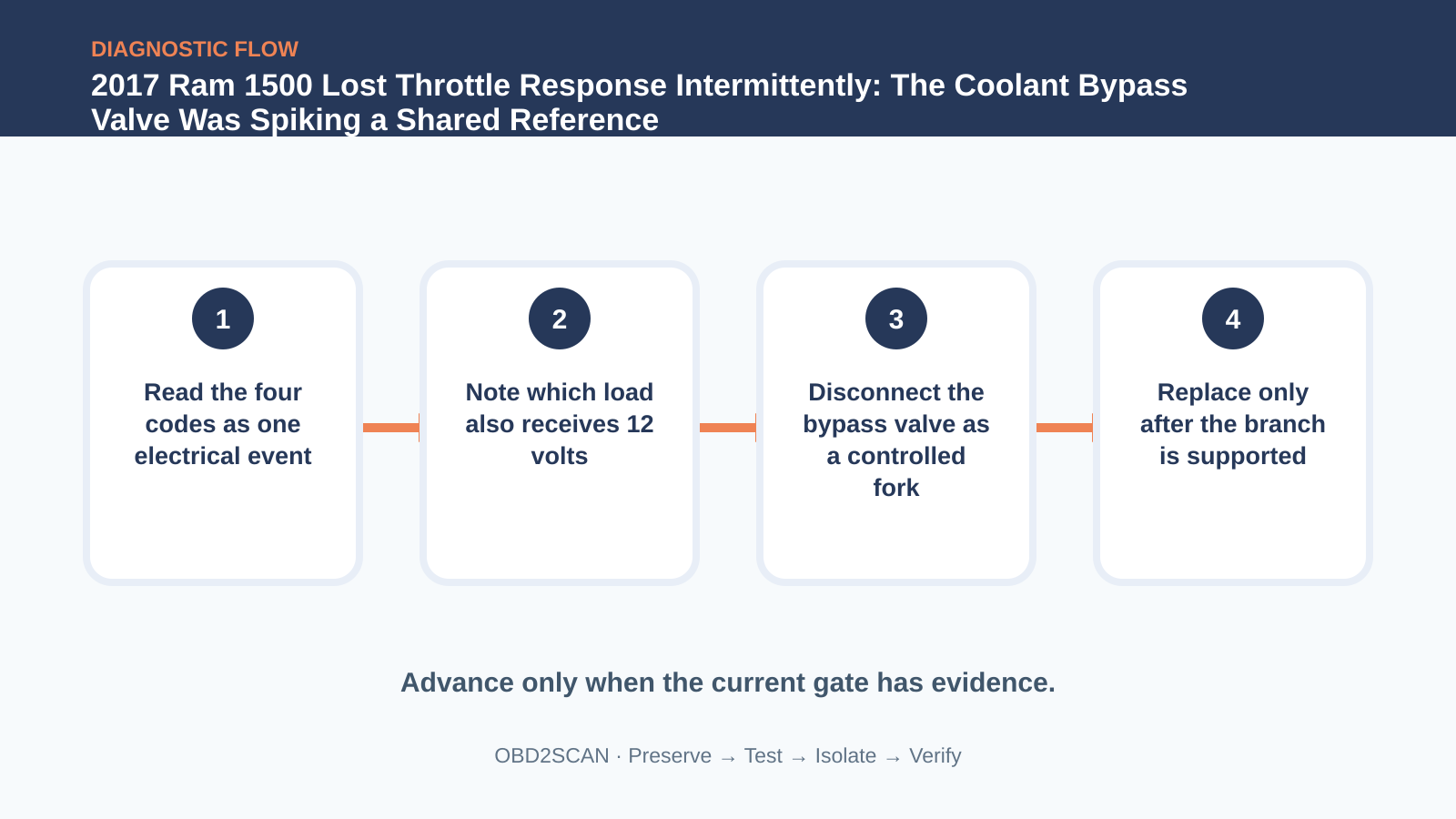
- Read the four codes as one electrical event
- Map every five-volt consumer
- Note which load also receives 12 volts
- Measure without shorting the reference
- Disconnect the bypass valve as a controlled fork
- Check whether symptoms and reference recover
- Replace only after the branch is supported
- Rescan and repeat the throttle event
Read the four codes as one electrical event
Capture the code set as one event: high five-volt reference, low accelerator-pedal signal, cooling performance and open coolant-bypass-valve control. Four component descriptions do not require four failed parts. Shared power, ground and reference paths deserve a diagram before anything is unplugged. Preserve the original condition before changing it. The first observation is the control sample against which every later test must be compared.
Map every five-volt consumer
Both accelerator five-volt references measured about 5.02 volts when checked. A normal snapshot does not clear an intermittent spike. Graph the reference during the complaint, use high-impedance instruments and avoid back-probing that spreads terminals or shorts the supply to ground. Use service information for the exact engine, build date and options. A correct method on the wrong terminal can create a precise but useless result.
Note which load also receives 12 volts
Map the MAP, cam sensors, accelerator pedal, fuel-rail sensor and coolant valve according to the exact 3.6L schematic. The coolant bypass valve was important because it participated in the monitored group while also receiving a 12-volt supply—a possible bridge between voltage domains if internally shorted. Treat prior work as evidence, not blame. A repair that made no change can narrow the case when its installation and test conditions are verified.
Measure without shorting the reference
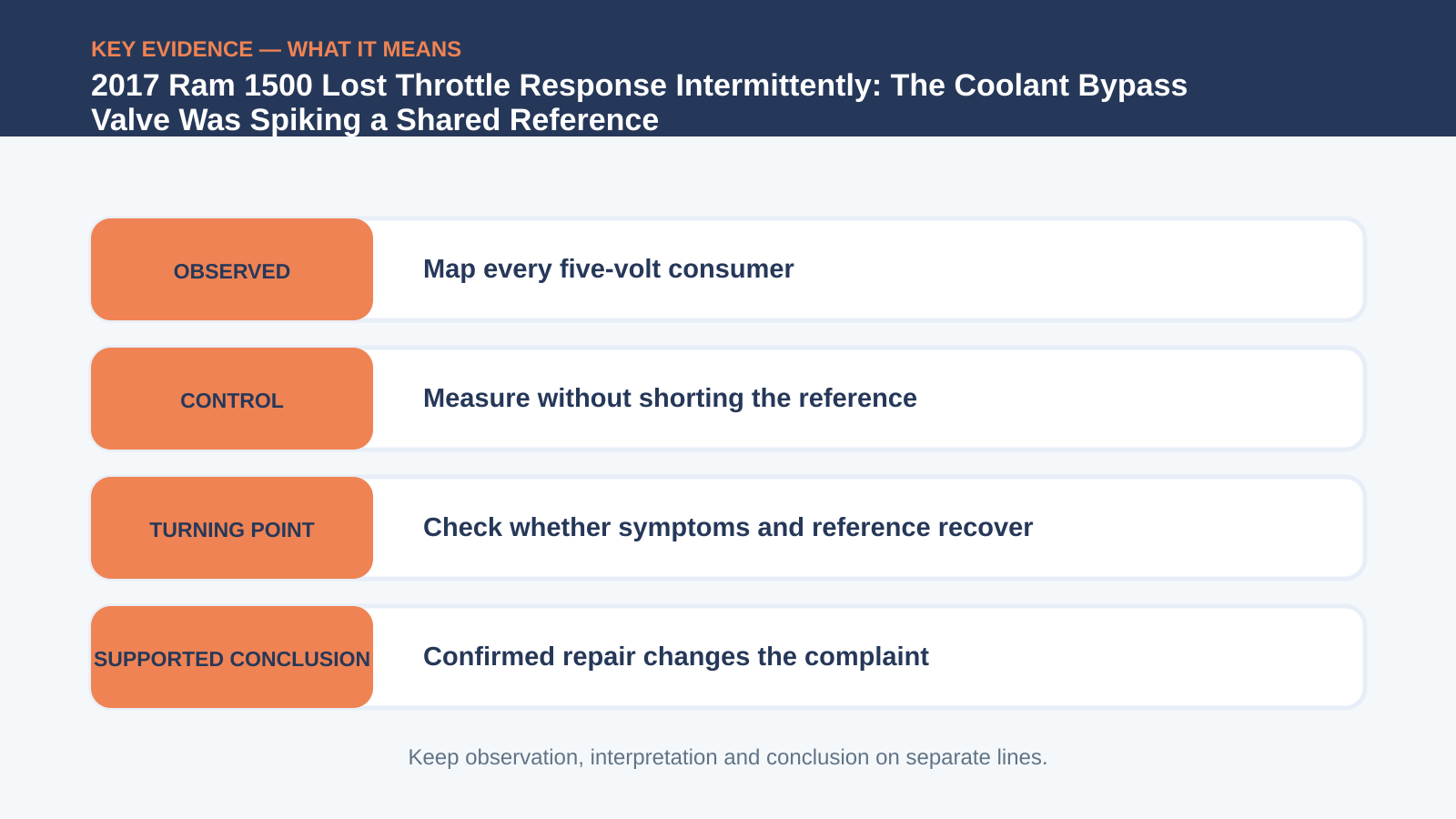
Disconnect only the identified valve with ignition state and connector handling matched to service information. In the documented case the idle and throttle symptoms disappeared when that branch was removed. That A/B response moved the valve ahead of the accelerator pedal without claiming every P0653 is caused there. At this stage, separate what was observed from what is inferred. The observation should remain true even if the current theory is later rejected.
| Observation | What it supports | What it does not prove |
|---|---|---|
| P0653, P2127, P2181, P2681 | Shared electrical path deserves mapping | Four parts have failed |
| Five-volt snapshot looks normal | Reference is present at that moment | No intermittent spike exists |
| Valve disconnect ends symptoms | That branch can disturb the system | The harness is perfect |
| Replacement passes road test | Valve was causal here | Every P0653 needs this valve |
Disconnect the bypass valve as a controlled fork
Inspect the connector for coolant intrusion, pin tension, rubbing and prior repair. Measure the isolated valve and harness by the specified tests. Do not inject power into a reference circuit or force a ground onto a control wire; either can damage several sensors and the PCM. This is the decision point in the documented case. Its value comes from changing one bounded condition while leaving the rest of the system intact.
Check whether symptoms and reference recover
Replace the coolant bypass valve after the branch evidence is complete, then refill or bleed any disturbed cooling circuit by the vehicle procedure. Clear the codes only after confirming the five-volt reference remains stable with the new valve connected. A confirmed component still needs a repair that restores sealing, support, torque, routing or terminal fit—the physical conditions that keep the fault from returning.
Replace only after the branch is supported
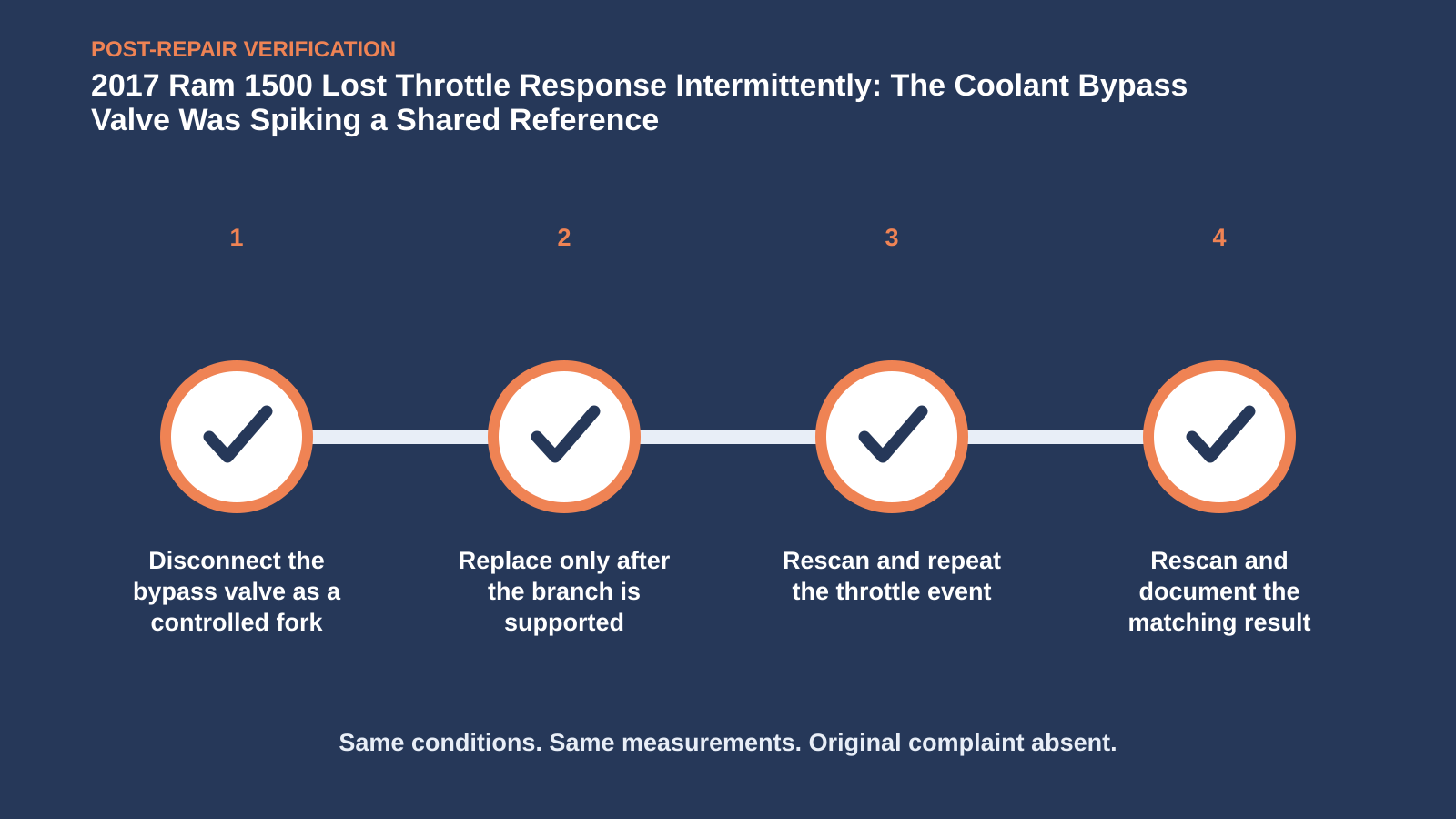
Road-test the same idle and throttle conditions while logging accelerator tracks, reference voltage and coolant data. Both pedal tracks should remain plausible and correlated, response should be normal and the complete four-code set should not return as pending or stored. Reassemble protective covers and retainers before declaring success. A diagnostic shortcut must not become the next failure mechanism.
Rescan and repeat the throttle event
This diagnosis works because one unusual electrical feature joined the symptoms. The reader should reuse the method—draw the shared-reference tree, identify loads with another supply, isolate one branch safely—not memorize the bypass valve as a shortcut for unrelated Ram complaints. Use the customer’s original complaint as the final specification. A cleared code, quiet bay or one good key cycle is not equivalent to reproducing and passing that condition.
If you are bringing a similar symptom to a shop, arrive with the useful conditions rather than a requested part: whether the vehicle was cold or hot, the exact speed or switch position, which warning lamps appeared, what changed after a restart, and a chronological list of earlier repairs. A short video can preserve an intermittent sound or lamp pattern, but record it only while parked or with a passenger handling the camera. Ask the technician to retain the pre-repair scan and measurements, explain the test that separated the failed path from the alternatives, and show how the original complaint was repeated afterward.
For the owner or service adviser, a useful repair explanation has three parts: what was observed, why the decisive test narrowed the fault, and which original condition passed after the repair. It should also say what the test did not prove. That boundary prevents a memorable case from becoming an automatic parts recommendation.
The accelerator pedal was not the useful first replacement. A coolant bypass valve sharing the reference environment was coupling its 12-volt fault into the five-volt circuit; disconnecting it ended the symptom, and replacement closed all four codes. The reusable lesson is narrower and more valuable: Organize the article as a shared-reference map, with one unplug result changing the whole code cluster instead of four separate component stories.








Comments 0
Questions, fixes, and real-world diagnostic notes from readers.
Be the first to share a diagnostic result or ask a follow-up question.