
2003 Toyota Camry Stalled About Seven Minutes After Start: The EVAP Canister Was Feeding It Raw Fuel

Stalls On A Timer—Watch When Purge Begins
Quick answer: The stall began when purge flow introduced excess fuel from a saturated canister. Replacing the air/fuel sensor could not help because both oxygen sensors were reporting a real rich condition; replacing the canister and overfill valve removed the timed fuel source. This article follows one documented vehicle. It explains the evidence chain, not a universal failure rate or a direction to replace the same part on every similar car. Stop whenever the test would involve overheated brakes, high current, moving parts, refrigerant handling or an uncontrolled road condition.
Fuel pressure still belongs in the first branch of a stall diagnosis, and a digital gauge such as AUTOOL PT635 Digital Fuel Pressure Gauge can record rail pressure and temperature while the event develops. It cannot identify a saturated charcoal canister, measure vapor concentration, or make pinching an EVAP hose safe or valid without the correct routing and procedure.
This Camry did not stall randomly; it stalled on a clock. Stable ignition and position signals followed by an agreed rich event turned seven minutes of idling into a map toward purge flow and a fuel-soaked canister.
Quick answer: The stall began when purge flow introduced excess fuel from a saturated canister. Replacing the air/fuel sensor could not help because both oxygen sensors were reporting a real rich condition; replacing the canister and overfill valve removed the timed fuel source.
In this guide
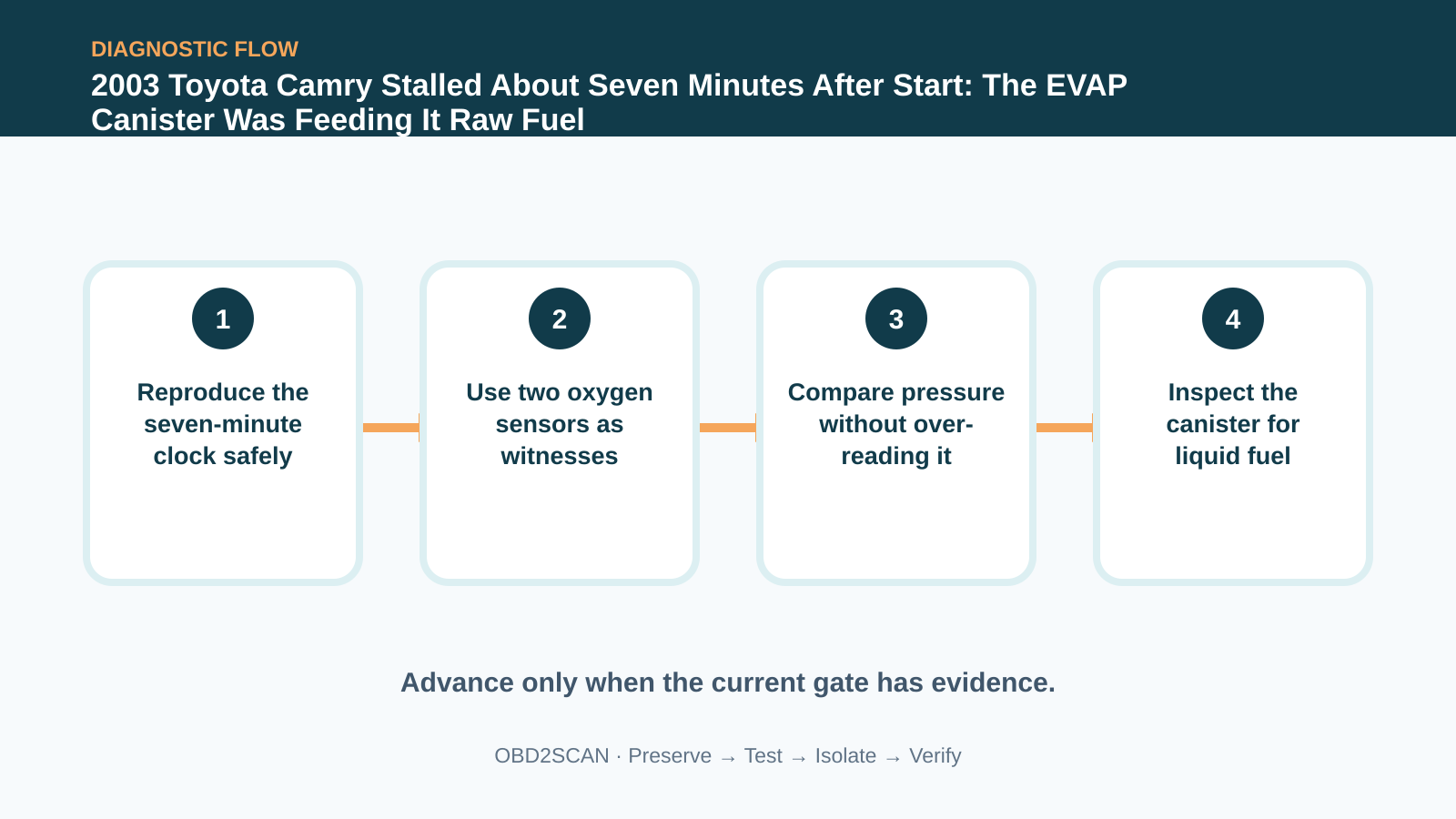
- Reproduce the seven-minute clock safely
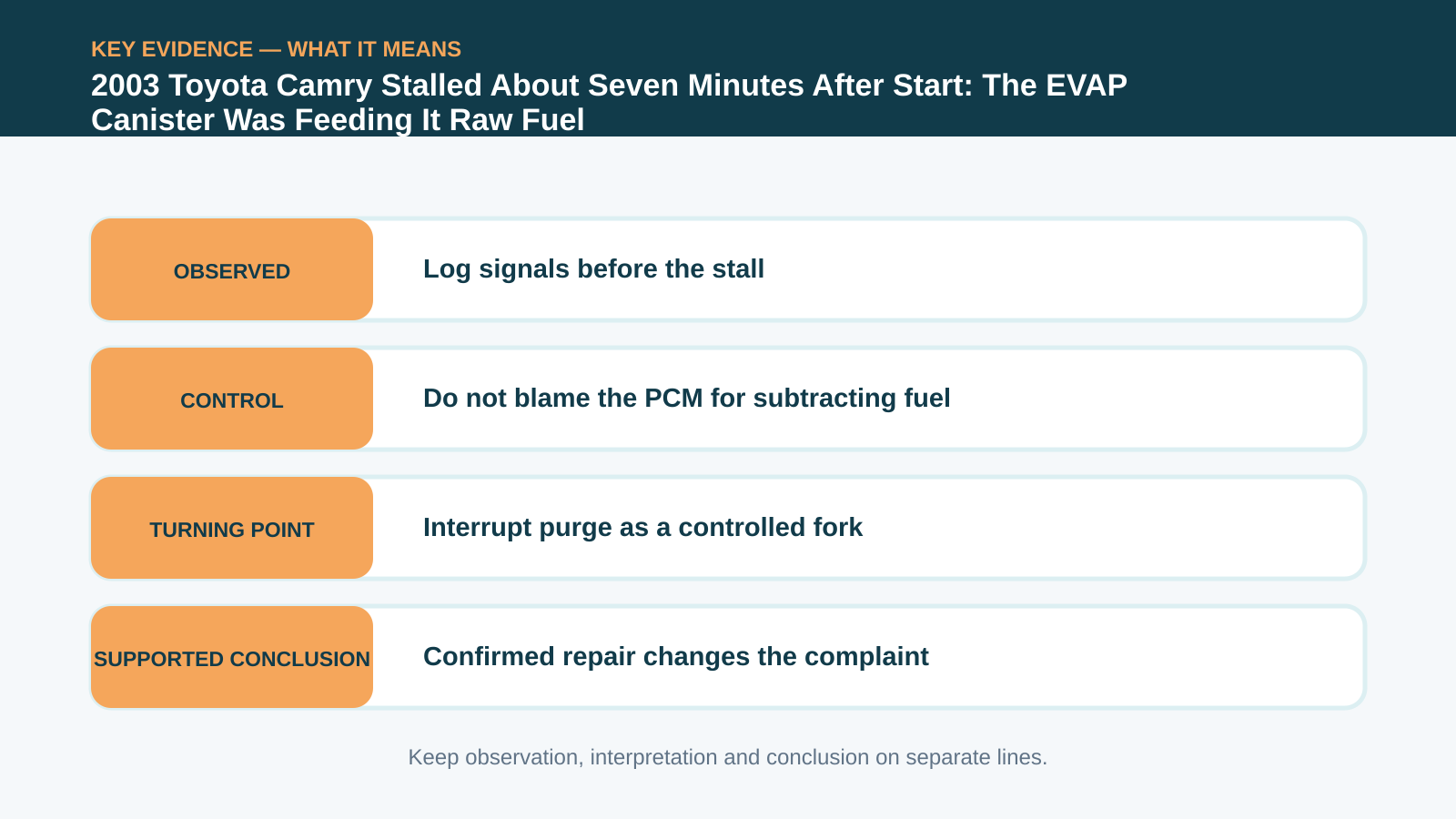
- Log signals before the stall
- Use two oxygen sensors as witnesses
- Do not blame the PCM for subtracting fuel
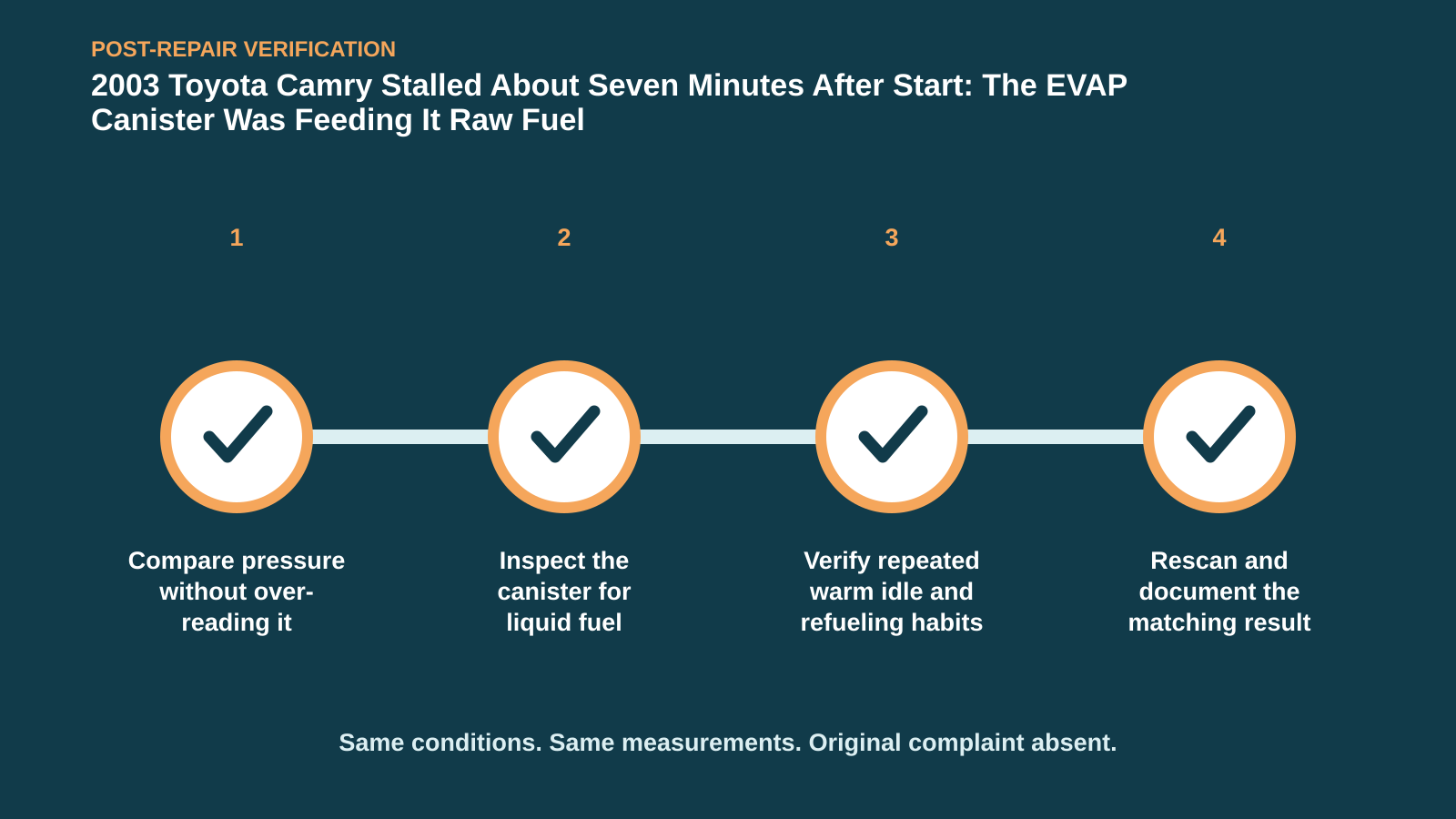
- Compare pressure without over-reading it
- Interrupt purge as a controlled fork
- Inspect the canister for liquid fuel
- Verify repeated warm idle and refueling habits
Reproduce the seven-minute clock safely
Reproduce the stall only in a ventilated area with an operator ready to shut down. The Camry idled normally, began to surge and then stalled after roughly seven minutes. Record elapsed time, coolant temperature, purge command, fuel trims and oxygen data from startup; the clock is part of the symptom. Preserve the original condition before changing it. The first observation is the control sample against which every later test must be compared.
Log signals before the stall
No DTCs were stored. Scope captures from crank, cam, injector, MAF and ignition signals did not glitch or disappear before the stall. That result moved sudden loss of synchronization or primary command lower on the list, but it did not prove the mixture was correct. Use service information for the exact engine, build date and options. A correct method on the wrong terminal can create a precise but useless result.
Use two oxygen sensors as witnesses
Short-term fuel trim drove sharply negative and the air/fuel sensor voltage changed before the engine stopped. At first that looked like a sensor hanging up and telling the PCM to remove fuel. Replacing it did not help, so the hypothesis needed a second witness rather than another sensor. Treat prior work as evidence, not blame. A repair that made no change can narrow the case when its installation and test conditions are verified.
Do not blame the PCM for subtracting fuel
The rear oxygen sensor also went rich before the PCM subtracted fuel. Agreement upstream and downstream supported a real rich event. The controller was reacting to excess fuel, not creating the stall merely because its correction value looked extreme. At this stage, separate what was observed from what is inferred. The observation should remain true even if the current theory is later rejected.
| Observation | What it supports | What it does not prove |
|---|---|---|
| Stall repeats near seven minutes | A timed control event matters | Ignition is failing |
| Primary waveforms stay stable | Several dropout branches lose priority | Mixture is normal |
| Both oxygen sensors go rich | Excess fuel is reaching the engine | The sensors are causing it |
| Blocking purge stops the stall | EVAP fuel path is causal | Purge valve itself must be failed |
Compare pressure without over-reading it
Fuel pressure is still worth measuring with a sealed, correct adapter because an abnormal regulator or supply can create richness. Compare it through the timed event and follow fire-safety procedures. A normal rail-pressure trace would not evaluate vapor fuel entering through the purge line. This is the decision point in the documented case. Its value comes from changing one bounded condition while leaving the rest of the system intact.
Interrupt purge as a controlled fork
The purge valve did not begin pulsing until several minutes after start in this case, matching the delay. Disconnecting or safely pinching the identified purge path stopped the stall. Never pinch an unknown or brittle hose; use the OEM isolation method and keep liquid fuel away from ignition sources. A confirmed component still needs a repair that restores sealing, support, torque, routing or terminal fit—the physical conditions that keep the fault from returning.
Inspect the canister for liquid fuel
Inspection found the charcoal canister full of fuel, and the overfill check-valve float did not seal reliably. Replace contaminated components and investigate repeated tank topping, because filling beyond the first automatic shutoff can push liquid into a system intended for vapor. Reassemble protective covers and retainers before declaring success. A diagnostic shortcut must not become the next failure mechanism.
Verify repeated warm idle and refueling habits
Verify several full warm-idle periods beyond the former seven-minute window, normal fuel trims when purge begins and a clean road test. Recheck for EVAP faults and fuel odor. One successful restart is not closure when the original failure waited for a timed control event. Use the customer’s original complaint as the final specification. A cleared code, quiet bay or one good key cycle is not equivalent to reproducing and passing that condition.
If you are bringing a similar symptom to a shop, arrive with the useful conditions rather than a requested part: whether the vehicle was cold or hot, the exact speed or switch position, which warning lamps appeared, what changed after a restart, and a chronological list of earlier repairs. A short video can preserve an intermittent sound or lamp pattern, but record it only while parked or with a passenger handling the camera. Ask the technician to retain the pre-repair scan and measurements, explain the test that separated the failed path from the alternatives, and show how the original complaint was repeated afterward.
For the owner or service adviser, a useful repair explanation has three parts: what was observed, why the decisive test narrowed the fault, and which original condition passed after the repair. It should also say what the test did not prove. That boundary prevents a memorable case from becoming an automatic parts recommendation.
The stall began when purge flow introduced excess fuel from a saturated canister. Replacing the air/fuel sensor could not help because both oxygen sensors were reporting a real rich condition; replacing the canister and overfill valve removed the timed fuel source. The reusable lesson is narrower and more valuable: Make elapsed time a diagnostic channel: stable signals, a sudden rich swing and purge onset form a causal timeline the reader can reproduce.










Comments 0
Questions, fixes, and real-world diagnostic notes from readers.
Be the first to share a diagnostic result or ask a follow-up question.