
Fiat Kobelco E135 Kept Killing Stop Solenoids: Alternator Ripple Was the Cause

Repeated Stop Solenoids? Check Alternator Ripple
A Fiat Kobelco E135 excavator shut down intermittently and had already consumed more than one stop solenoid. The repeated part failure was not reassurance that the solenoid was weak; it was evidence that something upstream might be hurting every replacement. The overlooked clue lived in the 28-volt charging waveform.
A meter with an oscilloscope mode can support charging-voltage, frequency and accessible ripple checks at correctly identified points. The AUTOOL DM303 is one example for that bounded electrical work. DM303 can support voltage, frequency and accessible ripple checks on truck and off-highway low-voltage systems within its ratings; it cannot replace a current clamp, prove heat damage without the correct load conditions or make a running excavator safe around belts and hydraulics.
Average alternator output did not tell the whole story. Excessive ripple and instability provided a plausible electrical stress on the stop-solenoid circuit. Alternator replacement produced a clean, stable supply, and the machine completed more than a month of work without another shutdown. This is a fundamentals-first case for a machine with limited data.
Quick answer: Repeated stop-solenoid failures were victims of unstable charging. Excessive alternator ripple disappeared after replacement, with no shutdown for a month.
In this guide
- Treat repeated solenoid failure as upstream evidence
- Reproduce shutdown without entering the danger zone
- Measure charging voltage at idle and load
- Look beyond average voltage to ripple
- Connect ripple to solenoid heating cautiously
- Replace the failed alternator and inspect the harness
- Check the stop solenoid under a stable supply
- Verify immediately and again after real work
Treat repeated solenoid failure as upstream evidence
List every stop-solenoid replacement with date, hours and failure mode. Did the coil open, short, stick or overheat? Does shutdown follow high engine speed, lighting load, vibration or a long hot work cycle? Secure the attachment on the ground, isolate unintended movement and keep leads away from belts and the fan. A running excavator adds hydraulic and crush hazards to ordinary electrical testing. If charging voltage becomes extreme, wiring heats or control becomes unpredictable, stop the engine rather than waiting for the next shutdown.
Reproduce shutdown without entering the danger zone
Reproduce only from a safe station. Monitor battery voltage, alternator output and stop-solenoid feed from start through warm operation and controlled electrical loads. Confirm batteries are matched and serviceable, terminals are secure and major grounds pass loaded voltage-drop tests. A weak battery pair can distort charging behavior, while a poor ground can make one circuit see a different voltage from another. Fix those foundations before judging ripple. The question is what the solenoid actually receives during the work state that precedes failure.
Measure charging voltage at idle and load
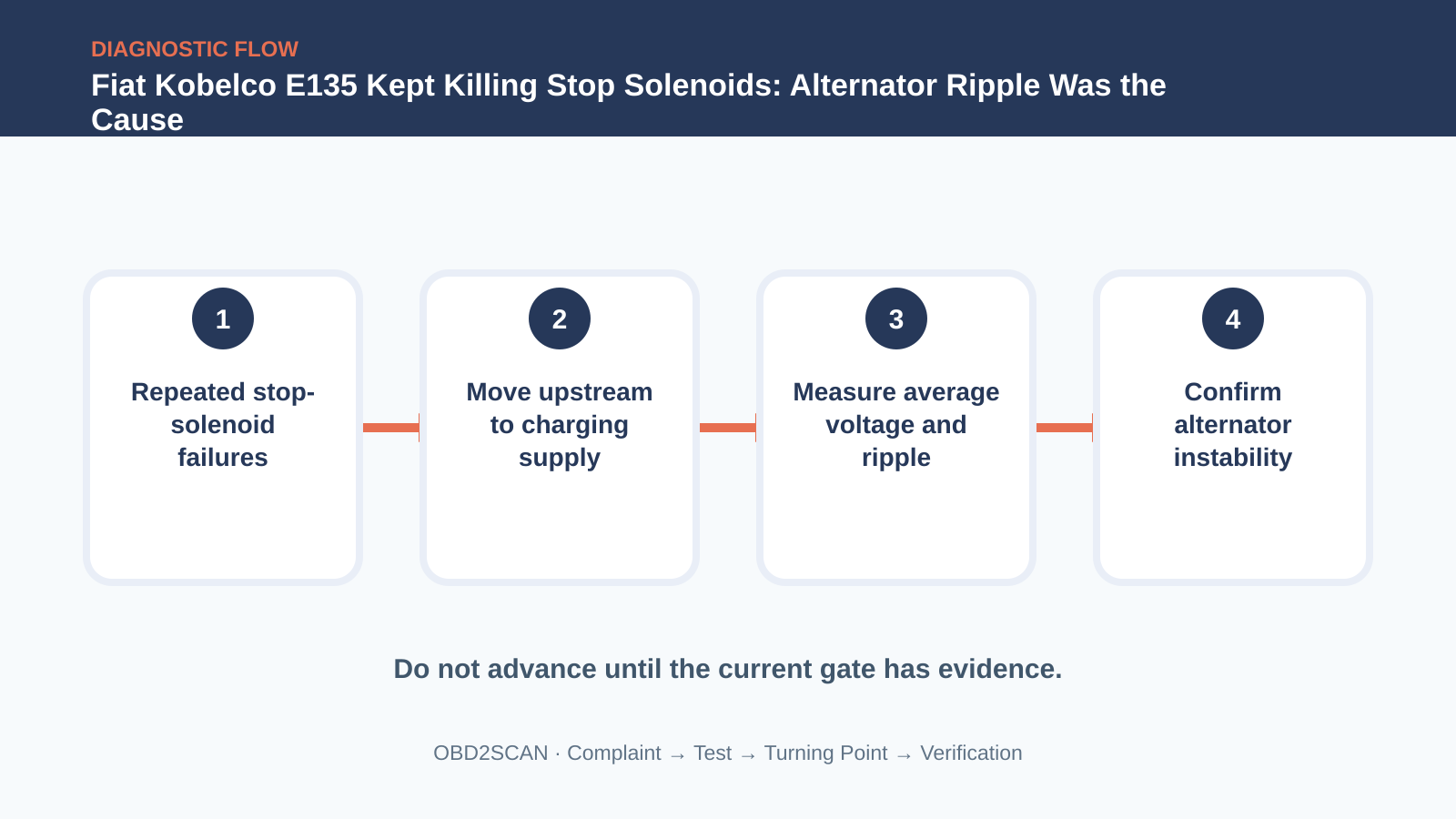
Measure charging voltage at idle and the approved raised speed with key loads on and off. Compare at alternator, batteries and solenoid supply. Do not use one universal 28-volt number as the specification; consult the system data. A normal average on a digital display can coexist with rapid excursions. Record maximum and minimum behavior over time, especially around shutdown. If voltage control is unstable, protect sensitive modules and do not keep operating simply because the battery lamp is off.
Look beyond average voltage to ripple
Ripple shows how much AC-like variation remains on the DC supply. Use correct coupling, scale, bandwidth and ground connection, and understand what the instrument displays. A handheld scope can reveal abnormal patterning, while a specialist current and phase capture may be needed to identify a failed diode or stator path. Compare with a known-good machine where possible. In this case alternator behavior was abnormal enough that the charging source, not another stop solenoid, became the repair target.
| Evidence | Immediate meaning | Boundary |
|---|---|---|
| Several solenoids fail | Repetition points upstream | Does not identify alternator alone |
| Supply instability under work | Solenoid sees unhealthy power | Could still be cable or battery path |
| Excessive alternator ripple | Charging source is defective | Heat damage still needs inspection |
| Clean 28V after alternator | Source behavior corrected | Time in service verifies intermittency |
Connect ripple to solenoid heating cautiously
Electrical ripple can increase coil heating or disturb control, but avoid claiming a universal damage threshold without component data. Inspect the failed solenoid, connector and driver circuit for heat, loose terminals and suppression components. Measure coil current and voltage during operation where safe. If the solenoid still draws abnormally on a stable external source, it may have independent damage. The diagnosis becomes defensible when source instability, component history and post-repair behavior agree—not when one waveform is dramatic.
Replace the failed alternator and inspect the harness
Replace the alternator according to engine and machine procedure, verify belt or drive condition, and clean and torque output and ground connections. Inspect batteries for damage caused by prior charging faults. Do not leave a new alternator connected to a shorted cable or failed battery pair. Recheck the stop-solenoid circuit and replace the solenoid only if its own tests require it. Support the harness against vibration and restore covers before running; a correct electrical repair should not create a mechanical hazard.
Check the stop solenoid under a stable supply
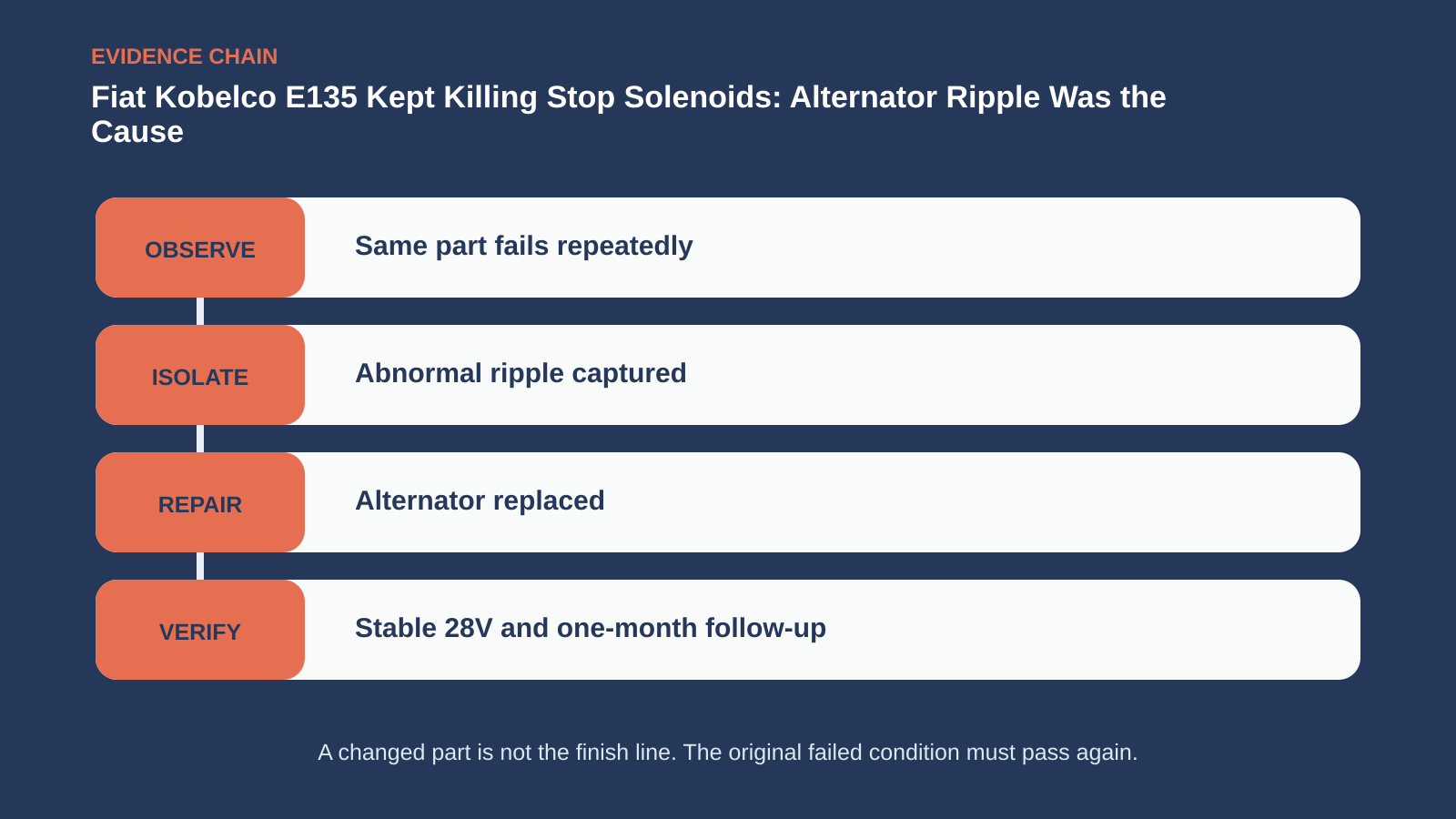
Immediately after repair, capture charging voltage and ripple with the same instrument settings. Apply the loads used before and confirm a stable supply at both batteries and the stop solenoid. Cycle start and shutdown functions, then complete a controlled work period while watching temperature and voltage. A clean waveform and successful hour are the first closure. The source case added a stronger test: more than a month in real service without recurrence.
Verify immediately and again after real work
Time matters for an intermittent fault. Ask the operator to log any stumble, lamp flicker or changed shutdown behavior during the follow-up period. Record the new alternator data and removed-part evidence so a future solenoid failure does not restart the case from zero. The human-centered lesson is economical: when the same component dies repeatedly, stop asking which brand of replacement to buy and ask what common condition every replacement has been forced to endure.
The stop solenoids were messengers. Charging ripple was the damaging environment. Stable voltage plus a month of real work closed the case more convincingly than fitting the third version of the same part.




Comments 0
Questions, fixes, and real-world diagnostic notes from readers.
Be the first to share a diagnostic result or ask a follow-up question.