
QX60 Driver Vents Warm? Dye at the Pipe Blocks Is the Repair Gate

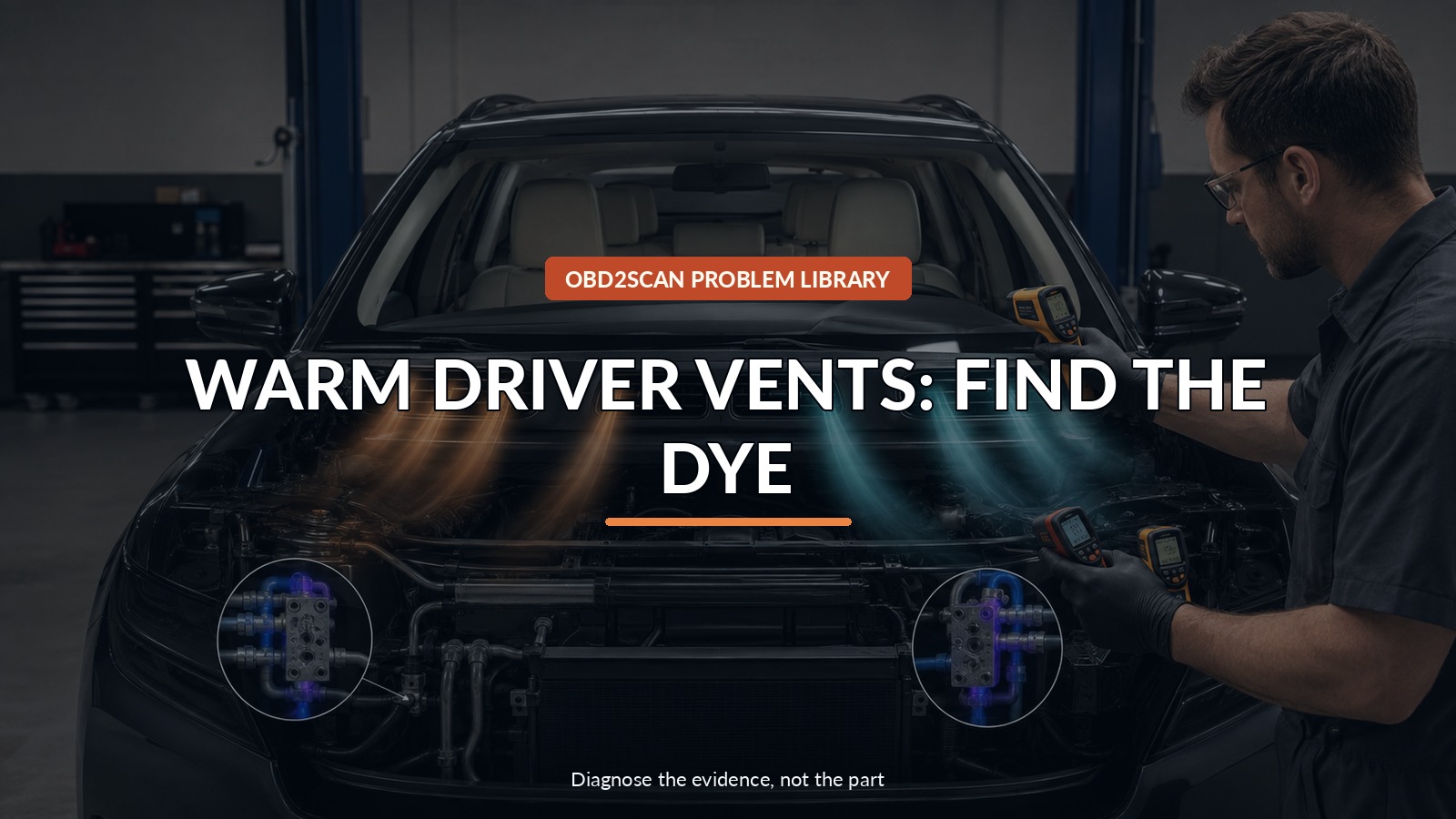
Warm Driver Vents: Find The Dye
Map left/right vent temperatures under equal settings, confirm the December 1, 2023 build fence, and look for approved leak-detection dye specifically at the high/low pipe junction blocks; without that location-specific evidence, ITB25-005 does not authorize the pipe replacement. A left-right temperature split can come from air-mix control, uneven evaporator behavior, or loss of refrigerant. Infiniti ITB25-005 narrows one repair only when two facts coexist: the scoped build and visible leak-detection dye at the named high/low pipe junction blocks. Warm air alone does not open the pipe order.
The useful tool category here is a digital A/C manifold paired with clamp temperatures, but only after the safe test point and question are clear. The MRCARTOOL L205 is one practical route for that bounded measurement. L205 can add compatible high/low pressure and line-temperature context for a trained technician; it cannot locate dye, prove which junction leaks, recover R-1234yf, distinguish an air-mix fault by itself, or authorize pipe replacement.
The reader can create a useful vent map without opening the refrigerant system. The qualified shop then looks for the location-specific physical evidence that controls the bulletin.
Quick answer: Equalize the QX60 cabin and map every vent; ITB25-005 opens only when approved dye is visible at the named high/low pipe junction blocks.
In this guide
- Equalize the cabin before judging one side
- Map every vent, not just the warmest
- Check the December 2023 build fence
- Use dye location as the repair gate
- Keep pressure readings in supporting roles
- Recover refrigerant instead of venting it
- Exit to air-mix or normal leak diagnosis when dye is absent
- Verify both vent balance and leak integrity
Equalize the cabin before judging one side
Start with both zones set to the same low temperature, SYNC enabled, fresh-air mode, PANEL outlets selected, and blower at one fixed speed. Open doors briefly to equalize the cabin, then close them and record center-left, center-right, outer-left, and outer-right temperatures at equal depths and time intervals. Note ambient temperature, humidity, idle speed, sun load, and whether the difference changes with rpm. A hand-feel report is useful for locating the complaint, but measured symmetry makes it reproducible.
Map every vent, not just the warmest
A vent map shows whether one side is genuinely warmer, whether all outlets are weak, or whether airflow—not temperature—is the main complaint. Listen for actuator movement when commands change and note whether the warm side follows a zone command. Do not repeatedly move every setting while measuring; that mixes multiple states. If the QX60 has a flashing warning, unusual compressor noise, visible oily residue, or cooling suddenly disappeared, stop testing and have the system inspected rather than continuing to run it for more numbers.
Check the December 2023 build fence
The bulletin applies to 2024–2025 QX60 L51 vehicles built on or after December 1, 2023. Confirm build date from vehicle records, not registration or purchase date. Record the VIN, previous collision or A/C work, recharge history, and current codes. A listed model does not prove the leak is present, and a technical bulletin is not a recall or guarantee of coverage. Current Infiniti ESM and VIN-specific service information control the work.
Use dye location as the repair gate
Infiniti requires leak-detection dye at the high-pressure and low-pressure pipe junction blocks. The location matters: dye elsewhere can explain refrigerant loss but does not open this exact replacement action. A qualified technician should clean old residue as the procedure permits, use the specified inspection light and protection, and distinguish fresh dye from manufacturing lubricant, road contamination, or old repair traces. Photograph an establishing view and close-up so the evidence can be found again after components are moved.
| Gate | Pass condition | If it fails |
|---|---|---|
| Vehicle | 2024–2025 QX60 built on/after Dec. 1, 2023 | Use normal diagnosis |
| Symptom | No cold air or warm driver vents | Reproduce and map complaint |
| Physical evidence | Approved dye at named high/low junction blocks | Check other leak and air-mix paths |
| Verification | Balanced cooling and no leak after repair | Preserve result and reopen diagnosis |
Keep pressure readings in supporting roles
Pressure and line temperature can show whether the cycle is moving heat plausibly, but they support rather than replace leak evidence. Record static and operating readings only under the specified ambient, airflow, engine, and refrigerant conditions. One pressure cannot establish charge weight, and a pressure split cannot identify which junction leaks. Do not add refrigerant to make a gauge look normal. The correct route is leak diagnosis, recovery, measured service, and repair of the proven path.
Recover refrigerant instead of venting it
ITB25-005 identifies R-1234yf and lists a charge amount of 0.85 kg in the service information. Refrigerant must be recovered—not released—and the equipment, oil, seals, evacuation, and measured recharge must match the current ESM. R-1234yf is mildly flammable; shop ventilation and ignition control matter. Stop-leak additives can contaminate service equipment and are not a substitute for repairing the pipe junction. This is trained-professional work, not a can-and-hose driveway operation.
Exit to air-mix or normal leak diagnosis when dye is absent
If fresh dye is absent at the two junction blocks, keep the vent map and return to normal diagnosis. Check other approved leak locations, actual recovered mass where warranted, pressure-sensor plausibility, condenser airflow, evaporator performance, cabin filter restriction, and air-mix command versus position. A separate blend-door concern can coexist with a small refrigerant leak. The discipline is simple: do not stretch one location-specific bulletin until it covers every reason the driver’s side feels warm.
Verify both vent balance and leak integrity
After the approved pipe replacement, use new specified seals, evacuate and recharge by weight, then leak-check the serviced joints. Repeat the original equal-setting vent map at similar ambient conditions and confirm both temperature balance and adequate cooling. Inspect again for dye after an appropriate operating interval. Save pre/post readings and code status. The repair is not complete merely because the driver’s vent is colder; the named junction must remain dry and the whole system must perform normally.
A visible dye gate makes this diagnosis unusually concrete. It protects owners from an unnecessary pipe replacement and gives the shop a measurable finish: the proven leak is gone, the charge is correct, and the original left-right complaint no longer reproduces.




Comments 0
Questions, fixes, and real-world diagnostic notes from readers.
Be the first to share a diagnostic result or ask a follow-up question.