
Nissan P0456 With a Capless Filler? Cycle the Seal Before Replacing the Tube

P0456: Cycle The Seal First
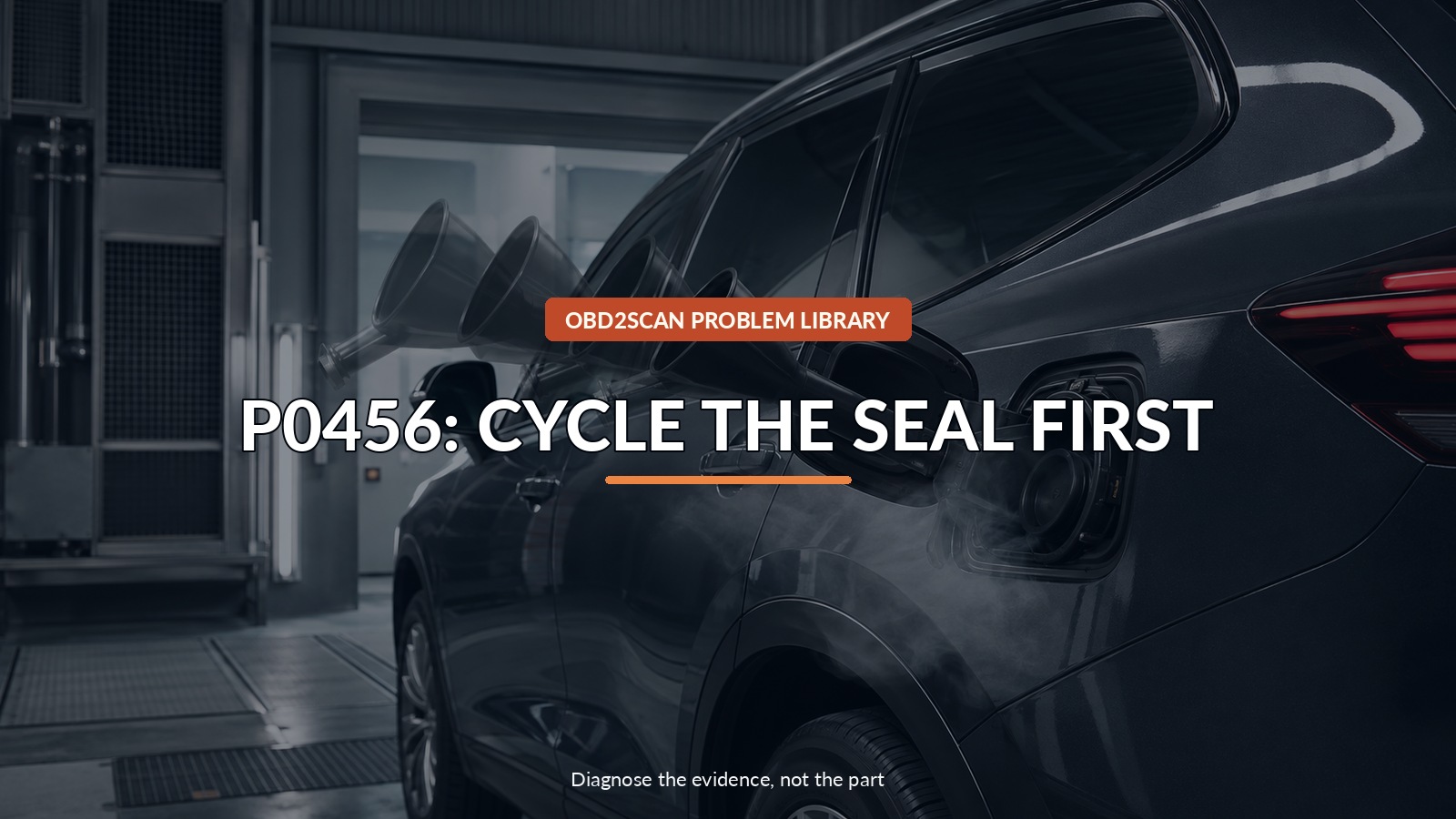
A capless Nissan with P0456 does not automatically need a filler tube. Nissan NTB26-006 requires two pieces of evidence: the code must be active, past, or pending, and smoke must be visibly leaking from the lower fuel-filler seal. Then comes a remarkably simple control trial—fully insert and remove the vehicle’s supplied funnel five times, repeat the same smoke test, and replace the tube only if the lower seal still leaks.
The leak-location step calls for controlled visible smoke, introduced through the approved vapor-system route. The MRCARTOOL T105 smoke leak detector is one possible source of adjustable smoke and flow indication. Its published maximum output must never be applied blindly to EVAP; it cannot command Nissan valves, prove monitor conditions, identify vapor by smell, or make fuel-system work safe.
This diagnosis is strongest as a before-and-after filmstrip: same connection, same light, same lower seal, with only the five complete funnel cycles changed.
Quick answer: Require visible smoke at the capless lower seal, cycle the supplied funnel completely five times, and repeat the same smoke test before replacing the filler tube.
In this guide
- Require both the code and visible lower-seal leak
- Check that the filler is truly capless
- Preserve the first smoke path
- Cycle the supplied funnel completely five times
- Repeat the same test without changing the scene
- Replace the tube only on a persistent leak
- Leave this branch when smoke appears elsewhere
- Verify monitor readiness without clearing evidence early
Require both the code and visible lower-seal leak
Save the full ECM scan before clearing anything. Record P0456 status—active, past, pending, or permanent—plus freeze frame, fuel level, ambient temperature, refueling history, capless-filler behavior, odor, collision history, and any prior EVAP repair. Check for other codes that may alter valve control or monitor validity.
Then require visual smoke at the lower filler seal. A P0456 code by itself means the monitor detected a very small leak under its conditions; it does not name the filler tube. Smoke from a purge connection, hose, canister, tank seam, service port, or upper seal does not satisfy the bulletin’s two-key entry.
Stop if there is liquid fuel, tank damage, a strong uncontrolled vapor release, or any ignition risk. Work belongs in an approved ventilated setting with the fuel-system cautions in the ESM.
Check that the filler is truly capless
The bulletin lists 2025–2026 Armada, Kicks, and Murano; 2022–2025 Pathfinder; and 2021–2026 Rogue, but only versions with a capless fuel filler. It explicitly does not apply to vehicles with a fuel cap. Confirm VIN, model code, filler design, engine, build, and current Nissan ESM.
Do not apply the list as a parts catalogue. A covered model can still leak elsewhere, and an out-of-range model can have a capless seal problem that requires ordinary diagnosis rather than this bulletin. Recall or warranty status is a separate VIN question.
Preserve the first smoke path
Nissan’s procedure accesses the tank-side vapor hose at the purge control solenoid. A qualified technician should identify the correct hose, isolate/control the system as directed, use the approved adapter, and introduce smoke at the specified low pressure. Illuminate the filler opening with a bright light without placing hot or sparking equipment near vapor.
Film long enough to show where smoke first emerges. Include a wide view of the fuel door, then a close view of the lower seal. Keep the camera and light angle fixed for the later comparison. Do not increase pressure to make the picture more dramatic; excess pressure can create false leaks or damage the system.
Cycle the supplied funnel completely five times
Retrieve the funnel supplied with the vehicle, usually stored in the rear cargo or trunk area. Inspect it for damage and contamination. Insert it completely far enough to open the capless mechanism, then remove it completely so the lower seal closes. One partial in-and-out motion is not a cycle.
Repeat five complete cycles, counting aloud or on video. Do not pry the flaps, add lubricant, scrape the seal, use a fuel nozzle as a substitute, or insert an improvised object. The action is meant to exercise the existing mechanism, not reshape it.
Why can this matter? Capless systems use spring-loaded sealing elements that are repeatedly opened by the correct nozzle or funnel. The trial tests whether controlled full travel changes the observed seal leak. It does not prove why the seal failed to close the first time.
Repeat the same test without changing the scene
Reconnect the smoke setup in the same approved way and reproduce the initial test. Use the same machine setting, approximate fill time, valve state, light position, camera angle, and viewing duration. Watch the lower seal first, then inspect the remainder of the system if the lower seal is dry.
| Before five cycles | After five cycles | Bulletin direction |
|---|---|---|
| Smoke at lower seal | No smoke at lower seal | Procedure complete; no tube replacement in this branch |
| Smoke at lower seal | Smoke persists at lower seal | Follow ESM filler-tube replacement path |
| No confirmed lower-seal smoke | Any result | Do not enter this bulletin from P0456 alone |
| Smoke begins elsewhere | Same or changed | Diagnose that location separately |
The second view should make the comparison obvious without relying on memory.
Replace the tube only on a persistent leak
If the correctly repeated test still shows smoke at the lower seal, NTB26-006 directs filler-tube replacement under the model-specific ESM procedure. The tank area, fuel vapor, retainers, seals, underbody support, and exact tube route make this professional work.
Use the VIN to identify the correct part. Do not seal the mechanism with adhesive, grease it without authorization, or replace only a visible flap when Nissan specifies the tube assembly. Preserve the pre/post film and the five-cycle record for the repair order.
Leave this branch when smoke appears elsewhere
A different smoke source sends the case back to normal EVAP diagnosis. Inspect accessible hoses, purge and vent plumbing, canister, tank and pump seals, impact areas, and filler-neck connections under the ESM. Electrical valve control and monitor enable conditions may also matter.
Avoid using P0456 as a synonym for “bad gas cap” on a capless vehicle. Also avoid condemning the purge valve solely because the smoke connection is nearby; the connection is an access route, not a failed-part indication.
Verify monitor readiness without clearing evidence early
After the confirmed repair or successful funnel trial, restore every hose, connector, cover, and funnel to its proper location. Perform the approved leak check, then clear codes only after the original report is saved. Complete the Nissan drive/monitor procedure when safe and legal.
Verification is no visible leak at the lower seal under the same controlled test, no fuel odor or liquid leak, correct capless operation, and no returning P0456 after the monitor runs. A lamp that stays off while the monitor remains incomplete is not yet the same result.


Comments 0
Questions, fixes, and real-world diagnostic notes from readers.
Be the first to share a diagnostic result or ask a follow-up question.