
Kia Coolant Smell, Leak, or Overheating? Check WTY039 Before Teardown

Kia Coolant Loss: Check Wty039
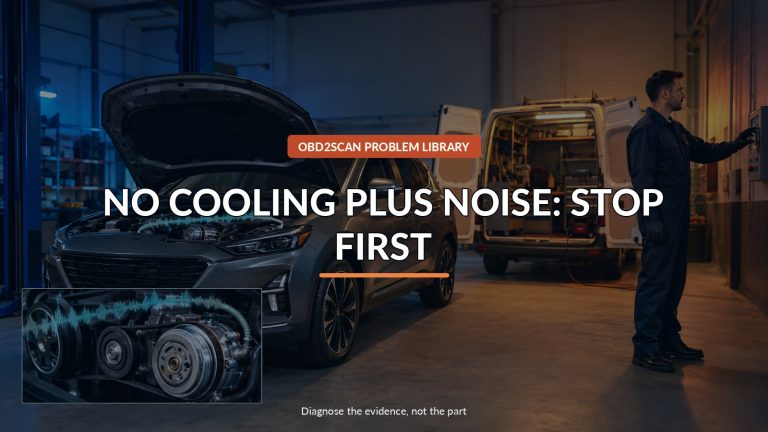
A Kia with coolant smell, visible loss, or the temperature gauge near hot needs cooling and documentation before diagnosis. Shut it down safely, never open a hot pressure cap, and check the VIN/model/engine/production-date fence for WTY039. Then keep two questions separate: does the cooling system lose pressure, and is there combustion-gas evidence?
A cooling-system tester can support the containment question and controlled vacuum filling when the correct adapter and manufacturer limit are known. The AUTOOL SC301 coolant leak tester and filler is one example of that capability. It cannot perform the combustion block test, make a hot system safe, confirm WTY039 eligibility, or authorize engine replacement.
Kia ENG254 uses a two-test fork. A pressure loss sends the technician toward the leaking system; no pressure loss opens a block-test branch. Neither result should be rewritten as “head gasket confirmed” without following the exact Kia path.
Quick answer: Stop after overheating, verify WTY039 vehicle scope, and keep the cooling pressure test separate from the combustion block test.
In this guide
Treat overheating as the stop signal
If the temperature approaches hot, a warning appears, steam rises, or heater output suddenly turns cold while the engine is hot, reduce load and stop as soon as safely possible. Shut the engine off. Do not pour cold water into a hot engine or remove the cap; scalding coolant can erupt under pressure.
Arrange towing if coolant is visibly escaping, the engine has overheated, or the safe fill status is unknown. Continued driving can turn a diagnosable leak into cylinder-head, bearing, or engine damage.
Once fully cold, photograph the reservoir level and visible residue without crawling under an unsupported vehicle. Record how far the car traveled after the first warning.
Run model, engine, date, and VIN gates
ENG254 lists 2014–2015 Sorento XMa 3.3L GDI built from December 17, 2012 through December 11, 2014; 2014–2017 Cadenza VG/YG 3.3L GDI built from February 1, 2013 through July 12, 2017; and 2015–2016 Sedona YP 3.3L GDI built from July 21, 2014 through March 17, 2016.
Confirm all fields and ask Kia to check the VIN for WTY039. The bulletin describes a warranty extension, not an unlimited recall for every coolant problem. Current dealer data decides eligibility and documentation.
Separate loss, smell, and temperature evidence
Build three columns. “Loss” means measured level change after consistent cold checks. “Smell” includes location, timing, and cabin versus engine bay. “Temperature” includes gauge behavior, warning text, fan operation, heater output, and load.
Look for dried coolant at hose joints, radiator seams, reservoir, cap area, water pump, heater connections, and underbody—without touching hot or moving components. Note white exhaust after warm-up, rough cold start, oil appearance, and bubbles, but do not call any one sign a head gasket.
Ask the containment question
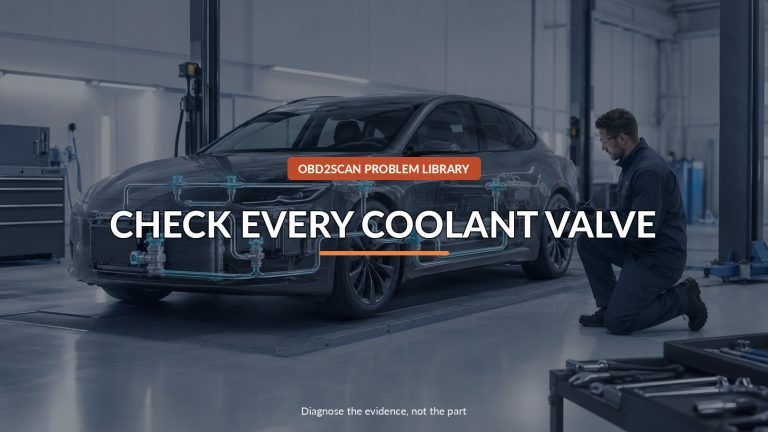
The pressure test asks whether the closed cooling system holds the controlled pressure specified by Kia. ENG254 provides a bulletin-specific range and warns not to exceed its limit. Use the current publication because caps, adapters, and procedures vary.
Pressurize only a cold or properly conditioned system under the service procedure. Watch the gauge over the required interval while inspecting external paths. A falling reading proves loss somewhere in the tested system; it does not locate the leak by itself or prove combustion entry.
| Test result | Kia flow direction | What it does not prove |
|---|---|---|
| Pressure falls and leak is found | Diagnose leaking component/path | Head gasket is the only leak |
| Pressure falls, no leak visible | Hidden/internal path remains | Engine replacement is approved |
| Pressure holds | Opens the next branch in WTY039 | Cooling system is healthy under every condition |
| Block test passes | Return to further diagnosis | The original overheat did no damage |
Ask the combustion question
In Kia’s flow, a system that does not lose pressure proceeds to an engine block test. That test looks for combustion-gas evidence using its own kit, fluid condition, sampling point, temperature, and interpretation. The pressure tool does not perform it.
Contaminated test fluid, coolant drawn into the tester, exhaust exposure, or an engine not at the required state can mislead. A failed result enters Kia’s authorization process; it is not DIY permission to dismantle the engine. A pass sends the technician back to further diagnosis.
Keep each tool inside its answer
Vacuum filling helps remove trapped air after an approved repair and can reveal whether vacuum is retained. It does not prove the engine is combustion-tight. A block test does not prove a hose will hold pressure. Scan data may document temperature behavior but cannot show where coolant escaped.
Do not combine partial results into certainty. Write “pressure fell, external source not visible” rather than “internal head-gasket leak.” The precise sentence protects both diagnosis and warranty handling.
Build the WTY039 handoff
Provide VIN, engine, production date if available, mileage, first in-service information, exact symptom, maximum gauge position or warning, distance driven hot, cold level history, top-up amount and coolant type, residue photographs, pressure-test setup/result, block-test result if professionally completed, codes/freeze data, and past cooling repairs.
Ask the dealer to document WTY039 eligibility before teardown. If the vehicle previously received related work, retain invoices; Kia’s current policy controls any reimbursement or authorization.
Verify cooling stability after the approved repair
After repair, confirm no external leak, correct cold level, stable pressure under the Kia procedure, proper fan and heater operation, and no trapped-air behavior. Road verification should include the load that formerly raised temperature, while scan data and the gauge are monitored safely.
Recheck the fully cold level after heat cycles. “No smell in the bay” is not enough; successful verification means stable level, normal temperature, no code return, no pressure loss, and a documented result for whichever WTY039 branch actually applied.


Comments 0
Questions, fixes, and real-world diagnostic notes from readers.
Be the first to share a diagnostic result or ask a follow-up question.