
What Car Do I Actually Have? A 5-Minute VIN, Build-Date, and Drivetrain Check

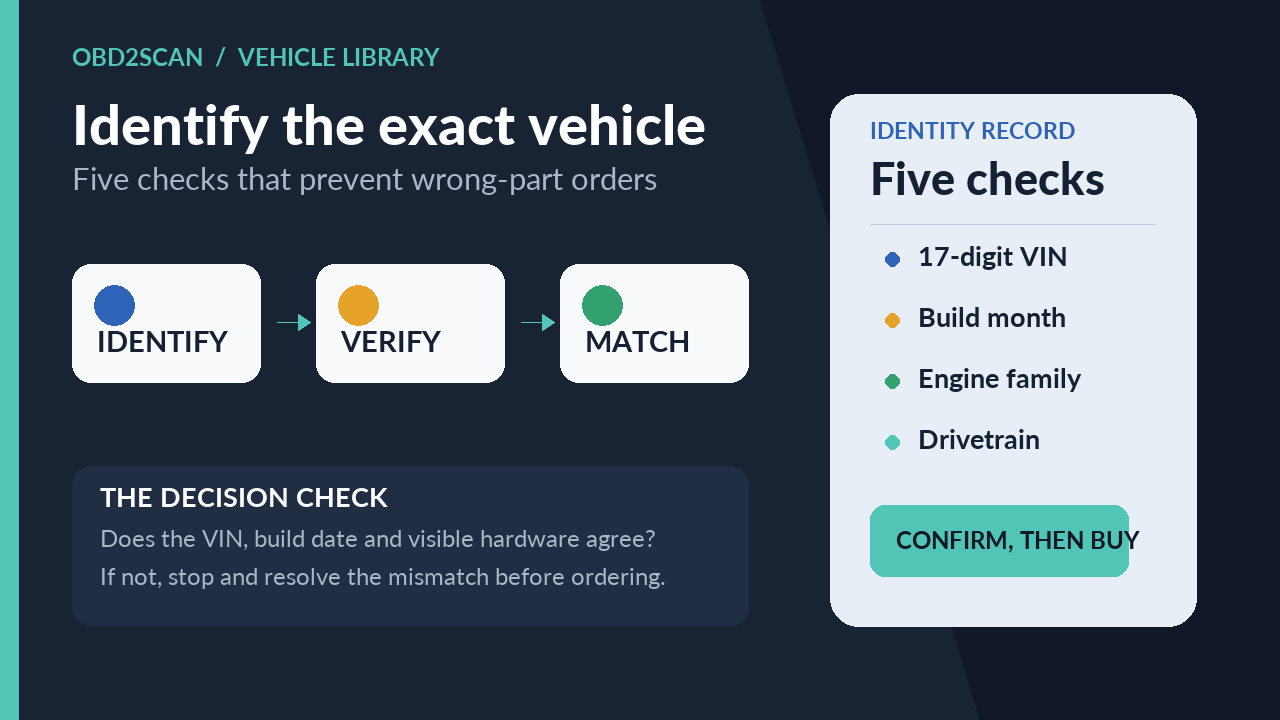
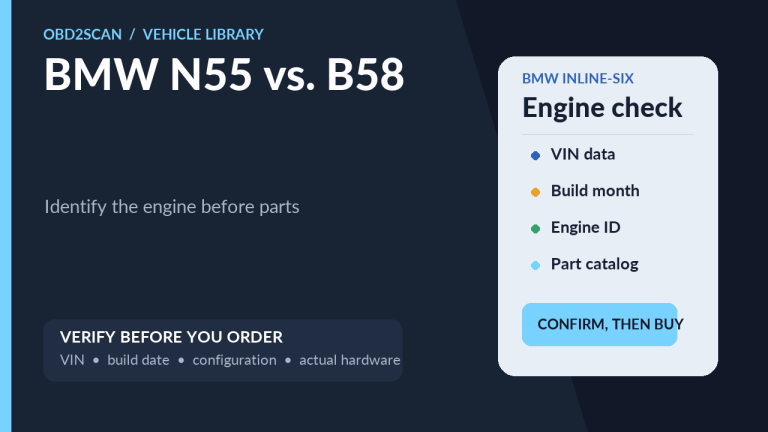
The badge on the trunk is only the beginning. Before ordering a part, downloading a procedure, or accepting a quote, record the 17-character VIN, the production month on the certification label, the emissions-family information under the hood, and the vehicle’s actual drivetrain and installed hardware. Those five minutes prevent the most common identity mistake: using a correct part or procedure for the wrong version of the car.
Fast answer
- Decode the full VIN with the official NHTSA decoder; do not post the complete VIN publicly.
- Photograph the driver-door certification label and record its month and year of manufacture.
- Photograph the underhood Vehicle Emission Control Information label before it fades or is replaced.
- Confirm engine, transmission, driven wheels, body style, and important option hardware rather than inferring them from a badge.
- Run the resulting identity through the current OEM parts catalog or service-information system before buying.
In this guide
1. Start with the VIN—but know what it can and cannot answer
A modern road vehicle normally carries a 17-character vehicle identification number. Read it from the lower windshield and compare it with the certification label and title. If the characters disagree, or a label looks altered, stop treating the car as a routine parts lookup. That mismatch belongs in a title, inspection, or qualified repair conversation before money changes hands.
Enter the VIN in the NHTSA VIN Decoder. It can return manufacturer-reported fields such as model, body class, restraint system, engine information, and assembly plant. Save the results as a PDF or screenshot. The decoder is an identity starting point, not a complete build sheet: optional brakes, suspension packages, mid-year revisions, replacement assemblies, and market-specific equipment may not appear.
Protect the full VIN
Use the complete number in trusted official tools and with a shop or parts supplier. In forum posts, marketplace listings, and public photos, mask enough characters to prevent the full identifier from being copied.
2. Separate model year, build date, and first-sale date
These dates answer different questions. Model year is the regulatory and sales designation usually returned by the VIN. Build date is when the vehicle was manufactured. First registration is when an owner or dealer first put it on the road. A car sold in January can easily have been built several months earlier, and a late model-year change can make two cars with the same badge require different parts.
NHTSA says the certification label includes the manufacturer and date of manufacture and is normally placed on the driver-side hinge pillar, door-latch post, or door edge. Photograph the entire label, not only the date. Gross-weight ratings and type information can matter for springs, brakes, tires, towing, and commercial variants.
The underhood emissions label is a second identity source. Look for the heading “Vehicle Emission Control Information.” It records emissions-related information for the installed configuration and often includes an engine family or test group. It does not automatically translate to an enthusiast engine nickname, but it can distinguish configurations that a sales badge cannot.
3. Confirm what is physically installed
Now compare the decoded record with the car. Record sedan, wagon, coupe, convertible, SUV, or long-wheelbase body; gasoline, diesel, hybrid, or electric propulsion; front-, rear-, or all-wheel drive; and automatic, manual, or dual-clutch transmission. Photograph the engine-bay overview, wheel and tire label, brake caliper and rotor, headlamp connector area, and any option label available from the manufacturer.
This step matters because cars change. An engine, transmission, differential, control module, headlamp, or brake package may have been replaced. A previous owner may have retrofitted bumpers or wheels from a newer trim. A visual facelift does not rewrite the VIN, while an installed replacement assembly may require its own serial or part-number verification.
| Question | Best evidence | What not to trust alone |
|---|---|---|
| Which model and model year? | VIN plus certification label | Marketplace title or trunk badge |
| Early or late production? | Build month and VIN sequence | Registration date |
| Which engine? | VIN-specific OEM data, emissions label, engine identifier | Displacement or power badge |
| Which brakes or suspension? | Build options and measured installed hardware | Wheel design or trim name |
| Which replacement part? | Current catalog supersession for the VIN | A photo that looks similar |
4. Turn identity into a parts match
Give the supplier the VIN, build month, market, body, engine, transmission, and driven wheels. Then ask a useful question: “Does this part number apply to my VIN, and has it been superseded?” A superseded number may be the correct current replacement; a similar-looking older number may not be.
For brakes, compare rotor diameter and thickness, caliper type, wear-sensor provision, and axle load. For lighting, compare body style, market, lamp technology, steering side, connector, and module requirements. For cooling and intake parts, verify engine designation and production split. For electronic modules, verify hardware number, software/coding requirement, and whether the old unit must be read before removal.
If a catalog says “up to” or “from” a production date, the door label is not always precise enough to the day. Use the VIN break in the OEM catalog. If two choices remain, read the original part number or measure the relevant hardware before ordering. The used-car inspection checklist applies the same evidence-first habit before a purchase.
5. Keep one reusable vehicle identity record
Create a note on your phone with masked VIN, full VIN stored privately, build month, market, body code if verified, engine designation, transmission, drivetrain, tire label, paint code, major factory option codes, and known replacement assemblies. Attach the label photographs and a link to the official decoder result. Update the note after an engine, transmission, control module, brake, or lighting retrofit.
That record makes every later conversation faster. A shop can select the right service information, a supplier can check a production split, and you can reject a “fits all” listing that ignores the configuration. The objective is not to memorize chassis codes. It is to create an identity chain strong enough that the part and procedure match the car in front of you.
Official sources used for this guide
- NHTSA VIN Decoder — National Highway Traffic Safety Administration
- Importation and Certification FAQ — National Highway Traffic Safety Administration
- Locating the Vehicle Emissions Label — U.S. Environmental Protection Agency
What a successful identification looks like
You can state the market, VIN-confirmed model and body, production date, engine, drivetrain, and the equipment relevant to the job. The catalog result and the hardware on the vehicle agree, and the supplier can confirm a current part number for that exact record.


Comments 0
Questions, fixes, and real-world diagnostic notes from readers.
Be the first to share a diagnostic result or ask a follow-up question.