
Toyota Celica P0172: How One MAF Read Rich at Idle and Lean Under Load

Bottom line: A 2ZZ Celica fuel-trim case where the same contaminated MAF overreported idle air yet responded too slowly and too little at wide-open throttle.
In this case
- Case at a glance
- The answer: the MAF was wrong in two directions
- Let the freeze frame define the test condition
- Test fuel delivery, purge and exhaust evidence
- Test MAF offset, range and response as separate properties
- A long parts history does not become evidence
- Replace the failed input and remove the learned compensation
- Verify idle and load, not just code clearance
- Minimum record to retain
Case at a glance
| Field | Case detail |
|---|---|
| Vehicle | 2001 Toyota Celica 1.8 2ZZ, 190 PS |
| History | Cylinder-head work after overheating and many prior replacement parts |
| Complaint | Poor idle, heavy fuel use, low power and overrun cutout |
| Trim evidence | LTFT −26.59% and STFT −10.97% at the captured condition |
| Decisive test | Faulty MAF high by 20–33% at idle but slow/low under acceleration |
| Repair | MAF replaced and fueling adaptation reset |
| Verification | Symptoms and abnormal fuel control resolved |
The answer: the MAF was wrong in two directions
The MAF sensor made the engine rich at idle because it reported roughly 20–33% more air than the engine was actually consuming. Under hard acceleration, the same sensor responded too slowly and produced too little voltage change. The ECU therefore removed large amounts of fuel at idle while the car still lacked power under load.
A replacement sensor restored the expected dynamic range and response. After fuel adaptation was reset, the poor idle, fuel consumption, overrun cutout and power complaint disappeared. One static MAF value would not have explained both halves of the failure.
Evidence boundary: The numeric values in this article belong to the documented vehicle unless an official applicability statement says otherwise.
Let the freeze frame define the test condition
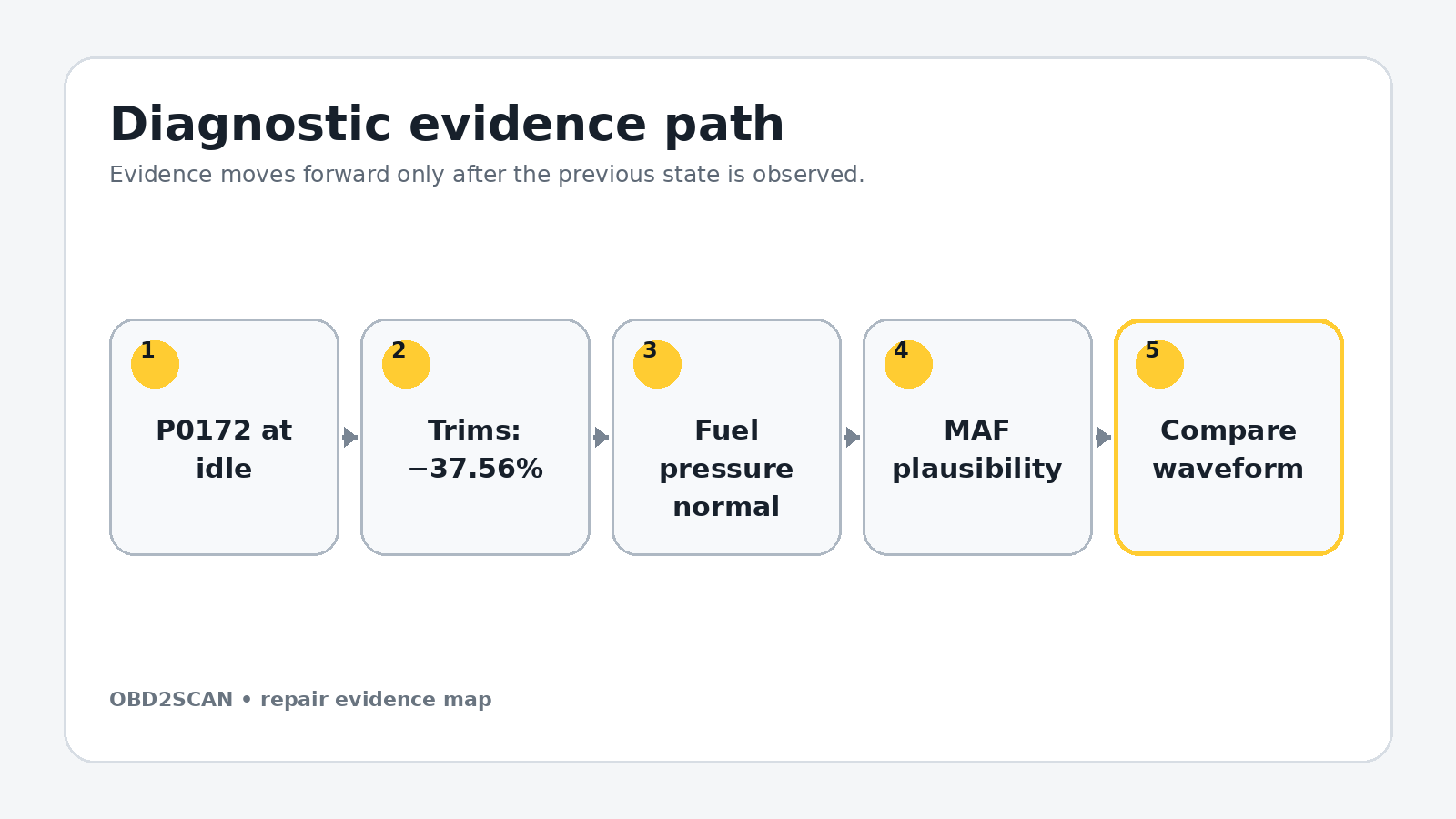
P0172 was captured at idle. Long-term trim was −26.59% and short-term trim was −10.97%, a combined correction near −37.56%. That is the ECU trying to remove fuel, not proof that fuel pressure is excessive or an injector is leaking.
Follow the freeze-frame-first scan process: preserve load, rpm, temperature, closed-loop state and trim data before clearing anything. Recreate the same condition before testing another branch.
Test fuel delivery, purge and exhaust evidence
Fuel pressure measured 46 psi and did not support an overpressure theory. Intake, exhaust, EVAP and crankcase-breather checks did not reveal the missing explanation. The oxygen signal stayed rich at idle but switched above 2,000 rpm, which described combustion rather than naming the faulty input.
Four-gas data added weight: hydrocarbons were 305 ppm at idle and only 17 ppm at 2,500 rpm. The rich/unstable problem was concentrated where the freeze frame said it was.
Test MAF offset, range and response as separate properties
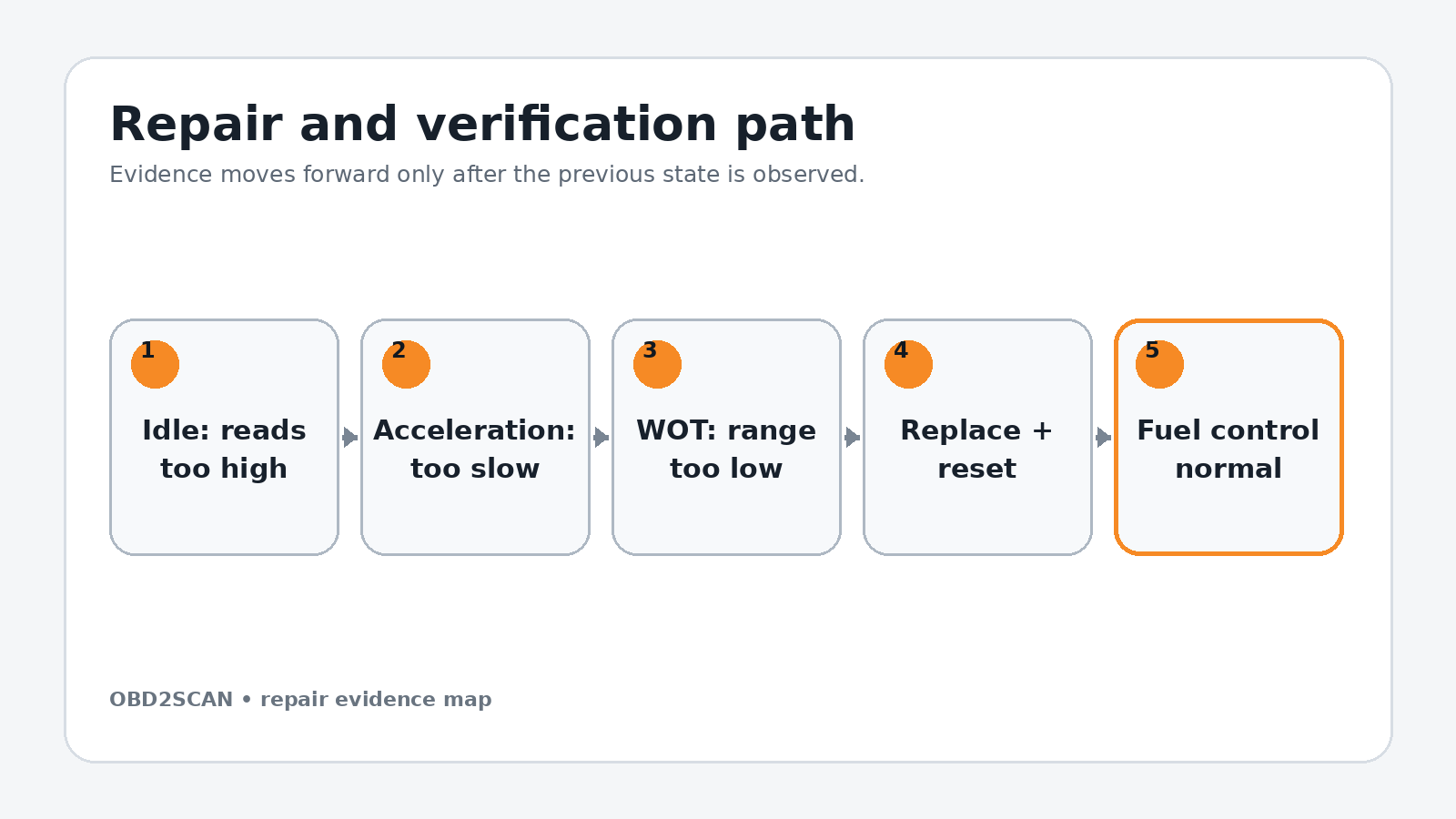
At idle, the suspect sensor looked active and plausible until its airflow was compared with expected engine demand. It was biased high. During an idle-to-wide-open-throttle snap, it changed only 1.31 volts and lagged the airflow event.
A known-good sensor produced almost 4 volts of change and reached its response in about 56 milliseconds. The waveform shape explained the full complaint: positive offset at low flow created rich correction, while weak dynamic response restricted load calculation under acceleration.
A long parts history does not become evidence
This Celica had already received cylinder-head work after overheating and numerous replacement parts. That history raised legitimate mechanical questions, but it also made it easy to keep revisiting the last repair. Compression, air path and fuel pressure checks allowed the diagnosis to leave that history behind.
Use the air/fuel/ignition/mechanical workflow to keep every hypothesis tied to a test. New parts are not known-good data unless their output is measured.
Replace the failed input and remove the learned compensation
Once the MAF failed the known-good comparison, replacement was justified. The large learned negative correction also needed to be reset according to the vehicle procedure; otherwise the ECU could continue applying an adaptation learned around the failed sensor.
Do not clean or replace a MAF solely because P0172 is present. Intake leaks, fuel pressure, injectors, purge flow, oxygen feedback and mechanical condition can create different trim patterns. The dynamic comparison is what made this repair defensible.
Safety boundary: Use current vehicle-specific service information, approved support and the correct test load before opening a circuit or assembly.
Verify idle and load, not just code clearance
After replacement and adaptation reset, repeat the original hot-idle condition, the 2,500-rpm check and a safe load test. Confirm that trims return toward normal, the oxygen signal switches appropriately, MAF response is fast and the overrun cutout no longer occurs.
A code-free idle alone would miss the under-load half of the sensor failure. The repair closes only when the complete operating envelope that exposed the bad waveform has been retested.
Verification boundary: A cleared code is not a result by itself. Repeat the original operating condition and retain the measured before-and-after evidence.
Minimum record to retain
Keep the initial scan before clearing anything, the exact ambient and operating condition that reproduces the complaint, and one labeled result for every branch tested. Save photographs or waveforms at their original resolution and identify the measurement point, scale, engine state and tool setup. A future technician should be able to distinguish a direct observation from an inference without reconstructing the whole visit from invoices. Retain exact vehicle identification with every saved measurement.
- Combined stored trims were about −37.56% at idle.
- Fuel pressure was 46 psi and idle HC was 305 ppm versus 17 ppm at 2500 rpm.
- The faulty MAF read 20–33% high at idle yet produced only a 1.31 V idle-to-WOT change.
- A known-good MAF produced about 4 V range and 56 ms response; replacement and reset resolved the complaint.
This case includes a repair result, but the same-condition retest is still the reason the result is credible. Record what changed, what did not change, and which test was repeated after the work. Also retain any programming, adaptation or calibration report and a final whole-vehicle scan. If the symptom is intermittent, define a monitoring window instead of treating one successful start or one short drive as permanent proof.






.jpg)
Comments 0
Questions, fixes, and real-world diagnostic notes from readers.
Be the first to share a diagnostic result or ask a follow-up question.