
A Realistic High-Mileage Maintenance Plan Built on Evidence

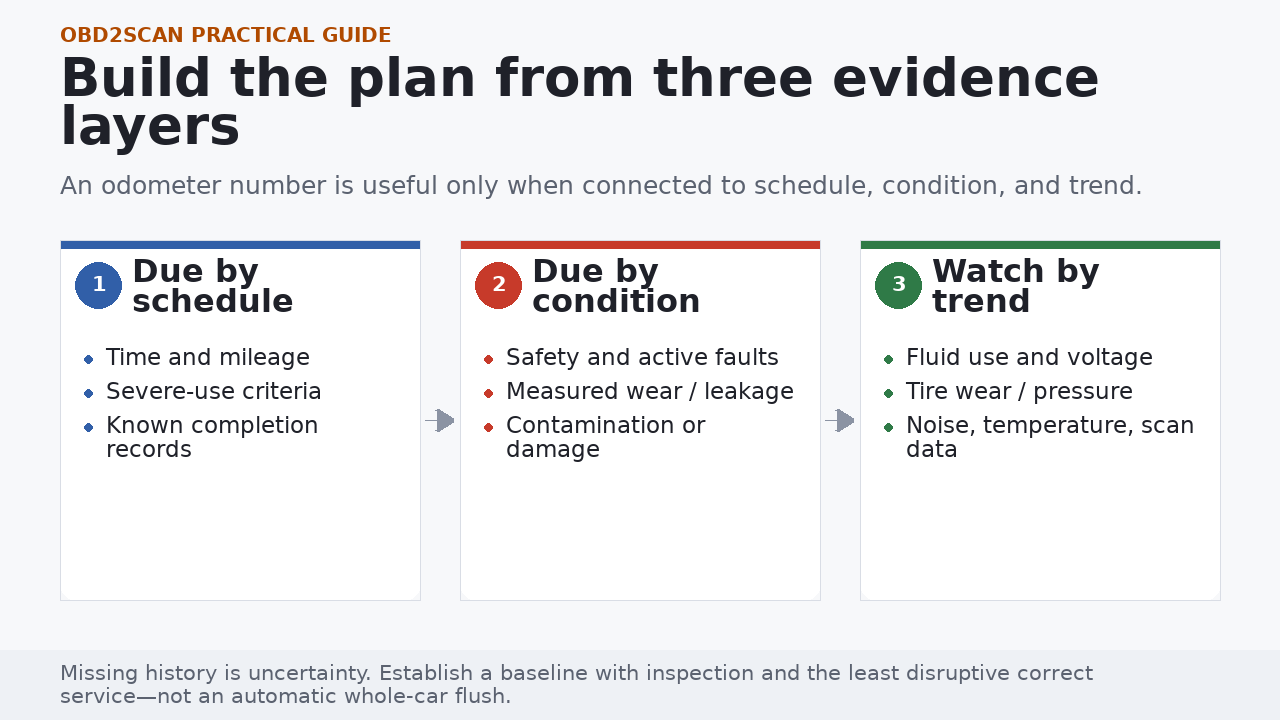
High mileage is context, not a component failure. Begin with the exact maintenance schedule, repair history, current warnings, leaks, tire and brake condition, and baseline measurements. Then fund the highest-consequence needs first and monitor trends that have not yet justified repair.
What to do first
- Use the owner’s manual, maintenance guide, and model-specific service information as the interval and fluid baseline—not a generic high-mileage checklist.
- Prioritize active safety or overheating/oil-pressure concerns, then overdue time/mileage service, then condition-based wear, then comfort and cosmetic work.
- Do not use a flush, additive, thicker fluid, or parts bundle to replace diagnosis. Confirm compatibility, service history, leaks, and the maker’s procedure first.
In this guide
1. Collect records and establish the baseline
- Record VIN, powertrain, mileage, acquisition date, use pattern, climate, towing/load, trip length, and any severe-service criteria in the vehicle guide.
- Build a dated history from invoices and credible records. Separate completed work from seller statements and unknowns.
- Scan warning systems without clearing evidence; inspect tires, brakes, steering/suspension, lights, wipers, leaks, fluid conditions, belts/hoses, battery/charging, and recall status as applicable.
- Record measurements—not just pass/fail words: tread across each tire, pressure, pad or rotor measurements when inspected, fluid level changes, voltage test conditions, and leak locations.
Unknown is not automatically failed
When service history is missing, use inspection, fluid condition where meaningful, model-specific failure modes, and maker procedures to choose a baseline. Avoid aggressive service simply to make every box look complete.
2. Rank work by consequence and proof
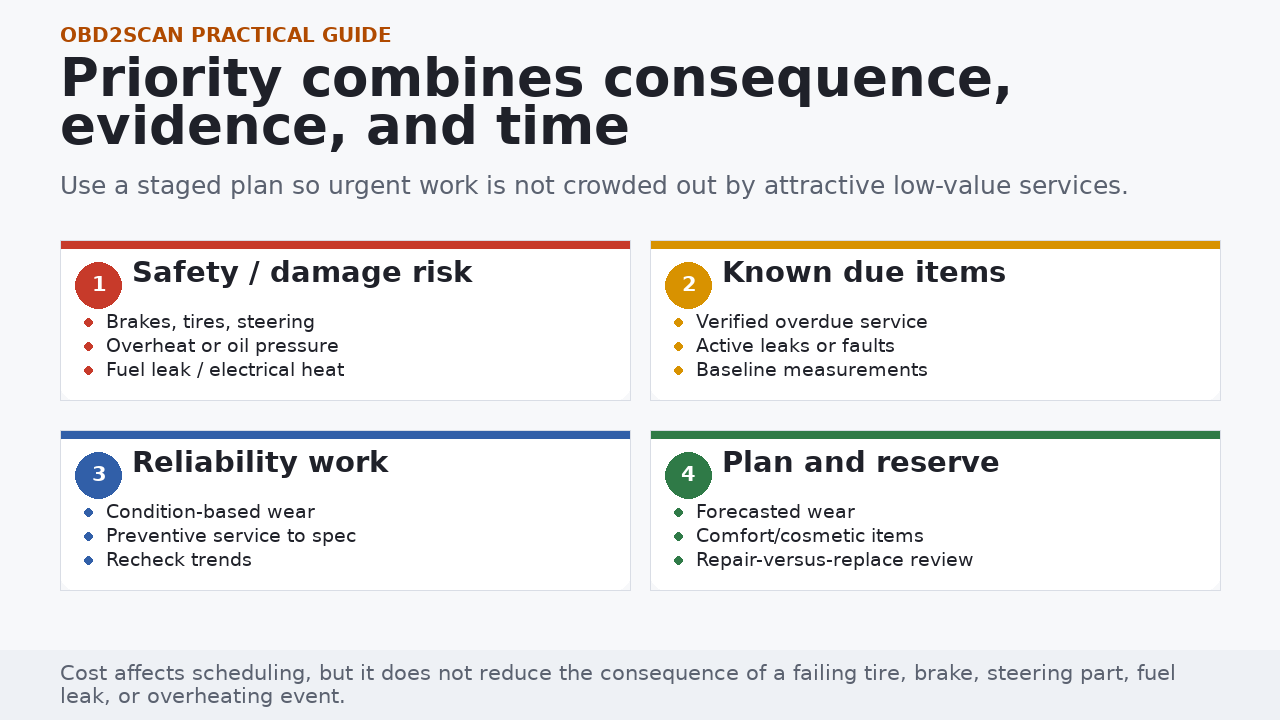
| Priority | Examples | Planning rule |
|---|---|---|
| Immediate | Unsafe tire/brake/steering condition, fuel leak, overheating, oil-pressure event, severe electrical heat | Stop or limit use as required; diagnose and correct before routine maintenance. |
| Known overdue | Documented interval missed, aged time-dependent item, recall or required inspection | Confirm exact schedule/specification, then book with related condition checks. |
| Condition-based | Measured wear, active leak, weak tested battery, damaged mount/boot/hose | Repair when evidence and consequence justify it; do not replace every same-age neighbor blindly. |
| Monitor | Stable seep, non-progressive noise, acceptable but changing measurement | Set a measurement, date/mileage interval, and escalation trigger. |
3. Service fluids and wear items without shortcuts
For engine oil, coolant, transmission, brakes, differentials, transfer cases, power steering, and other systems, confirm whether the exact vehicle specifies a fluid, interval, test, fill-temperature procedure, bleeding method, or lifetime wording. Similar-looking fluids can have incompatible friction, seal, electrical, or corrosion properties.
- Repair significant leaks and identify contamination before repeatedly topping up.
- Do not substitute a universal flush for a specified drain/fill, exchange, bleed, or diagnostic procedure.
- Treat additives and viscosity changes as product- and vehicle-specific decisions, not repairs for pressure loss, oil consumption, slip, noise, or overheating.
- Coordinate related labor only when parts are actually due or access overlap is real; bundled replacement should still have an evidence line.
- After service, verify level under the specified condition, leaks, warnings, operation, and the original concern.
4. Run a 30/90/365-day plan and update it
- Put stop-use and safety work first, with written findings and estimates.
- Within 30 days, close known overdue items and collect missing baseline measurements.
- Within 90 days, address reliability items supported by condition and recheck monitored trends under the same conditions.
- For the year, forecast time/mileage service, tires, brakes, battery, known model-specific work, downtime, and a repair reserve.
- After every job, record date, mileage, parts/fluid specifications, measurements, warranty, and the next due or recheck condition.
A maintenance plan is a living record
Move an item forward only when new evidence raises consequence or urgency; move it back when a proper test disproves the concern. The plan should become more precise over time, not merely longer.
Official references
Use these sources for the principles in this guide, then use the owner’s manual and current service information for your exact vehicle.
- Toyota Owners: General Maintenance (toyota.com)
- NHTSA TireWise: Tire Safety Ratings and Awareness (nhtsa.gov)
- NHTSA: Check for Recalls (nhtsa.gov)
The useful outcome
You now have a staged plan tied to the actual vehicle, evidence, and consequence. It can absorb new records or measurements without rewriting the system, and it prevents a long generic maintenance menu from displacing the few items that truly protect safety and reliability.


Comments 0
Questions, fixes, and real-world diagnostic notes from readers.
Be the first to share a diagnostic result or ask a follow-up question.